
Psyllium husk is widely regarded as an effective natural remedy for blood glucose regulation, but the clinical evidence extends far beyond that. Recent meta-analyses involving nearly 1,000 participants highlight impressive effects on metabolic markers, cholesterol levels, and body weight. What exactly happens inside the body when you consume 5 grams daily? This article examines the five primary mechanisms of action behind psyllium husk for diabetes, cardiovascular health, and digestion, based on randomised controlled trials.
Table of Contents
Key Findings
- Blood glucose: Significant reduction in fasting blood glucose (-6.89 mg/dL), HbA1c levels (-0.75%), and HOMA-IR (-1.17) according to a 2024 meta-analysis of 962 participants
- Cholesterol: 17% reduction in LDL cholesterol after 90 days in a meta-analysis of 1,924 participants across 28 trials
- Digestion: 66% of individuals with chronic constipation experienced meaningful relief (1,251 participants, 2022)
- Weight: Significant weight reduction driven by enhanced satiety with a daily intake of 5g (159 participants over 12 months)
- Inflammation: Marked reduction in CRP inflammatory markers in both normal-weight and overweight individuals
Optimising Digestion and Gut Health
How does psyllium husk work in the gut?
Psyllium husk exerts its physiological effects via a unique mechanism: as soon as the husks come into contact with fluid, they swell into a viscous gel. This action resembles a dry sponge absorbing water and multiplying in volume. The resulting gel possesses the remarkable capacity to regulate both constipation and diarrhoea.
When stools are too hard, the gel softens their consistency and makes them easier to pass. When stools are overly loose, it binds excess water, promoting firmer, well-formed bowel motions. This dual action has earned it the reputation of an “intestinal thermostat” – psyllium husk automatically restores optimal balance within the digestive tract.
What do clinical trials on constipation show?
The scientific evidence is robust: in a comprehensive 2022 meta-analysis, van der Schoot and colleagues evaluated 16 randomised controlled trials comprising 1,251 participants. The findings revealed that 66% of participants in the dietary fibre group experienced significant improvements in chronic constipation, compared to just 41% in the control group.
Most notably, psyllium (also known as ispaghula husk in UK pharmacies) and pectin demonstrated the most pronounced effects among all tested fibres. The improvements encompassed not only stool frequency, but also consistency and ease of evacuation.
Which form of psyllium husk should you use for constipation?
For relieving constipation, healthcare professionals recommend finely ground psyllium husk powder, as it provides a larger surface area and swells more rapidly. The recommended dosage is 5 to 10 grams per day, divided into 2 to 3 doses. Crucially, it must be taken with plenty of fluid – at least 200 ml of water per 5 grams of psyllium husk.
Psyllium husk is also beneficial for irritable bowel syndrome (IBS). Its regulating properties support both diarrhoea-predominant and constipation-predominant IBS. However, using psyllium husk during active inflammatory bowel flare-ups should always be discussed with your GP or a specialist gastroenterologist.
Psyllium Husk for Diabetes and Glycaemic Control
How to take psyllium husk for diabetes and blood glucose management?
Timing is critical: psyllium husk exerts its strongest glucose-lowering effects when taken approximately 30 minutes before meals. Alternatively, it can be stirred directly into food, such as morning porridge oats or natural yoghurt.
The mechanism of action is well documented in clinical literature: the rich soluble fibre forms a gel matrix that delays gastric emptying and slows the breakdown and absorption of carbohydrates. This grants the body more time to process circulating sugars, resulting in significantly blunted postprandial glucose spikes.
What does current research reveal about psyllium husk, diabetes type 2, and metabolic markers?
A landmark 2024 meta-analysis by Zeinali Khosroshahi and colleagues evaluated 19 randomised controlled trials involving 962 participants. The findings were striking:
- Fasting blood glucose: Reduced by 6.89 mg/dL (WMD: -6.89 mg/dL)
- HbA1c levels (long-term glycaemic control): Reduced by 0.75% (WMD: -0.75%)
- HOMA-IR (insulin resistance): Improved by 1.17 points (WMD: -1.17)
Particularly noteworthy: the improvements were even more pronounced in individuals with prediabetes than in healthy controls. Insulin sensitivity increased substantially, enabling target tissues to respond more effectively to insulin and clear glucose efficiently from the bloodstream.
Why is glycaemic control so vital?
The clinical relevance of these findings becomes apparent when evaluating cardiovascular risk: elevated blood glucose increases the risk of cardiovascular disease by a factor of 7.7 – substantially higher than smoking (factor 5.7) or hypertension (factor 3.3). Poorly controlled blood sugar represents the single most critical modifiable risk factor for heart disease.
Utilising psyllium husk for diabetes offers a natural, low-side-effect dietary intervention to support glycaemic control, working well alongside lifestyle adjustments and standard therapies such as metformin under medical supervision.
Naturally Lowering LDL Cholesterol
How does psyllium husk lower cholesterol levels?
The cholesterol-lowering action of psyllium husk relies on its ability to sequester bile acids in the small intestine. To synthesise bile acids – essential for the digestion of dietary fats – the liver consumes circulating cholesterol. Notably, this pathway represents the human body’s primary route for eliminating cholesterol: via bile into the stool.
Psyllium husk binds bile acids and forms a protective viscous barrier in the gut lumen. This inhibits bile acid reabsorption, prompting the liver to draw LDL cholesterol from the bloodstream to manufacture replacement bile acids. Consequently, circulating serum LDL cholesterol levels drop significantly.
What do clinical trials show regarding psyllium and cholesterol?
The scientific literature is extensive: in 2018, Solah and colleagues published a meta-analysis of 28 randomised controlled trials comprising 1,924 participants in the American Journal of Clinical Nutrition. The primary finding demonstrated that a daily dose of roughly 10.2 grams of psyllium lowered LDL cholesterol by an average of 0.33 mmol/L.
This equates to an overall reduction of 13% to 17% after just 90 days. Crucially, this reduction specifically targeted LDL cholesterol – the atherogenic fraction prone to oxidation and plaque formation within arterial walls, a key driver of coronary heart disease.
Weight Loss Through Satiety
How does psyllium husk support weight management?
The weight-reducing potential of psyllium husk is primarily due to its exceptional swelling capacity. Upon encountering gastric juices and fluids in the stomach, the soluble fibre expands to increase gastric distension, triggering stretch receptors that signal fullness and satiety to the brain earlier in the meal.
Furthermore, psyllium delays gastric emptying, allowing satiety to persist for several hours postprandially. This naturally moderates total calorie intake during subsequent meals and helps curb between-meal cravings.
What do studies on psyllium husk for weight loss show?
In 2016, Pal and colleagues conducted a randomised controlled trial involving 159 overweight Australian adults, published in the journal Nutrition & Metabolism. Participants supplemented with 5 grams of psyllium husk before main meals daily for 12 months, without being placed on any restrictive dietary regimen.
The results demonstrated significant weight loss in the psyllium group at 3, 6, and 12 months compared to controls. Remarkably, participants shed weight without deliberate calorie counting – achieved purely through the natural appetite-regulating properties of the fibre.
How much psyllium husk per day for weight loss is optimal?
For weight management, clinical trials support taking 5 grams of psyllium husk roughly 30 minutes before main meals, mixed with at least 250 ml of water (equivalent to approximately one heaped teaspoon). When introducing psyllium husk for weight management, begin gradually with 2.5 grams daily and increase slowly over a week to prevent mild gastrointestinal adaptation symptoms.
Anti-inflammatory Properties
How does psyllium husk influence inflammatory markers?
Whilst research into the exact molecular pathways is ongoing, epidemiological data consistently show that a higher intake of soluble fibre correlates with reduced systemic inflammation. In 2008, King and colleagues published findings from the TRIM trial (Trial to Reduce Inflammatory Markers), assessing the specific effect of psyllium on C-reactive protein (CRP).
CRP is an established biomarker for systemic low-grade inflammation and an independent risk factor for cardiovascular pathology. The trial demonstrated that psyllium supplementation significantly reduced serum CRP levels in both normal-weight and overweight hypertensive participants.
Practical Usage and Dosage
How much psyllium husk per day for diabetes, cholesterol, and digestion?
The optimal timing and dosage depend on your primary health objective:
- For blood glucose and glycaemic control: 5g taken 30 minutes prior to main meals
- For weight management: 5g taken 30 minutes prior to meals with 250–300 ml of water
- For digestive regularity: 5–10g taken with meals or between meals
- For lowering cholesterol: 10g daily, split into 2–3 doses across the day
How to take psyllium husk: practical tips
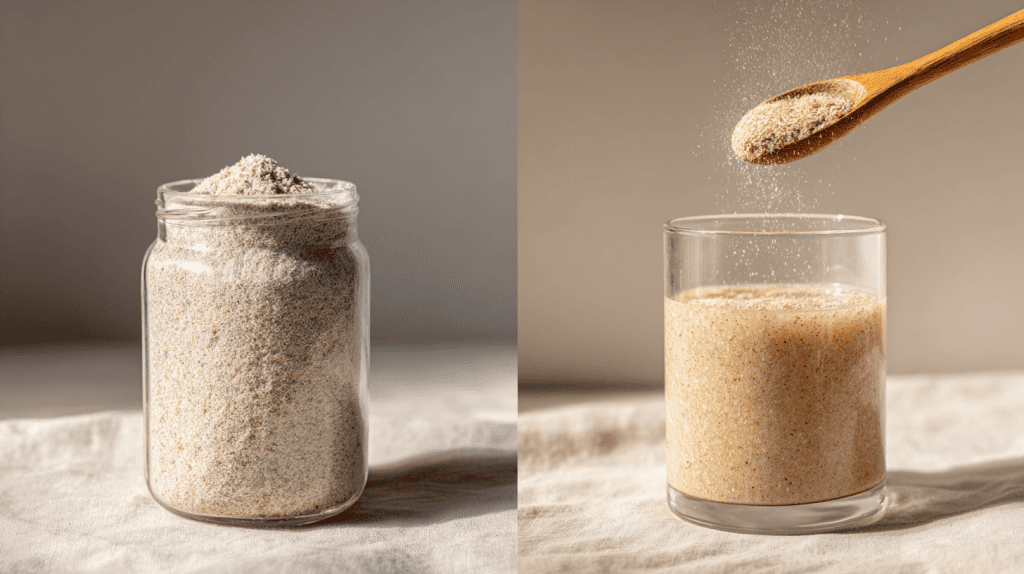
Taking psyllium husk is straightforward: stir 5 grams of psyllium husk powder into 200–300 ml of cold water, unsweetened juice, or plant-based milk and drink it immediately before it thickens. It is essential to follow this with an additional glass of water, as the fibre absorbs substantial fluid.
Alternatively, you can mix psyllium husk into Greek yoghurt, overnight porridge oats, smoothies, or soups. Ensure you maintain adequate daily hydration – aim for at least 2 litres of fluids per day when consuming psyllium regularly.
How quickly do you feel the effects of psyllium husk?
Improvements in bowel regularity and digestive comfort are generally noticeable within 12 to 24 hours. For tangible improvements in fasting blood glucose, HbA1c levels, and lipid profiles, allow at least 4 to 6 weeks of consistent daily supplementation. Noticeable shifts in body weight typically emerge over 4 to 8 weeks.
What is the best type of psyllium husk to buy?
Choose high-grade organic products without fillers, artificial flavourings, or added sugars. Blonde psyllium husk derived from Plantago ovata is widely regarded as the gold standard. Finely milled powders offer superior swelling capacity and blend more smoothly into drinks. Always verify that the batch has been independently tested for heavy metals and purity.
Where does psyllium husk come from?
Psyllium husk is harvested from the seeds of Plantago ovata (desert Indianwheat), a plant cultivated primarily across northwestern India and Pakistan. The outer husks are mechanically separated from the seeds, cleaned, and ground into powder. The name ispaghula or psyllium derives from traditional botanical nomenclature referring to the flea-like appearance of the small seeds.
What exactly is psyllium husk?
Psyllium husk is the outer mucilaginous coating of Plantago ovata seeds. Composed of approximately 85% soluble fibre, it rapidly absorbs water to create a soothing, viscous gel. In the colon, it is partially fermented by the gut microbiota, producing beneficial short-chain fatty acids (SCFAs) that nourish the intestinal lining and support metabolic health.
The husks provide virtually zero net carbohydrates, zero fat, and negligible calories – making them ideal for low-carb, keto, and diabetic-friendly diets. Their neutral taste makes them an effortless, highly versatile daily supplement.
Scientific sources
- van der Schoot, A., et al. (2022). The Effect of Fiber Supplementation on Chronic Constipation in Adults. American Journal of Clinical Nutrition, 116(4), 953-969.
- Zeinali Khosroshahi, M., et al. (2024). The effect of psyllium on fasting blood sugar, HbA1c, HOMA IR. Frontiers in Nutrition, 11, 1390272.
- Solah, V. A., et al. (2018). Effect of psyllium fiber on LDL cholesterol. American Journal of Clinical Nutrition, 108(5), 922-932.
- Pal, S., et al. (2016). Effect on body weight in overweight adults. Nutrition & Metabolism, 13, 82.
- King, D. E., et al. (2008). Effect of psyllium fiber on C-reactive protein. Annals of Family Medicine, 6(2), 100-106.
- Garg, P. K. (2022). Psyllium in Irritable Bowel Syndrome. Turkish Journal of Gastroenterology, 33(3), 277-279.
References and studies
Review articles, meta-analyses, and controlled clinical trials relating to the topic of this article. Every link was verified for accessibility on 16 August 2026.
- Chey SW, Chey WD, Jackson K et al.: Exploratory Comparative Effectiveness Trial of Green Kiwifruit, Psyllium, or Prunes in US Patients With Chronic Constipation. The American journal of gastroenterology 2021. PubMed 34074830. DOI: 10.14309/ajg.0000000000001149.
- Hajnal F, Florina R, Călin A et al.: The Role of Dietary Fibers in the Management of Type 2 Diabetes: A Synthesis of Current Evidence and Clinical Implications. 2026. PubMed 41754209. DOI: 10.3390/nu18040691.
- De Fano M, Baluganti S, Manco M et al.: The Sweet Side of Constipation: Colonic Motor Dysfunction in Diabetes Mellitus. 2025. PubMed 41097116. DOI: 10.3390/nu17193038.
- Strkalj L, Yakubov GE, Burton RA et al.: Structural and Functional Properties of Fiber From Psyllium (Plantago ovata) Husk: Current Knowledge and Strategies to Expand Its Application in Food and Beyond. 2025. PubMed 40985195. DOI: 10.1111/1541-4337.70297.
- van der Schoot A, Drysdale C, Whelan K et al.: The Effect of Fiber Supplementation on Chronic Constipation in Adults: An Updated Systematic Review and Meta-Analysis of Randomized Controlled Trials. The American journal of clinical nutrition 2022. PubMed 35816465. DOI: 10.1093/ajcn/nqac184.
- Jalanka J, Major G, Murray K et al.: The Effect of Psyllium Husk on Intestinal Microbiota in Constipated Patients and Healthy Controls. International journal of molecular sciences 2019. PubMed 30669509. DOI: 10.3390/ijms20020433.