
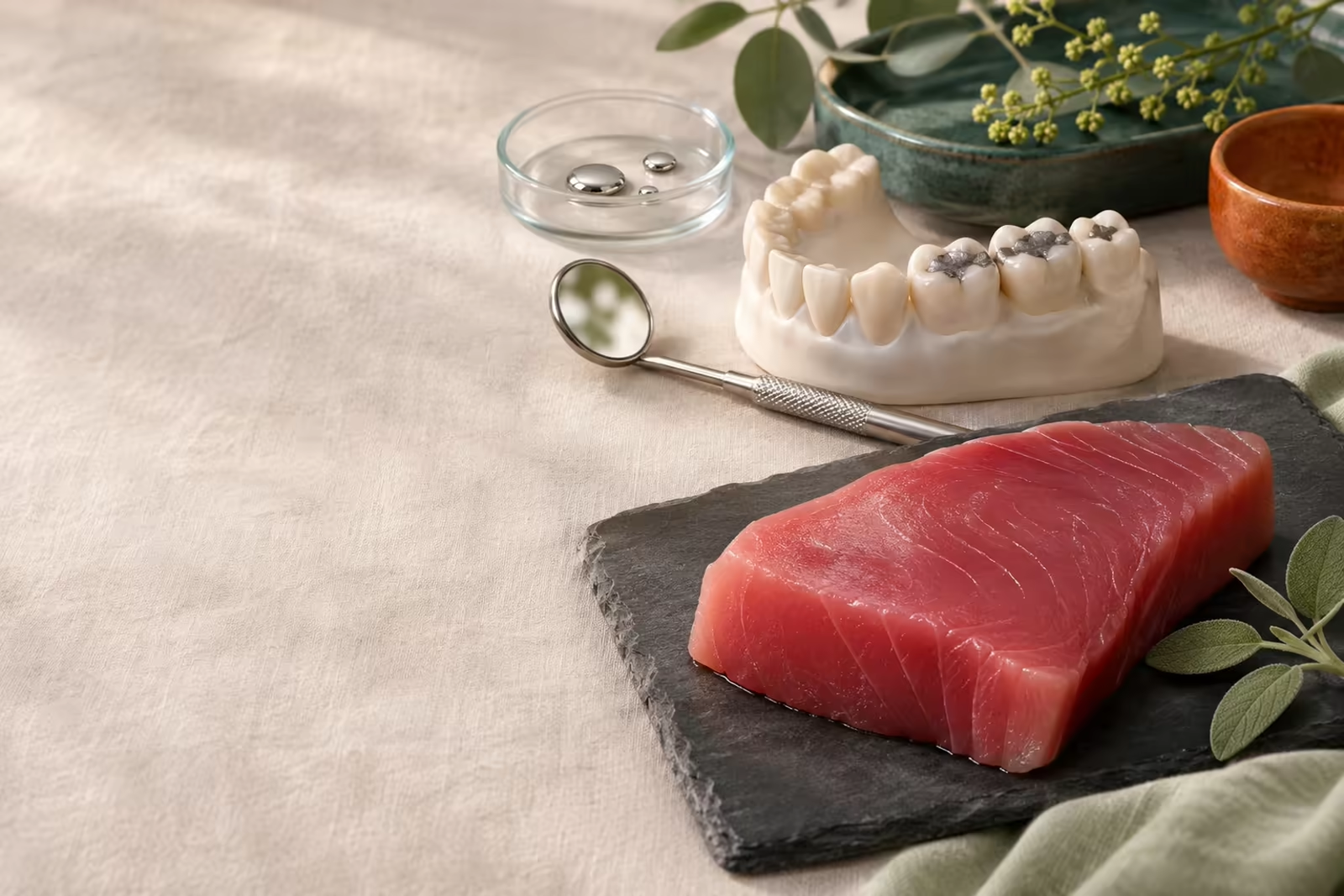
Mercury poisoning in the medical sense is rare in Germany. Almost everyone, however, carries small amounts of mercury in the body, mainly from fish and from old amalgam fillings (often called silver fillings in the US). Both methylmercury from fish and mercury vapor from amalgam can reach the brain and the unborn child. What matters is the amount: large predatory fish often contribute significantly more than intact fillings. This article shows what studies really prove about both sources and which common claims are not true.
It is part 1 of our series “How Do Humans Poison Themselves?”, in which we examine one poison after another. The article does not replace a conversation with your doctor or dental office. As of: November 2026.
Key points at a glance
- In two large randomized trials with more than 1,000 children combined, amalgam fillings showed no disadvantages compared with resin (composite) fillings in IQ, memory, or attention [1][2].
- People who had their amalgam fillings removed did not feel clearly better after 12 months than people in a health program without removal [3].
- Canned light tuna contains an average of 0.126 mg of mercury per kg, swordfish almost eight times as much, and salmon and sardines hardly any [4].
- Mercury levels in tuna have remained largely the same worldwide since 1971, not risen [5].
- Since January 1, 2025, amalgam has in principle no longer been allowed in the EU, mainly for environmental reasons [6].
What is mercury poisoning?
Mercury poisoning is damage to the nerves, kidneys, or other organs caused by too much mercury. How dangerous mercury is depends strongly on its form:
- Mercury vapor (metallic mercury): It is released, for example, from amalgam fillings or broken compact fluorescent bulbs. When inhaled, the lungs absorb about 80 percent of it [7].
- Inorganic mercury (mercury salts): It is poorly absorbed through the gut and mainly burdens the kidneys [8].
- Methylmercury: It accumulates in predatory fish, is almost completely absorbed from food, and reaches the brain and unborn children. The nervous system of children in the womb is particularly sensitive [8].
Symptoms of mercury poisoning
The symptoms of mercury toxicity depend on whether the poisoning occurs suddenly from a large amount or gradually over months. Medically, it is recorded as “toxic effect of mercury” (ICD-10 T56.1).
- Acute, for example after inhaling large amounts of vapor: cough, shortness of breath, chest pain, fever, nausea, later kidney damage [7].
- Chronic: tremor of the hands, irritability and mood swings, memory and sleep problems, inflammation of the gums and oral mucosa, increased salivation, numbness, kidney damage. With methylmercury, vision, hearing, and walking problems are in the foreground [7].
Suspected acute poisoning? For example after inhaling a lot of mercury vapor or swallowing chemicals containing mercury: call Poison Control (1-800-222-1222) or 911 in an emergency.
True chronic poisonings occur mainly through workplace accidents, in gold mining with mercury, through skin-lightening creams containing mercury, or after accidents involving large amounts of metallic mercury [9]. Nonspecific complaints such as fatigue, headaches, or trouble concentrating almost always have other causes.
How much mercury is in the body?
In most people in Germany, mercury is far below the levels at which health damage is possible. The Human Biomonitoring Commission of the German Environment Agency has set assessment values for this: from 20 micrograms per gram of creatinine in urine or, for women of childbearing age, from 15 micrograms per liter of blood, a health impairment is possible (HBM-II value). Below 5 micrograms per gram of creatinine or per liter of blood, respectively, no harmful effects are known (HBM-I value). If a value lies in between, the commission recommends rechecking it and looking for the source, especially in women who want to become pregnant [7]. According to the commission, the influence of amalgam fillings in good condition is negligible for the blood limit value. Which source dominates is shown by the type of sample:
- Urine mainly reflects inorganic mercury, that is, amalgam.
- Blood mainly reflects methylmercury, that is, fish. People who regularly eat heavily contaminated predatory fish can reach the blood value [7].
The European Food Safety Authority EFSA has set tolerable weekly intakes: 1.3 micrograms of methylmercury and 4 micrograms of inorganic mercury per kilogram of body weight. On average, adults in Europe are below these, while heavy fish eaters and some children can exceed them [8]. According to EFSA, the most important sources of methylmercury are tuna, swordfish, cod, whiting, and pike.
Amalgam fillings: What do the studies show?
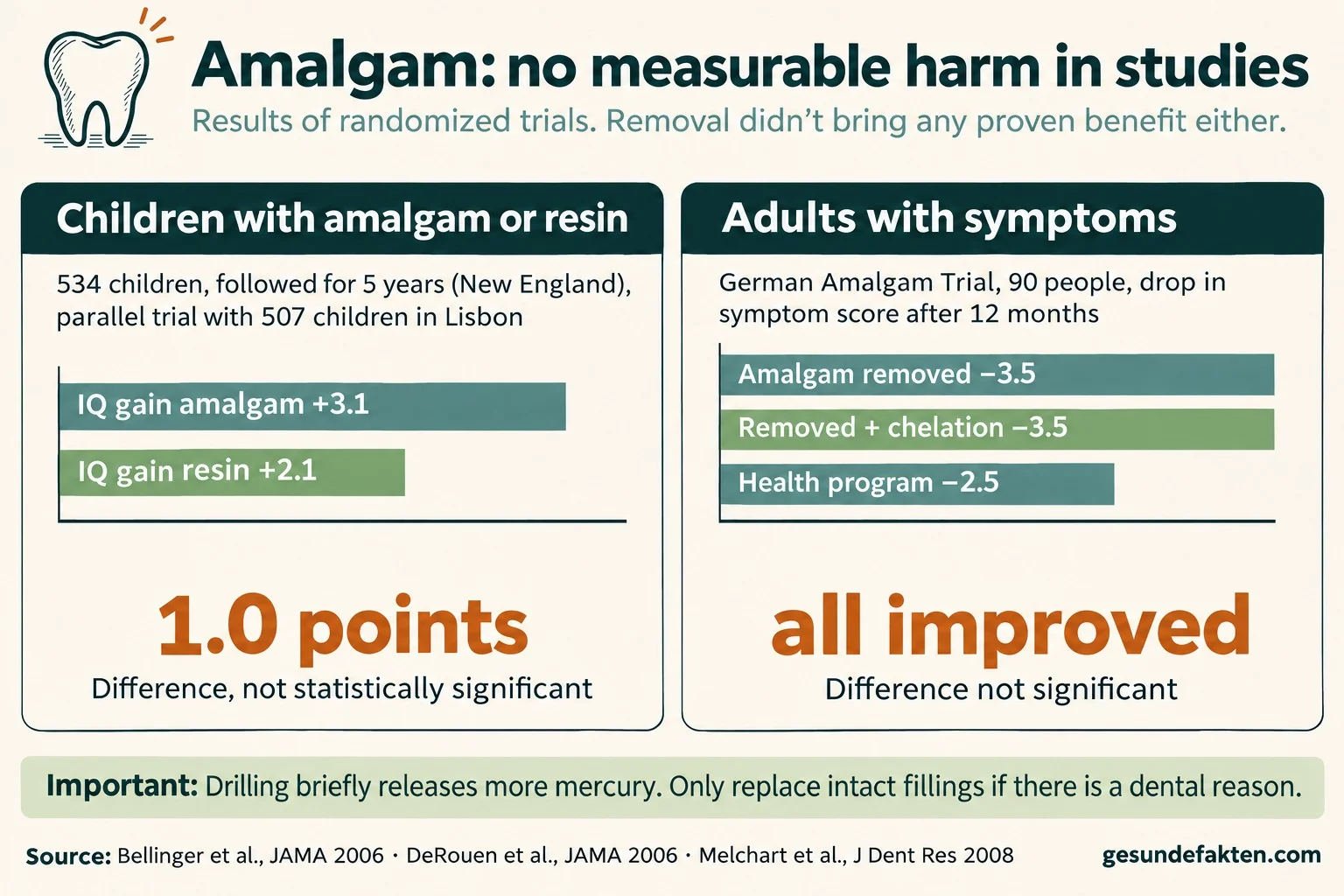
Amalgam fillings release measurable amounts of mercury, but in randomized trials this did not lead to demonstrable health damage. The most informative are two studies published in 2006 in the journal JAMA. In New England, 534 children were randomly assigned to amalgam or resin fillings. After five years, children with amalgam had somewhat more mercury in their urine, but their IQ did not differ: the difference was 1.0 points, even slightly in favor of the amalgam group, and was not significant. Memory, fine motor skills, and kidney values were also the same [1]. A parallel study with 507 children in Lisbon reached the same result [2].
For multiple sclerosis, a meta-analysis found no established link with amalgam [10]. For Alzheimer’s disease, there are only a few older studies without a clear result.
Still, amalgam is not completely harmless for everyone: rarely, there are true allergies or inflammatory mucosal reactions directly next to the filling. Since 2020, the US Food and Drug Administration (FDA) has recommended using other materials where possible for risk groups: pregnant and breastfeeding women, women planning pregnancy, children, people with kidney impairment, certain neurological diseases, or an amalgam allergy. It does not recommend removing intact fillings [11].
Removing amalgam fillings: Does it help?
According to the studies so far, having intact amalgam fillings removed does not improve complaints more than other measures. The most important study on this comes from Germany: in the German Amalgam Trial, 90 people who attributed their complaints to amalgam were randomly assigned to three groups: amalgam removal, amalgam removal plus “detoxification” with high-dose vitamins and trace elements, or a health program without removal. After 12 months, the symptom score fell by 3.5 points in both removal groups and by 2.5 points in the group without removal. The difference was not significant; all three groups improved [3].
A Norwegian study found fewer complaints three years after removal than in an untreated comparison group [12]. However, it was small, participants knew whether their amalgam had been removed, and expectation can noticeably change complaints.
Important: when a filling is drilled out, more mercury vapor is briefly released than when chewing on an intact filling [11]. If a filling has to be replaced anyway, for example because it breaks or decay develops underneath, water cooling, strong suction, and a rubber dam protect you. Replacing intact fillings without a medical reason is not covered by German statutory health insurance.

Use this graphic on your site
You may use the graphic freely with attribution and a link. Copy the code:
<a href="https://gesundefakten.com/en/health/mercury-poisoning/"><img src="https://gesundefakten.com/wp-content/uploads/2026/11/q2-amalgam-en.webp" alt="Infographic: Randomized trials on amalgam, IQ difference in children 1.0 points not significant, complaints after removal minus 3.5 versus minus 2.5 without removal" width="1536" height="1024"></a><br>Source: <a href="https://gesundefakten.com/en/health/mercury-poisoning/">gesundefakten.com</a>Is amalgam banned?
Yes, since January 1, 2025, amalgam has in principle no longer been allowed for dental fillings in the EU. Exceptions apply only if a dentist considers it strictly necessary for medical reasons [6]. Since July 2018, the ban already applied to baby teeth, children under 15, and pregnant and breastfeeding women [13]. The main reason is environmental protection: mercury from dental practices and crematoria enters air and water and ultimately fish.
For people with German statutory health insurance, this causes no additional costs. For back teeth, since 2025 self-adhesive materials such as glass ionomer cement are covered by statutory insurance in Germany, in exceptional cases also certain resin fillings, and for front teeth, resin fillings [14].
Mercury in fish: How contaminated is tuna?
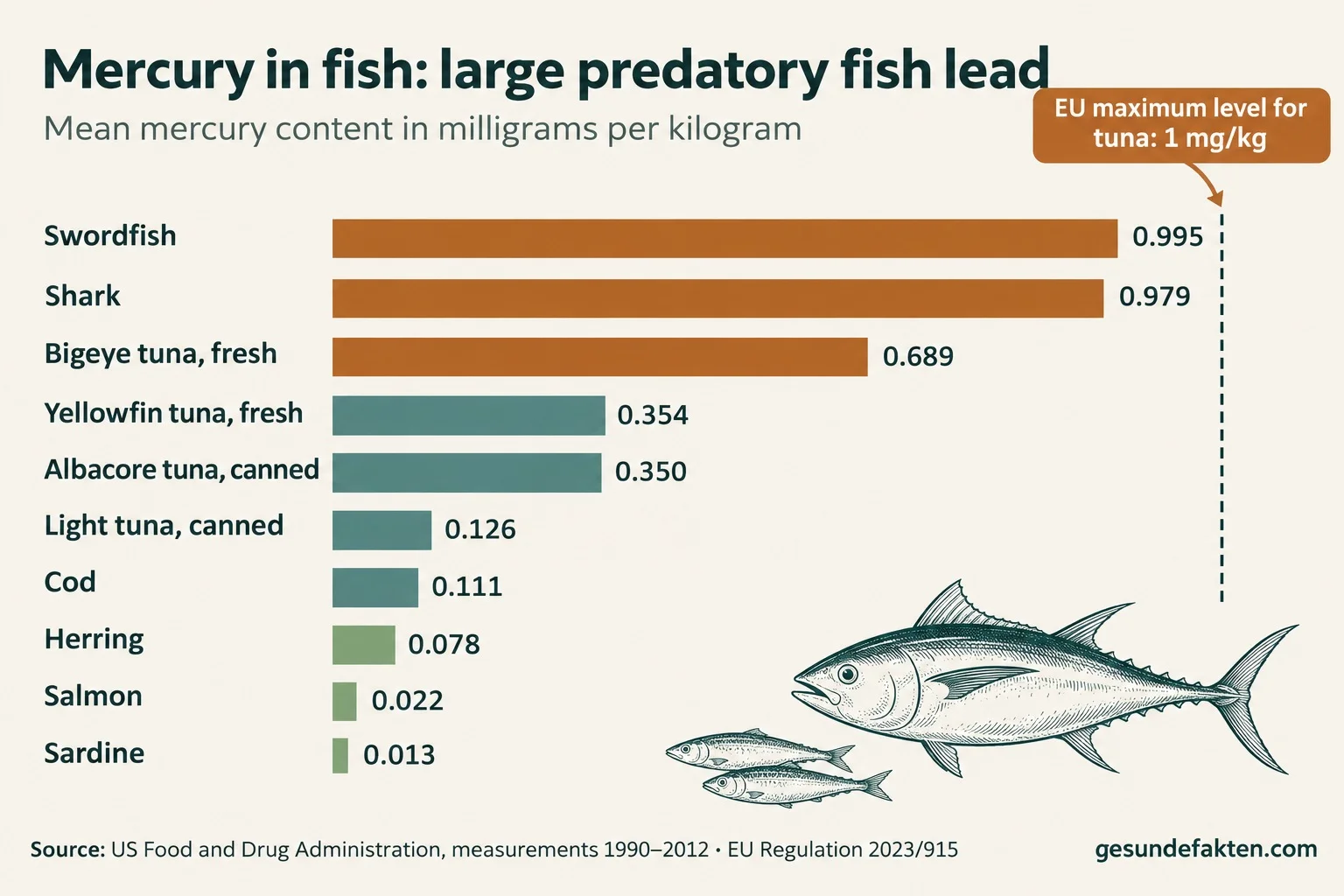
Mercury in tuna from a can is moderate; large predatory fish such as swordfish and shark are the real leaders. This is shown by measurement data from the US Food and Drug Administration (FDA) covering more than 20 years:
| Fish | Mercury, mean (mg/kg) |
|---|---|
| Swordfish | 0.995 |
| Shark | 0.979 |
| Bigeye tuna, fresh | 0.689 |
| Yellowfin tuna, fresh | 0.354 |
| White tuna (albacore), canned | 0.350 |
| Halibut | 0.241 |
| Light tuna (mostly skipjack), canned | 0.126 |
| Cod | 0.111 |
| Herring | 0.078 |
| Trout | 0.071 |
| Alaska pollock | 0.031 |
| Salmon, fresh | 0.022 |
| Sardine | 0.013 |
| Shrimp | 0.009 |
Source: FDA, Mercury Levels in Commercial Fish and Shellfish 1990–2012 [4]. Individual fish can be considerably higher or lower.

Use this graphic on your site
You may use the graphic freely with attribution and a link. Copy the code:
<a href="https://gesundefakten.com/en/health/mercury-poisoning/"><img src="https://gesundefakten.com/wp-content/uploads/2026/11/q2-fisch-en.webp" alt="Infographic: Mercury in fish, swordfish 0.995 and shark 0.979 mg/kg, canned light tuna 0.126, salmon 0.022, sardine 0.013 mg/kg" width="1536" height="1024"></a><br>Source: <a href="https://gesundefakten.com/en/health/mercury-poisoning/">gesundefakten.com</a>In the EU, a maximum level of 1 milligram of mercury per kilogram applies to tuna [15]. Canned light tuna averages about one eighth of that [4]. Smaller, short-lived tuna species such as bonito are less contaminated than large and old animals.
It is often said that mercury in tuna rises every year; some sources cite 4 percent. An analysis of almost 3,000 samples of tropical tuna shows something different: since 1971, levels have remained largely stable worldwide, and only in the Northwest Pacific did they temporarily rise. However, they have not fallen either despite lower emissions, because the ocean stores old mercury for decades [5].
Fish during pregnancy: avoid or eat?
Pregnant women should eat fish but avoid large predatory fish. The German Federal Institute for Risk Assessment (BfR) advises pregnant and breastfeeding women to be cautious with tuna and to avoid swordfish, shark (also sold in Germany as “Schillerlocken” or “Seeaal”), and other large predatory fish [16]. Fish itself is valuable: in the Seychelles, pregnant women ate an average of 12 fish meals per week, and their children showed no developmental disadvantages from the mercury at age 9 [17]. In the Faroe Islands, where a lot of pilot whale was eaten, researchers, by contrast, found slight deficits in children with high exposure [18]. EFSA assumes that omega-3 fats from fish offset part of the effect of mercury [8].
Myth check: What is said about mercury
Many conflicting claims circulate about amalgam and tuna. The most common errors:
- “No mercury at all is absorbed from amalgam.” False. About 80 percent of inhaled mercury vapor is absorbed; only the amount is small [7].
- “Salmon is a heavily contaminated predatory fish.” False. At 0.022 mg/kg, salmon is among the least contaminated food fish [4].
- “After removal, 70 percent of patients feel better.” Such figures come from practices without a comparison group. In the randomized German study, the group without removal also improved [3].
- “Tuna at most once a week” or “two to three cans are no problem.” Very different limits circulate online. The German Nutrition Society (DGE) recommends one to two servings of fish per week in total, ideally alternating lean sea fish and fatty fish such as salmon or herring [19].
Other widespread claims, fact-checked:
| Claim | What the evidence shows |
|---|---|
| “In every second amalgam wearer, mercury in saliva is above the limit” (Tübingen chewing gum test) | The saliva test mainly captures mercury that the body barely absorbs, and not the inhaled vapor. The Human Biomonitoring Commission therefore considers it unsuitable [20]. |
| “A provocation test with DMPS shows how much mercury is stored in the body” | A chelating agent increases mercury excretion in almost everyone, even without particular exposure. There are no reference values, the test is not informative and can have side effects [21]. |
| “Childhood vaccines contain mercury” | The mercury-containing preservative thimerosal (thiomersal) was removed or greatly reduced in childhood vaccines in the EU from the end of the 1990s. Studies found no link with developmental disorders [22]. |
Testing for mercury, chelation therapy for mercury poisoning, and how the body clears it
A sensible test is a blood or urine sample without prior administration of medication, assessed against the values of the German Environment Agency [7]. Contacts are primary care practices and occupational and environmental medicine clinics. Hair analyses and provocation tests with DMPS or DMSA are not suitable for this [21].
For a “detox” with chlorella algae, cilantro, or dietary supplements, there are no reliable studies in humans. In the German Amalgam Trial, a detoxification with high-dose vitamins and trace elements brought no additional benefit [3]. True poisonings are treated by doctors with approved chelating agents (chelation therapy for mercury poisoning). Without proven poisoning, these drugs do not belong in self-treatment. The body also clears mercury on its own: methylmercury in the blood falls by half within about 50 to 80 days according to estimates, if no new intake follows [23].
How to lower your mercury exposure
- Choosing fish: One to two servings of fish per week [19], more often salmon, herring, sardine, trout, or pollock, rarely tuna steak, no swordfish or shark, especially during pregnancy and breastfeeding [16].
- Canned tuna: “Light” or skipjack is less contaminated than white tuna [4].
- Intact amalgam fillings: do not have them removed as a precaution, but replace them when they have to be renewed anyway. With a proven allergy, the dental office decides.
- Broken compact fluorescent bulb: Ventilate the room immediately and leave it for 15 minutes, pick up the remains with a damp cloth, do not vacuum, and take them in a sealed jar to the recycling center [24].
- No skin-lightening creams from unreliable sources: Such creams and soaps from the internet repeatedly contain mercury, although it is banned in cosmetics in the EU [9].
Frequently asked questions
What are the symptoms of mercury poisoning?
Typical of chronic poisoning are tremor, irritability, memory and sleep problems, inflammation in the mouth, and kidney damage; acute poisoning causes cough, shortness of breath, and fever. If you suspect poisoning, have your blood and urine examined by a doctor; in an emergency, call Poison Control or 911 [7].
Should I have my amalgam fillings removed?
Only if there is a dental reason or an allergy has been proven. Removal briefly releases more mercury and, in the German amalgam study, brought no additional benefit compared with a health program [3].
How often can you eat tuna?
For adults, canned tuna is harmless now and then; levels are on average far below the EU maximum level [4][15]. Varying your diet with low-mercury fish such as salmon, herring, or sardine lowers intake, and overall the DGE (German Nutrition Society) recommends one to two servings of fish per week [19]. Pregnant and breastfeeding women should limit tuna [16].
What should you do if a mercury thermometer breaks?
An old fever thermometer contains considerably more mercury than a compact fluorescent bulb. Everyone else, including pets, leaves the room; open windows and close the doors to other rooms. Push the beads together with stiff paper and put them into a sealable jar using tape or an eyedropper. Never vacuum or sweep, and do not flush anything down the drain. For larger amounts or beads in carpet or cracks, ask Poison Control or your local environmental agency [25].
Conclusion: Mercury poisoning from amalgam and fish
Mercury poisoning from intact amalgam fillings is not proven by the current body of studies, and removal as a precaution has no demonstrated benefit. The more important source today is fish: if you avoid large predatory fish and eat small, fatty fish instead, you benefit from omega-3 and absorb little mercury. You can save yourself expensive tests and detox cures. The next part of the series covers lead. To learn how plastic particles get into the body, read our article on microplastics in the body.
Suggested citation: gesundefakten.com (2026): Mercury Poisoning: How Dangerous Are Amalgam Fillings and Tuna Really? https://gesundefakten.com/en/health/mercury-poisoning/
Sources
- Bellinger DC, Trachtenberg F, Barregard L et al.: Neuropsychological and renal effects of dental amalgam in children: a randomized clinical trial. JAMA 2006. PubMed 16622139. DOI: 10.1001/jama.295.15.1775.
- DeRouen TA, Martin MD, Leroux BG et al.: Neurobehavioral effects of dental amalgam in children: a randomized clinical trial. JAMA 2006. PubMed 16622140. DOI: 10.1001/jama.295.15.1784.
- Melchart D, Vogt S, Köhler W et al.: Treatment of health complaints attributed to amalgam. J Dent Res 2008. PubMed 18362317. DOI: 10.1177/154405910808700410.
- U.S. Food and Drug Administration: Mercury Levels in Commercial Fish and Shellfish (1990–2012). fda.gov.
- Médieu A, Point D, Sonke JE et al.: Stable Tuna Mercury Concentrations since 1971 Illustrate Marine Inertia and the Need for Strong Emission Reductions under the Minamata Convention. Environ Sci Technol Lett 2024. DOI: 10.1021/acs.estlett.3c00949.
- Regulation (EU) 2024/1849 amending Regulation (EU) 2017/852 as regards dental amalgam and other mercury-added products. eur-lex.europa.eu.
- Umweltbundesamt, Kommission Human-Biomonitoring: Stoffmonographie Quecksilber – Referenz- und Human-Biomonitoring-Werte (HBM). Bundesgesundheitsblatt 1999, Addendum 2009. umweltbundesamt.de. As well as: UK Health Security Agency: Elemental mercury and inorganic mercury: toxicological overview. gov.uk.
- EFSA Panel on Contaminants in the Food Chain: Scientific Opinion on the risk for public health related to the presence of mercury and methylmercury in food. EFSA Journal 2012;10(12):2985. DOI: 10.2903/j.efsa.2012.2985.
- UN Environment Programme, Global Mercury Partnership: Fact sheet: Mercury in skin lightening creams. unep.org.
- Aminzadeh KK, Etminan M: Dental amalgam and multiple sclerosis: a systematic review and meta-analysis. J Public Health Dent 2007. PubMed 17436982. DOI: 10.1111/j.1752-7325.2007.00011.x.
- U.S. Food and Drug Administration: FDA Issues Recommendations for Certain High-Risk Groups Regarding Mercury-Containing Dental Amalgam, 24.09.2020. fda.gov.
- Lygre GB, Sjursen TT, Svahn J et al.: Characterization of health complaints before and after removal of amalgam fillings – 3-year follow-up. Acta Odontol Scand 2013. PubMed 22746255. DOI: 10.3109/00016357.2012.697577.
- Regulation (EU) 2017/852 on mercury, Article 10. eur-lex.europa.eu.
- GKV-Spitzenverband und KZBV: Füllungen ohne Amalgam: neue Kassenleistung ab 2025. gkv-spitzenverband.de.
- Regulation (EU) 2023/915 on maximum levels for certain contaminants in food, Annex I, section mercury. eur-lex.europa.eu.
- Bundesinstitut für Risikobewertung: Fischverzehr in Schwangerschaft und Stillzeit: Einige Fischarten weisen hohe Methylquecksilber-Gehalte auf. Stellungnahme 2024. bfr.bund.de.
- Myers GJ, Davidson PW, Cox C et al.: Prenatal methylmercury exposure from ocean fish consumption in the Seychelles child development study. Lancet 2003. PubMed 12767734. DOI: 10.1016/S0140-6736(03)13371-5.
- Grandjean P, Weihe P, White RF et al.: Cognitive deficit in 7-year-old children with prenatal exposure to methylmercury. Neurotoxicol Teratol 1997. PubMed 9392777. DOI: 10.1016/s0892-0362(97)00097-4.
- Deutsche Gesellschaft für Ernährung: Gut essen und trinken – die DGE-Empfehlungen, 2024. dge.de.
- Umweltbundesamt, Kommission Human-Biomonitoring: Stellungnahme zur Bestimmung von Quecksilber im Speichel („Kaugummitest“). umweltbundesamt.de.
- Ruha AM: Recommendations for provoked challenge urine testing. J Med Toxicol 2013. PubMed 24113861. DOI: 10.1007/s13181-013-0350-7.
- European Medicines Agency: EMEA public statement on thiomersal in vaccines for human use – recent evidence supports safety of thiomersal-containing vaccines, 2004. ema.europa.eu.
- Jo S, Woo HD, Kwon HJ et al.: Estimation of the Biological Half-Life of Methylmercury Using a Population Toxicokinetic Model. Int J Environ Res Public Health 2015. PubMed 26264017. DOI: 10.3390/ijerph120809054.
- Umweltbundesamt: Energiesparlampen: Bei Bruch ist Lüften das A und O. Pressemitteilung. umweltbundesamt.de.
- U.S. Environmental Protection Agency: What to Do if a Mercury Thermometer Breaks. epa.gov.