
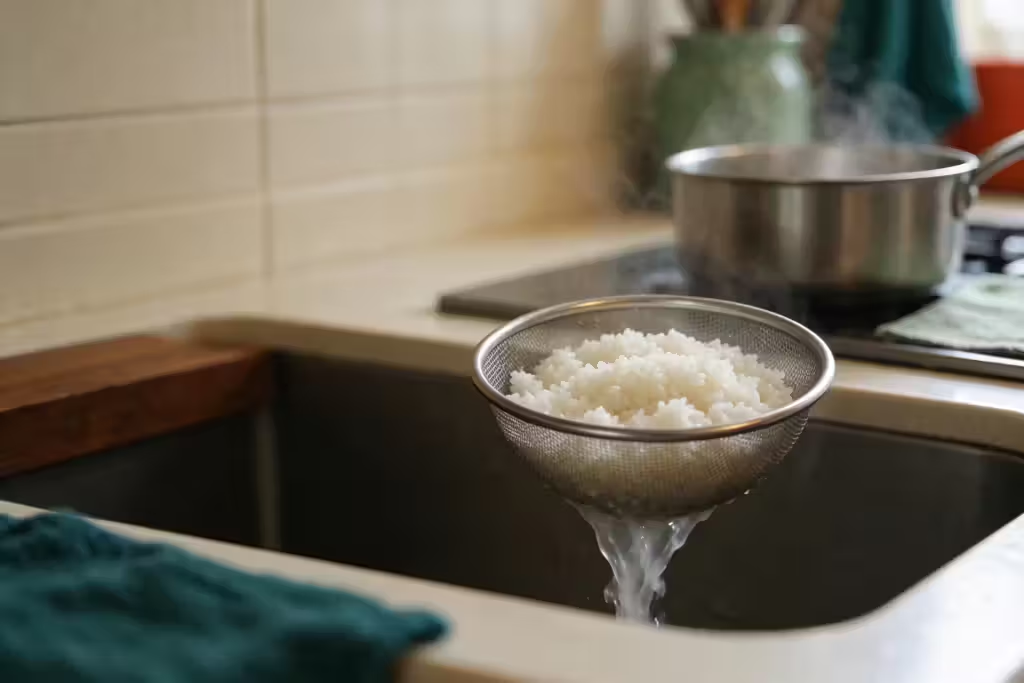
Arsenic in rice is not a myth: rice takes up more toxic inorganic arsenic from soil and water than other cereal grains do. You cannot be acutely poisoned by it. The problem is duration. Anyone who eats rice, rice cakes or rice porridge every day for decades may raise their cancer risk. In 2024, the European Food Safety Authority (EFSA) confirmed that arsenic intake in Europe is a health concern.
The good news: hardly any contaminant can be reduced as much in your own kitchen as arsenic in rice. With the right cooking method, up to three quarters of it ends up in the cooking water. Here you will learn which rice contains the least arsenic, how to cook low arsenic rice, what applies to rice cakes and children, how to recognize arsenic poisoning, and why arsenic in fish is mostly harmless.
This article is part 4 of our series “How Do We Get Poisoned?”, in which we examine one poison after another. Published so far: Mercury poisoning from amalgam and fish, Lead poisoning and lead pipes and Cadmium in food. This article is no substitute for a conversation with your doctor. Last updated: November 2026.
Key Takeaways: Arsenic in Rice
- Inorganic arsenic is carcinogenic to humans. There is no safe intake level [1][2].
- In Germany, white rice contains an average of 0.1 milligrams of inorganic arsenic per kilogram. Brown rice, rice cakes and rice flakes contain more [1].
- Cooking rice in plenty of water and draining it reduces inorganic arsenic by about 45 percent [8]. Parboiling briefly, draining and then letting the rice steam removes 73 percent of the inorganic arsenic from white rice [9].
- Organic rice does not contain less arsenic. It comes from soil and irrigation water, not from the chemical-synthetic pesticides that organic farming avoids [14].
- Infants and young children take in the most per kilogram of body weight [3][25]. Rice drinks are unsuitable for young children, and rice cakes should remain the exception [1][15].
- Arsenic in fish is mostly present as arsenobetaine. It is considered non-toxic and is excreted unchanged [18].
- Be careful with the seaweed hijiki: it can contain very large amounts of inorganic arsenic [16].
What Is Arsenic and Why Is It Toxic?
Arsenic (chemical symbol As) is a toxic metalloid found everywhere in the Earth’s crust, in very different amounts depending on the rock. It also enters soil and water through the smelting of zinc, lead and copper ores, the burning of coal, phosphate fertilizer and sewage sludge [1]. Plants absorb it through their roots, and people take it in through food and drinking water.
The chemical form is what matters. Experts distinguish two groups:
- Inorganic arsenic is the most toxic form. It includes arsenic trioxide, notorious for centuries as the murder poison “arsenic” [16]. It is found mainly in rice, in smaller amounts in other cereal grains, in some seaweeds and in contaminated groundwater.
- Organic arsenic is found mainly in fish and seafood, mostly as arsenobetaine. It is considered unproblematic for health [1][18]. Other organic compounds, such as arsenosugars in seaweed and arsenolipids in fatty fish, are still poorly studied [18]. Dimethylarsinic acid (DMA), which occurs mainly in rice but also in fish, is not entirely harmless: in 2024 the EFSA classified it as probably genotoxic, and in animal experiments it caused bladder tumors in rats [27].
When this article talks about “arsenic in rice”, it always means inorganic arsenic. The EU maximum levels for rice apply only to this form.
Arsenic Poisoning Symptoms and Warning Signs
With arsenic, two kinds of poisoning need to be told apart.
Acute arsenic poisoning: It results from a large amount taken at once, for example through a mix-up, a suicide attempt, a crime or a workplace accident. According to the German Federal Institute for Risk Assessment (BfR), it is unlikely to come from rice, even in people who eat a great deal of rice [1]. According to the World Health Organization (WHO), it first shows up as:
- Vomiting
- Abdominal pain
- Diarrhea
In severe cases, numbness and tingling in the hands and feet, muscle cramps and, in the worst case, death follow [6]. Treatment takes place in the hospital, including with medications that bind arsenic, such as DMPS [23].
Suspected acute poisoning? For example, if someone has swallowed a wood preservative, an old pesticide or unknown chemicals and then vomits or gets diarrhea: call Poison Control (1-800-222-1222) or 911.
Chronic arsenic poisoning (arsenicosis): It develops over years from smaller amounts, worldwide mainly through contaminated well water. According to the WHO, skin changes typically come first [6]:
- dark or light spots on the skin (pigmentation disorders)
- hard, thickened patches on the palms and soles of the feet
- later, skin cancer
In the long term, inorganic arsenic raises the risk of cancers of the skin, bladder and lung. It is also linked to cardiovascular disease and diabetes. For exposure in the womb and in early childhood, there are indications of disadvantages for mental development [6][2]. The BfR also names damage to blood vessels and nerves [1].
Important for putting this in perspective: these symptoms are known from regions with heavily contaminated drinking water, such as Bangladesh, India, Chile or Argentina. According to the WHO, around 140 million people in at least 70 countries have drunk water with more than 10 micrograms of arsenic per liter [6]. According to the BfR, such non-cancer damage is unlikely to result from rice in Germany. An increased cancer risk cannot be ruled out, however [1].
“Blackfoot Disease” in Taiwan
How severe long-term arsenic exposure can become was shown on the southwest coast of Taiwan. There, people drank water from deep wells with a high arsenic content for decades. Many developed “blackfoot disease”: the arteries in the legs became blocked, the feet turned black, and ulcers and gangrene often led to amputation. The disease was most common between 1956 and 1960. In some villages at that time, up to 19 in 1,000 people were affected [19]. In the same areas, people also died far more often from cancers of the bladder, kidney, skin and lung [20]. After the villages were connected to a piped water supply, the disease declined sharply [19].
Is Arsenic in Rice Carcinogenic?
Inorganic arsenic is classified by the International Agency for Research on Cancer (IARC) as carcinogenic to humans (Group 1) [22]. It can damage genetic material. For this reason, no amount can be given below which it would be safe [1][2].
The EFSA updated its assessment in 2024. Its reference point: with a lasting intake of 0.06 micrograms of inorganic arsenic per kilogram of body weight per day, skin cancer risk in studies rose by 5 percent compared with the baseline risk [2]. For arsenic, the EFSA no longer sets a health-based guidance value, that is, a “tolerable” amount. Instead, it compares actual intake with this reference point (margin of exposure). Result: adults in Europe take in on average between half and two and a half times this amount, and high consumers up to five times. Despite uncertainties, the EFSA considers this a health concern [2].
A sample calculation shows why rice matters here: a 75-gram portion of uncooked white rice with the German average of 0.1 milligrams per kilogram [1] contains 7.5 micrograms of inorganic arsenic. For an adult weighing 70 kilograms, that is 0.11 micrograms per kilogram of body weight, almost double the EFSA reference point if you eat this portion every day. Anyone who eats rice only once or twice a week is well below that. And anyone who cooks rice in plenty of water roughly halves the amount [8].
It is also worth noting that for the population as a whole, rice is not the only source. According to the EFSA, rice, rice products, other grain products and drinking water contribute most to intake [3]. For infants, according to EFSA data, milk and dairy products, drinking water and infant food are also among the most important sources [25]. Anyone who eats rice every day, by contrast, takes in a large share of their arsenic through rice.
Arsenic in Rice: Why Rice in Particular?
Rice usually grows in flooded fields. Under water, the soil lacks oxygen, and arsenic becomes more soluble as a result. The rice plant absorbs it through its roots and also stores it in the grain. If the irrigation water is also contaminated, the content rises further [1]. That is why rice contains more inorganic arsenic than wheat, corn or oats.
In the grain, the arsenic sits mainly in the outer layers. This is why brown rice (whole-grain rice), in which the outer layers are retained, contains more arsenic than polished white rice [1]. Rice cakes and rice flakes also often contain more than white rice. According to the BfR, several things contribute: water is removed during manufacture, so the arsenic is more concentrated, and origin, variety and a higher share of outer layers add to this [1].
Since 2016, maximum levels for inorganic arsenic in rice and rice products have applied in the EU [1]. The current ones are [4]:
| Food | Maximum level (mg/kg) |
|---|---|
| White (polished) rice, non-parboiled | 0.15 |
| Parboiled rice and brown rice (husked rice) | 0.25 |
| Rice flour | 0.25 |
| Rice cakes, rice cookies, rice crackers, rice flakes, breakfast rice | 0.30 |
| Rice for the production of food for infants and young children | 0.10 |
| Rice drinks (non-alcoholic rice-based beverages) | 0.030 |
Maximum levels are not a safety threshold. They are meant to keep the most heavily contaminated products off the market. What lies below them is allowed, but not automatically harmless [1].
Which Rice Has the Least Arsenic? Choosing Low Arsenic Rice
There is no arsenic-free rice, and parboiled rice does not reliably contain less arsenic either. The content also cannot be read from the label [1]. A few rules help anyway:
| Rice | Arsenic content | Source |
|---|---|---|
| White rice | Lower than brown rice, in Germany an average of 0.1 mg/kg inorganic arsenic | [1] |
| Brown rice (whole-grain rice) | Higher than white rice, because the arsenic-rich outer layers are retained | [1][14] |
| Parboiled rice | By law it may contain more than white rice (0.25 instead of 0.15 mg/kg) | [4] |
| Basmati (arsenic in basmati rice) | When washed, basmati lost more arsenic than other varieties (about 10 percent). A low content is not guaranteed, however | [8] |
| Organic rice | No advantage. Arsenic comes from soil and irrigation water, not from today’s pesticides. In Swedish analyses in 2017, organic products even had the highest values | [14] |
Origin also plays a role, but not as simply as is often claimed. In an international analysis of 901 rice samples from 10 countries, the typical total arsenic content (median) was lowest in rice from Egypt (0.04 mg/kg) and India (0.07 mg/kg) and highest in rice from the USA (0.25 mg/kg) and France (0.28 mg/kg) [11]. Total arsenic is not the same as inorganic arsenic, however. In a partial analysis, the share of the toxic inorganic form was particularly high in rice from Bangladesh and India and lowest in rice from the USA [11]. Values also vary within a single country. In Italian rice, the content depended clearly on growing region and variety [12], and in Spain and Portugal it likewise depended on the region [13]. The safest approach is therefore to alternate varieties and brands [14].
And whole grain? In general, whole grain is healthier. For rice, however, the Swedish food agency explicitly advises against always choosing brown rice [14]. If you want the fiber, you can choose whole grain for other cereals and vary your rice.
How to Cook Rice to Remove Arsenic: Which Method Really Works
Arsenic in the rice grain is water-soluble. The more water comes into contact with the rice during cooking and is then poured away, the more arsenic is lost. That is why the BfR recommends: wash rice in plenty of water right before cooking, cook it in plenty of water and pour off the excess cooking water [1]. Studies have measured how much this achieves:
| Method | Less inorganic arsenic | Source |
|---|---|---|
| Absorption-method rice (the water is completely absorbed; in the study 2.5 parts water to 1 part rice) | practically nothing | [8] |
| Washing only | about 10% for basmati, less for other varieties | [8] |
| Cooking in plenty of water (6 : 1) and draining | about 45% | [8] |
| Cooking in a great deal of water (12 : 1) and draining | about 57% | [10] |
| Parboiling, draining, then letting the rice steam | 73% for white rice, 54% for brown rice | [9] |

Use the graphic on your site
You may use the graphic freely with attribution and a link. Copy the code:
<a href="https://gesundefakten.com/en/health/arsenic-in-rice/"><img src="https://gesundefakten.com/wp-content/uploads/2026/11/arsen-kochmethoden-en.webp" alt="Infographic: How to cook rice with less arsenic. Absorption-method rice removes practically nothing, washing only about 10 percent, cooking in plenty of water and draining about 45 percent, parboiling, draining and steaming up to 73 percent" width="1536" height="1024"></a><br>Source: <a href="https://gesundefakten.com/en/health/arsenic-in-rice/">gesundefakten.com</a>The most effective method that works in everyday cooking comes from the University of Sheffield. It combines draining with the familiar absorption method [9]:
- Bring plenty of water to a boil.
- Add the rice to the boiling water and cook for 5 minutes.
- Drain the water. A large share of the arsenic goes away with this water.
- Add fresh water, about as much as you would otherwise use for absorption-method rice, and cook the rice over low heat until it has absorbed all the water.
The researchers explicitly recommend the method also for rice eaten by babies and young children [9]. It has a further advantage: cooking in a great deal of water also loses nutrients, according to one review mainly zinc and copper [24]. With the Sheffield method, more minerals stayed in the rice in the study, especially in brown rice [9]. Soaking alone achieved less than parboiling in the Sheffield study [9]. Vinegar or other acids in the soaking water barely helped in the studies reviewed, with the exception of citric acid [24]. This has hardly been tested for everyday use, however.
Important: the cooking water itself should contain little arsenic. In Germany, this is the case for tap water (more on this below).
Rice Cakes Arsenic, Rice Porridge and Rice Drinks: What Applies to Children?
Children are the most sensitive group. Because they eat more in proportion to their weight, infants and young children have the highest arsenic intake per kilogram of body weight, according to the EFSA [3][25]. In addition, rice cakes, rice flakes and rice porridge often contain more inorganic arsenic than white rice [1], and these are exactly the products that are popular with small children.
What the authorities advise:
- BfR (Germany): Do not feed infants and young children exclusively on rice porridge or rice drinks. Alternate rice cakes as a snack with rice-free snacks [1].
- European Society for Paediatric Gastroenterology, Hepatology and Nutrition (ESPGHAN): Avoid rice drinks for infants and young children entirely [15]. Rice drinks are also unsuitable as a milk substitute for infants because of their nutrient content [1].
- Livsmedelsverket (Sweden): Children should eat rice or rice products at most four times a week. Children under six should not eat rice cakes or drink rice drinks [14].
Rice-based baby food is subject to the strictest EU limits: rice for infant and young-child food may contain at most 0.10 milligrams of inorganic arsenic per kilogram, and complementary foods for infants and young children at most 0.020 milligrams per kilogram (measured in the product as sold) [4]. Ordinary rice cakes from the supermarket shelf, on the other hand, may contain 0.30, which is three times as much as rice for baby food [4].
For people with celiac disease, rice is often a staple. The BfR recommends here too not to rely on rice alone but to include other gluten-free grains: corn, millet, buckwheat, amaranth or quinoa [1].
Arsenic in Seaweed, Fish and Drinking Water
Fish and seafood
Fish often contains much more total arsenic than rice. That sounds alarming but is mostly harmless: in fish, arsenic is present mainly as arsenobetaine, which the body excretes unchanged in the urine [18]. Mussels and other filter feeders contain less arsenobetaine and relatively more inorganic arsenic [18]. This is why, since October 2025, EU maximum levels for inorganic arsenic also apply to fish, crustaceans, mussels and squid [5][4]. No reason to give up fish. Its benefits are well documented; more on this in part 1 of the series on mercury in fish.
Seaweed: Be careful with hijiki
Most edible seaweeds contain mainly arsenosugars and little inorganic arsenic [16]. One exception is the brown seaweed hijiki (also hiziki), which is used in Japanese cooking and in seaweed salads. It can accumulate extreme amounts of inorganic arsenic. The Bavarian State Office for Health and Food Safety (LGL) found 95 milligrams of inorganic arsenic per kilogram in one hijiki sample. That is more than 600 times the maximum level for white rice. Health damage could not be safely ruled out even at the amount recommended by the manufacturer, 10 grams per day [16]. To put this in perspective: 10 grams of this sample supply 950 micrograms of inorganic arsenic. For an adult weighing 70 kilograms, that is around 13.6 micrograms per kilogram of body weight, more than 200 times the EFSA reference point of 0.06. In Japan, hijiki measurably increased arsenic intake in children and pregnant women [17]. There is so far no EU limit for arsenic in seaweed [16].
Drinking water and well water
In Germany, drinking water may contain at most 10 micrograms of arsenic per liter (German Drinking Water Ordinance, TrinkwV). This corresponds to the WHO guideline value [6][7]. The limit is being tightened: from January 12, 2036, 4 micrograms per liter will apply to all water suppliers in Germany, and for new installations already from 2028 [7]. Anyone who drinks water from a private well should have it tested for arsenic, because private wells are not monitored automatically and some rock types release a lot of arsenic naturally.
Arsenic in the Body: Testing, Normal Values and “Detox”
Arsenic is usually measured in urine. The value mainly shows what you have taken in over the last few days. What influences it most is whether you ate fish in the two days before the sample [26]. The reference value of the German Environment Agency (Umweltbundesamt) for arsenic in first-morning urine is 15 micrograms per liter, both for adults and for children aged 3 to 14 [21]. A reference value describes the usual exposure of the population; it is not a boundary between healthy and sick.
Important for the measurement: in the 48 hours before the urine sample, you should not eat fish, seafood or seaweed. Otherwise the harmless arsenobetaine is measured too and the value is high without any risk being present [21]. An analysis that determines the arsenic forms separately (speciation) is more informative. It belongs in the hands of a doctor or an environmental medicine laboratory.
And “detox”? In acute poisoning, hospitals treat with medications that bind arsenic [23]. For the usual exposure through food, there is no detox cure with proven benefit. For chlorella or zeolite as “arsenic binders,” evidence in humans is lacking, and for selenium supplements too, no benefit has been shown at the usual exposure through food. The body itself excretes inorganic arsenic in the urine [18]. What works is taking in less.
Myth Check: What People Say About Arsenic
- “Organic rice is arsenic-free.” False. Arsenic comes from soil and water, not from today’s pesticides. Organic makes no difference for arsenic [14].
- “Washing rice is enough.” Only partly. Washing removes about 10 percent for basmati, less for other varieties [8]. The cooking method achieves more (see table above).
- “Soaking overnight removes almost all the arsenic.” Not proven. In the Sheffield study, soaking achieved less than brief parboiling with draining [9]. What matters is that the water with the dissolved arsenic is poured away.
- “Avoid rice from India at all costs.” It is not that simple. For total arsenic, rice from India was among the least contaminated in a large comparison study, but the share of toxic inorganic arsenic was comparatively high [11]. Blanket country lists help little, because values also vary strongly within a country [12][13].
- “Fish is full of arsenic and therefore dangerous.” Misleading. Fish does contain a lot of total arsenic, but mostly the non-toxic arsenobetaine [18].
- “Brown rice is always the healthier choice.” Not when it comes to arsenic. Brown rice contains more than white rice [1]. Alternating is the better strategy [14].
- “You should give up rice entirely.” Not necessary. The BfR advises continuing to eat rice as part of a balanced diet and varying the cereal grains [1].
- “Chlorella, zeolite, selenium or detox cures can remove arsenic.” There is no evidence for this at the usual exposure through food. Arsenic-binding medications are emergency medicine for acute poisoning [23].
- “With the right cooking method, the arsenic is completely gone.” No. Even the best method does not remove everything, for brown rice about half [9]. Variety remains important.
How to Lower Your Arsenic Intake
- Cook rice in plenty of water and drain it, or parboil for 5 minutes, drain and then let it steam [8][9].
- Don’t eat rice every day. The Swedish food agency advises adults not to eat rice and rice products daily [14].
- Alternate side dishes: potatoes, millet, buckwheat, quinoa, pasta or couscous instead of always rice [1].
- Switch varieties and brands, including between white rice and brown rice [14].
- Rice cakes and rice flakes in moderation, for small children only as an exception. No rice drinks for young children [1][15].
- No hijiki seaweed [16].
- Have your own well tested if you drink from it or cook with it.
Frequently Asked Questions
How much rice per week is safe?
Which rice is arsenic-free?
Can you remove arsenic from rice?
Are rice cakes carcinogenic?
Does parboiled rice have less arsenic?
Not reliably. The EU maximum level for parboiled rice is higher than for white rice (0.25 instead of 0.15 milligrams per kilogram) [4]. “Parboiled” on the package is an industrial process and has nothing to do with the cooking trick above, in which you parboil the rice at home for 5 minutes and pour off the water [9].
How do I know whether I have too much arsenic in my body?
Is arsenic in fish dangerous?
Mostly not. Fish contains mainly arsenobetaine, which is considered non-toxic and is excreted unchanged [18]. Other arsenic compounds in seafood, such as arsenolipids, are still poorly studied [18]. Mussels contain relatively more inorganic arsenic [18], and the seaweed hijiki even a great deal [16].
Should pregnant women give up rice?
No, a complete ban is not necessary. The BfR advises everyone to eat rice as part of a varied diet [1]. The same rules as for everyone make sense: alternate, cook in plenty of water and drain, no hijiki. The WHO points to indications that arsenic in the womb can impair development, though from regions with heavily contaminated drinking water [6].
Conclusion: Rice Yes, but Cooked Properly and Not Every Day
Arsenic in rice is a real, well-documented problem, but no reason to panic. You cannot be acutely poisoned by rice. Anyone who eats rice every day or regularly gives small children rice cakes and rice porridge should change something, though. The cooking method brings the most: cook in plenty of water and drain, or parboil briefly and then let it steam. In addition comes variety in cereal grains, varieties and brands. Organic rice does not help, fish is mostly harmless, and hijiki seaweed should be avoided.
Suggested citation: gesundefakten.com (2026): Arsenic in Rice and Rice Cakes: How Dangerous Is It, and Which Cooking Method Helps? https://gesundefakten.com/en/health/arsenic-in-rice/
Sources
- Bundesinstitut für Risikobewertung (BfR): Fragen und Antworten zu Arsengehalten in Reis und Reisprodukten. Updated FAQ of December 22, 2020. bfr.bund.de.
- EFSA Panel on Contaminants in the Food Chain (CONTAM): Update of the risk assessment of inorganic arsenic in food. EFSA Journal 2024;22(1):e8488. DOI: 10.2903/j.efsa.2024.8488.
- European Food Safety Authority (EFSA), Arcella D, Cascio C, Gómez Ruiz JÁ: Chronic dietary exposure to inorganic arsenic. EFSA Journal 2021;19(1):e06380. DOI: 10.2903/j.efsa.2021.6380.
- Verordnung (EU) 2023/915 der Kommission vom 25. April 2023 über Höchstgehalte für bestimmte Kontaminanten in Lebensmitteln, Annex I, Section 3.4 (Arsenic), consolidated version of August 19, 2026. eur-lex.europa.eu.
- Verordnung (EU) 2025/1891 der Kommission vom 17. September 2025 zur Änderung der Verordnung (EU) 2023/915 hinsichtlich der Höchstgehalte für anorganisches Arsen in Fisch und anderen Meeresfrüchten. eur-lex.europa.eu.
- World Health Organization (WHO): Arsenic. Fact sheet, December 7, 2022. who.int.
- Trinkwasserverordnung (TrinkwV) of June 20, 2023, Annex 2 Part I (Arsenic). gesetze-im-internet.de.
- Raab A, Baskaran C, Feldmann J, Meharg AA: Cooking rice in a high water to rice ratio reduces inorganic arsenic content. J Environ Monit 2009;11(1):41–44. DOI: 10.1039/b816906c.
- Menon M, Dong W, Chen X, Hufton J, Rhodes EJ: Improved rice cooking approach to maximise arsenic removal while preserving nutrient elements. Sci Total Environ 2021;755(Pt 2):143341. DOI: 10.1016/j.scitotenv.2020.143341.
- Carey M, Jiujin X, Gomes Farias J, Meharg AA: Rethinking Rice Preparation for Highly Efficient Removal of Inorganic Arsenic Using Percolating Cooking Water. PLoS One 2015;10(7):e0131608. DOI: 10.1371/journal.pone.0131608.
- Meharg AA, Williams PN, Adomako E et al.: Geographical variation in total and inorganic arsenic content of polished (white) rice. Environ Sci Technol 2009;43(5):1612–1617. DOI: 10.1021/es802612a.
- Sommella A, Deacon C, Norton G, Pigna M, Violante A, Meharg AA: Total arsenic, inorganic arsenic, and other elements concentrations in Italian rice grain varies with origin and type. Environ Pollut 2013;181:38–43. DOI: 10.1016/j.envpol.2013.05.045.
- Signes-Pastor AJ, Carey M, Carbonell-Barrachina AA, Moreno-Jiménez E, Green AJ, Meharg AA: Geographical variation in inorganic arsenic in paddy field samples and commercial rice from the Iberian Peninsula. Food Chem 2016;202:356–363. DOI: 10.1016/j.foodchem.2016.01.117.
- Livsmedelsverket (Swedish Food Agency): Arsenik i ris. livsmedelsverket.se.
- Hojsak I, Braegger C, Bronsky J et al. (ESPGHAN Committee on Nutrition): Arsenic in rice: a cause for concern. J Pediatr Gastroenterol Nutr 2015;60(1):142–145. DOI: 10.1097/MPG.0000000000000502.
- Bayerisches Landesamt für Gesundheit und Lebensmittelsicherheit (LGL): Arsen in Algen – Untersuchungsergebnisse 2005. lgl.bayern.de.
- Mise N, Ohtsu M, Ikegami A et al.: Hijiki seaweed consumption elevates levels of inorganic arsenic intake in Japanese children and pregnant women. Food Addit Contam Part A 2019;36(1):84–95. DOI: 10.1080/19440049.2018.1562228.
- Molin M, Ulven SM, Meltzer HM, Alexander J: Arsenic in the human food chain, biotransformation and toxicology – Review focusing on seafood arsenic. J Trace Elem Med Biol 2015;31:249–259. DOI: 10.1016/j.jtemb.2015.01.010.
- Tseng CH: Blackfoot disease and arsenic: a never-ending story. J Environ Sci Health C 2005;23(1):55–74. DOI: 10.1081/GNC-200051860.
- Chen CJ, Chuang YC, Lin TM, Wu HY: Malignant neoplasms among residents of a blackfoot disease-endemic area in Taiwan: high-arsenic artesian well water and cancers. Cancer Res 1985;45(11 Pt 2):5895–5899. PubMed: 4053060.
- Umweltbundesamt, Kommission Human-Biomonitoring: Referenzwerte für Metalle im Urin (Arsen im Morgenurin, no fish consumption 48 hours before sampling), compiled by LGL Bayern. lgl.bayern.de (PDF).
- International Agency for Research on Cancer (IARC): Arsenic, Metals, Fibres, and Dusts. IARC Monographs on the Evaluation of Carcinogenic Risks to Humans, Volume 100C. Lyon 2012. publications.iarc.who.int.
- Balali-Mood M, Eizadi-Mood N, Hassanian-Moghaddam H et al.: Recent advances in the clinical management of intoxication by five heavy metals: Mercury, lead, chromium, cadmium and arsenic. Heliyon 2025;11(4):e42696. DOI: 10.1016/j.heliyon.2025.e42696.
- Mishra S, Dwivedi S, Gupta A, Tiwari RK: Evaluating the efficacy and feasibility of post harvest methods for arsenic removal from rice grain and reduction of arsenic induced cancer risk from rice-based diet. Sci Total Environ 2023;874:162443. DOI: 10.1016/j.scitotenv.2023.162443.
- Gundert-Remy U, Damm G, Foth H et al.: High exposure to inorganic arsenic by food: the need for risk reduction. Arch Toxicol 2015;89(12):2219–2227. DOI: 10.1007/s00204-015-1627-1.
- Kommission Human-Biomonitoring des Umweltbundesamtes: Neue und aktualisierte Referenzwerte für Schadstoffgehalte in Blut und Urin von Kindern – Arsen, Blei, Cadmium und Quecksilber. Bundesgesundheitsblatt 11/2005. umwelt-online.de.
- Österreichische Agentur für Gesundheit und Ernährungssicherheit (AGES): Arsen. Risikobewertung, mit Zusammenfassung der EFSA-Bewertung kleiner organischer Arsenverbindungen (2024). Updated January 23, 2026. ages.at.