Heel spur treatment starts with the unspectacular: checking the diagnosis, adjusting your activity and stretching or strengthening consistently for at least twelve weeks. Insoles, taping and suitable footwear can support this. Shockwave therapy, injections and surgery only come into play if that is not enough, and their added benefit is often small or uncertain.
This article weighs up the treatments using current guidelines and controlled studies. It does not replace an examination. The sources are up to date as of November 2026.
Heel spur or plantar fasciitis: what actually hurts?
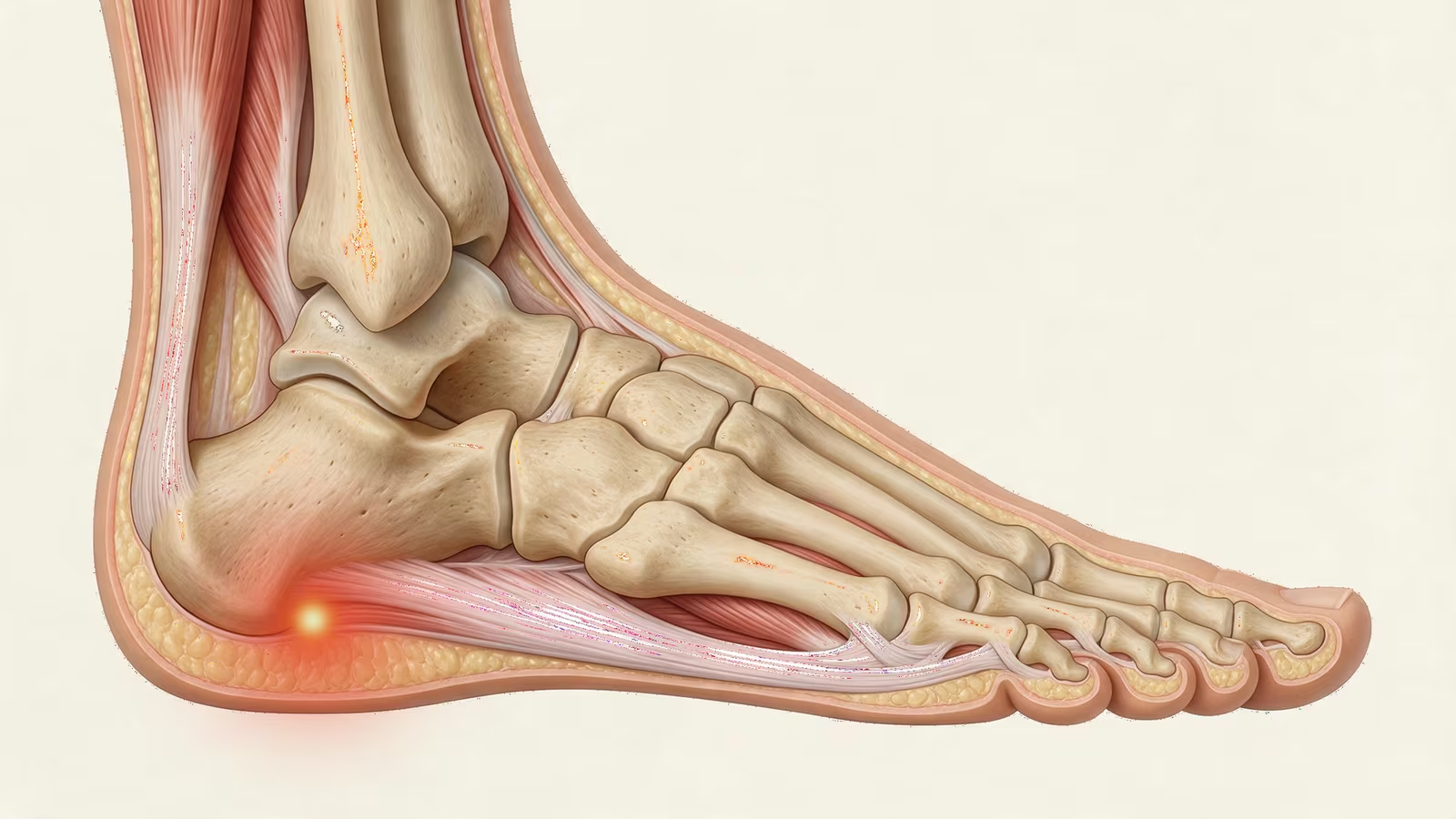
Usually it is not the heel spur itself that hurts, but the plantar fascia. The spur is a bony outgrowth on the heel bone. About 10 per cent of people have one, and it does not always cause symptoms. The German federal health portal describes it as more a consequence than a cause of the pain [1].
The plantar fascia is the strong plate of connective tissue that runs from the heel to the front of the foot and supports the arch. About 10 in 100 people develop heel pain from plantar fasciitis at some point in their lives, usually between the ages of 40 and 60. Only about half of those affected have a spur at all [1]. A spur on an X-ray therefore does not automatically explain your pain, and an X-ray without a spur does not rule out plantar fasciitis.
The word inflammation is also often misleading. For long-standing symptoms, specialists therefore also use the term plantar fasciopathy. The Dutch guideline from 2026 has this term in its title [3]. It describes overloaded tissue, which a single remedy cannot simply switch off.
Heel spur symptoms: what plantar fasciitis feels like
The typical symptom is first-step pain: the first steps after sleeping or after a rest hurt the most. It eases as you move, but comes back after long periods of standing, walking or running. It sits on the sole of the foot around the heel and arch, and stretching the sole can also hurt [2].
This pattern does not replace an examination. Heel pain can also be caused by an irritated fat pad, a tendon, a nerve or a stress injury of the bone. If several treatments have made no difference, the first thing to have rechecked is therefore the diagnosis.
See a doctor about heel pain if [2]:
- it is severe or limits you in everyday life
- it is getting worse or keeps coming back
- there is no improvement after two weeks of self-care
- tingling or numbness develops
- you have diabetes
After an injury, or if you have a fever or marked redness or swelling, get the foot examined promptly.
Causes of heel spur and heel pain: usually overload
Usually the cause is a load that has grown faster than the tissue can currently cope with. So ask yourself: what has changed? More miles, new shoes, a job on your feet, or going straight back to your old training routine after a break?
Foot shape alone does not explain it. People with flat arches and with high arches are both affected. If you are overweight, the NHS also advises losing weight [2]. Once the foot tolerates more again, Nordic walking can be one option.
Treating a heel spur: what you can do first
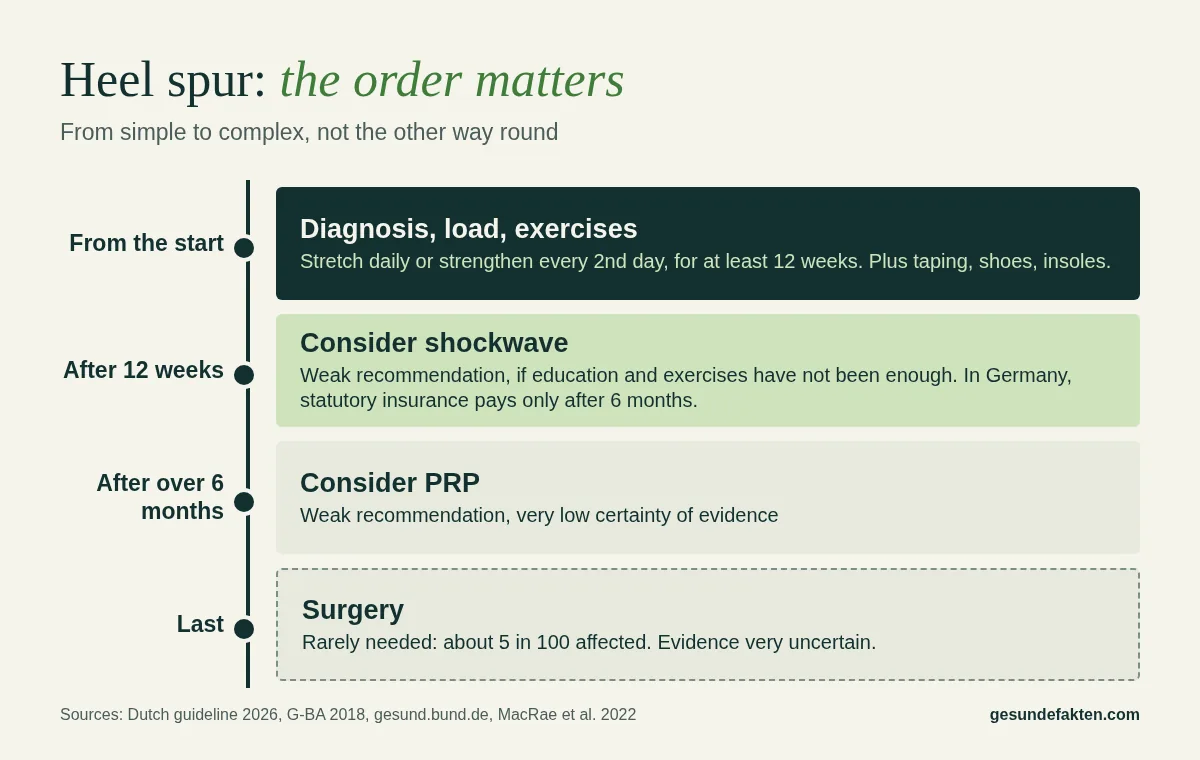
What can you do about a heel spur or plantar fasciitis? The starting point is education and adjusted activity, not the next gadget. A best-practice guide based on 51 studies, expert interviews and a patient survey names stretching, taping and individual advice as the core of treatment. Shockwave therapy and custom-made insoles follow as further steps if things do not improve [4].
Adjusting your activity does not mean stopping everything. Find an amount of movement that you currently tolerate well, and build up slowly from there. Shorter distances, more breaks or temporarily swimming instead of running can be part of this. The best guide is the first step the next morning: if it is regularly clearly worse after a long walk or run, it was probably too much.

Plantar fasciitis exercises: at least twelve weeks
The Dutch guideline from 2026 recommends either daily stretching or progressive strength training every other day, in each case for at least twelve weeks. The recommendation is strong, but the evidence behind it is thin: the certainty of the direct evidence is rated as very low [3]. Doing both programmes at the same time mainly increases the total load. Choose the one that fits into your daily life.
Stretching programme
- Plantar fascia stretch: Sit down, place the affected foot over the other leg and gently pull the toes upwards until you feel tension under the foot. The guideline suggests three times a day, 10 repetitions of 10 seconds each.
- Calf stretch: Support yourself against a wall and place the affected foot behind you. The heel stays on the floor and your weight moves forwards. At least 5 minutes a day, which can be spread over several short sessions.
Strengthening programme
Single-leg heel raises on a step, with a towel under the big toe, slowly and with control, every other day. Hold on to a stable surface while doing so:
- Weeks 1 and 2: 3 sets of 12 repetitions each
- Weeks 3 and 4: 4 sets of 10 repetitions each, with weight in a rucksack
- Weeks 5 to 12: 5 sets of 8 repetitions each, with the weight continuing to increase
The programme is demanding. If it does not work on one leg, ask to be shown an easier version, for example on both legs or sitting down. Twelve weeks is a planning horizon, not a waiting period: if it gets clearly worse, have it checked sooner. And an improvement after twelve weeks does not necessarily mean being pain-free.
Insoles, shoes and tape: what they can do
Insoles can be one part of the treatment, but the diagnosis does not mean you need an expensive custom-made pair straight away. The German federal health portal mentions simple silicone heel cushions and insoles as an option [1]. The US physiotherapy guideline from 2023 treats insoles as part of a combination, not as a stand-alone short-term treatment [5]. The 2021 guide found a small to moderate effect of custom-made insoles on general pain and ranks them as a later step [4].
With shoes, what matters is what suits your foot right now: a cushioned heel and support for the arch. In the acute phase the NHS advises against high heels, tight pointed shoes, flip-flops and walking barefoot on hard floors [2]. Barefoot walking as training can wait until the foot tolerates more again.
Tape relieves the pain of the first step in the short term [4] and is cheap. Night splints are an option for severe first-step pain [1], but only help if you can also sleep with them.
Home remedies and painkillers for heel pain: relief, not a solution
Cooling, a ball under the sole of the foot or a short-term painkiller can ease symptoms, but they probably change little in the tissue. The NHS suggests cold, wrapped in a towel, for up to 20 minutes every two to three hours [2]. Be careful with this if sensation in the foot is reduced or you have circulation problems. The German federal health portal mentions painkillers such as ibuprofen only for two to three weeks [1], and it is best to check at a pharmacy whether they are right for you.
If your foot feels better after rolling, that is a real gain. It just does not prove that adhesions were released or that the spur is shrinking. The bony spur does not shrink back [1], and it does not need to for the pain to go away.
Why personal accounts are often misleading
An improvement after a treatment does not prove that the treatment caused it. Most people are symptom-free after a year [1], and you usually go to the doctor when things are at their worst. After that it often gets better anyway. To find out, you need a comparison group.
A study of 90 people shows how strong this effect is: in the placebo group, pain fell from 8.1 to 5.4 points after 18 months, that is, without the active substance being tested [9]. So for every success rate, ask: how did the comparison group do?
Shockwave therapy for heel spur: why the findings differ
Shockwave therapy can be an option if twelve weeks of education and exercises have not been enough, but its added benefit is disputed. The Dutch guideline from 2026 makes a weak recommendation for it, with up to three sessions, a week apart. Compared with a sham treatment, it found around 2 points less pain on a scale of 0 to 10 after twelve weeks [6].
A Norwegian study of 200 people came to a different result. All participants received advice and custom-made insoles. On top of that, radial shockwave therapy brought no reliable benefit for activity-related pain after six months, and neither did the sham treatment or an additional exercise programme [7].

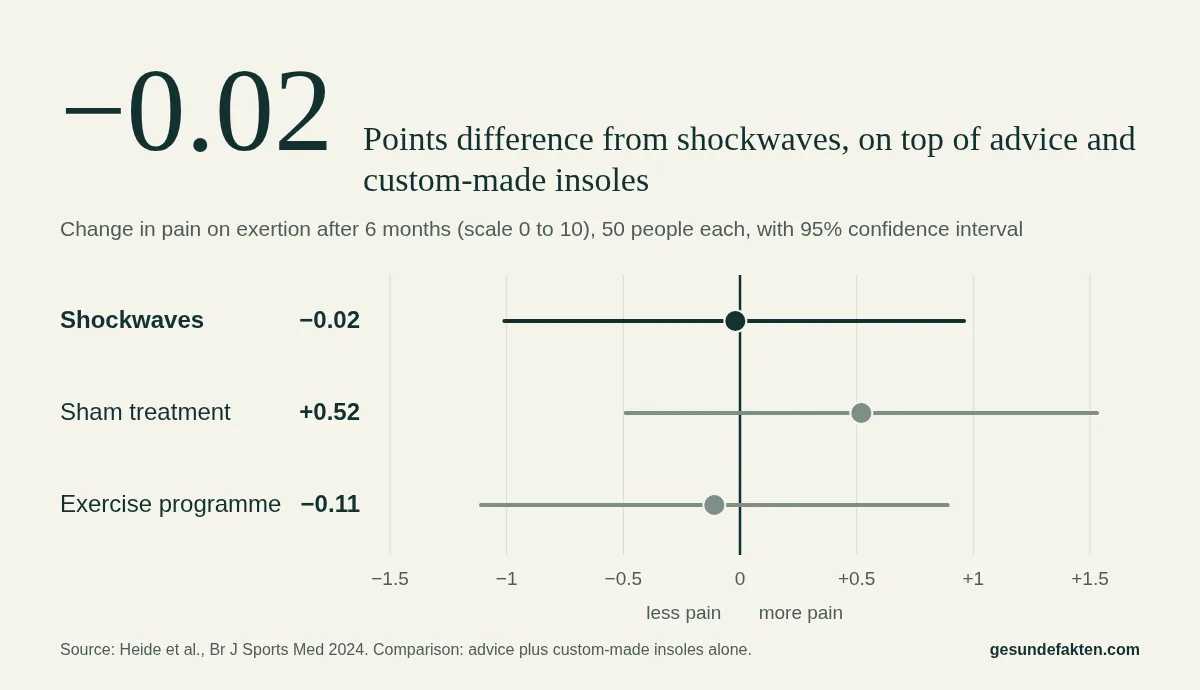
The contradiction partly comes down to the question each study asked. Beating a sham treatment is not the same as adding something to advice and insoles. The guideline discusses the Norwegian study but did not include it in its analysis, because it was very recent and the research question differed [6]. The result for the exercise programme also does not speak against exercise: it only shows that this one programme added nothing demonstrable beyond basic care.
In Germany, statutory health insurers cover the treatment under a 2018 G-BA decision, on stricter conditions than the guideline: the pain must have limited you for at least six months, and stretching exercises, insoles and other conservative measures must not have brought a relevant improvement. A maximum of three sessions per episode and foot is provided for, carried out by certain specialist doctors [15]. Ask before the appointment who pays: the insurer or you.
Injections for heel spur: corticosteroid, PRP and others
Corticosteroid injections probably ease pain only slightly, and only for up to about a month. The Cochrane review found a 6-point difference on a scale of up to 100, with low certainty of evidence, and no clear benefit afterwards [8]. Among 699 people given a corticosteroid, an exploratory analysis counted 2 ruptures of the plantar fascia and 3 infections at the injection site, although side effects were often poorly recorded. The German federal health portal also warns of tendon damage and a weakening of the heel fat pad [1].
For PRP, that is, a preparation made from your own blood, the findings are mixed. In the study of 90 people, pain with PRP fell from 8.2 to 2.1 points after 18 months, clearly lower than with placebo [9]. In a small study of 28 people, 8 of whom could not be followed up, PRP and saline improved to a similar degree [10]. The 2026 guideline makes a weak recommendation to consider PRP only after more than six months without sufficient improvement, and discussing the costs and unknown risks first. The certainty of the evidence is rated as very low [11]. By contrast, it clearly advises against simple injections of your own blood [12].
Botulinum toxin and concentrated sugar solutions (prolotherapy) show positive results, but with caveats. For botulinum toxin, the pooled studies vary widely [13], and the German federal health portal lists it among the treatments whose benefit is not clearly proven [1]. For prolotherapy, the advantage over saline is supported by low-certainty evidence, and corticosteroid was superior to it in the short term [14].
Radiotherapy for heel spur: benefit disputed
Low-dose radiotherapy is an option for stubborn cases, but how it is assessed varies by source. In its 2015 guideline, the German specialist society of radiation oncologists considers it effective, and a sensible alternative when simple measures have not helped [16]. The German federal health portal, by contrast, lists it among the treatments whose effectiveness is not clearly proven [1]. The Cochrane review rated the evidence from the one comparison it examined as very uncertain [8].
Even at a low dose, it is still ionising radiation. So ask for an explanation of what you can expect and which risks matter at your age.
Heel spur surgery: the rare last step
Surgery is rarely needed; the German federal health portal puts it at about 5 in 100 people with the condition [1]. Beforehand, it should be clear that the diagnosis is right and that other measures have been tried properly. The spur is not necessarily what is operated on: options include, for example, partially cutting the plantar fascia or an operation on the calf muscles.
The evidence is weak. A systematic review found 8 studies with a total of 345 people, all at high risk of bias and with very low certainty of evidence. Of five studies that compared surgery with non-surgical treatment, three favoured surgery in the long term and two found no difference. Side effects were barely recorded in a reliable way [17]. With such a far-reaching decision, a second opinion is worthwhile.
Treatments at a glance
| Treatment | When | Assessment |
|---|---|---|
| Stretching or strength training | from the start, for at least 12 weeks | strong recommendation, direct evidence thin |
| Taping | from the start | short-term relief of first-step pain |
| Insoles | as one component, not on their own | check the simple solution first |
| Shockwave therapy | after at least 12 weeks; in Germany, statutory health insurance covers it after 6 months | weak recommendation, added benefit disputed |
| Corticosteroid injection | in individual cases | slight effect for up to about 1 month, risks |
| PRP | after more than 6 months | weak recommendation, very low certainty |
| Simple injection of your own blood | not recommended | strong recommendation against |
| Radiotherapy | for stubborn cases | assessments contradict each other |
| Surgery | last, rarely needed | very low certainty of evidence |
Common questions about heel spur
How long does a heel spur last?
It can take a few weeks to months until the pain has gone. Most people no longer have symptoms after a year, but relapses are possible. The bony spur itself remains.
What helps heel pain straight away?
In the short term, rest, cooling wrapped in a towel, a cushioned heel, gentle stretching before the first steps and taping can ease it. This buys you some breathing space, but it does not replace the longer build-up over weeks.
Does a heel spur go away?
The spur does not shrink back, but the pain usually does. Many people have a spur and feel nothing from it.
What is the difference between a heel spur and plantar fasciitis?
A heel spur is a bony finding on an X-ray, while plantar fasciitis describes symptoms in the plate of connective tissue under the foot. The two can occur together, but also each on its own.
Can I jog with a heel spur?
That depends on how your foot reacts. If the first step the next morning is regularly clearly worse, cut back the distance or temporarily switch to a lower-impact sport, such as swimming.
Which shoes are good for a heel spur?
Shoes with a cushioned heel and good support for the arch of the foot. High heels, tight pointed shoes, flip-flops and walking barefoot on hard ground tend to put more strain on the foot in the acute phase.
Does heel pain have a psychological cause?
When should I see a doctor about a heel spur?
If the pain has not improved after two weeks of self-treatment, if it is severe or limits your daily life, if you have tingling or numbness, or if you have diabetes.
Conclusion: with a heel spur, what matters is the plan, not the gadget
A heel spur on an X-ray is rarely the actual problem. Check the diagnosis, adjust the load and stick with an exercise programme for twelve weeks. Keep a note of how the first step in the morning and your usual walking or standing time change. That way you can see whether anything is changing, and for any further treatment you can ask: what is it meant to improve for me, how likely is that, and what does it cost in money and risk?
Sources
- Bundesministerium für Gesundheit, gesund.bund.de: Fersensporn und Plantarfasziitis. As of 22.07.2026. gesund.bund.de.
- NHS: Plantar fasciitis. Reviewed 14.02.2025. nhs.uk.
- Richtlijnendatabase (NL): Fasciopathie plantaris, Oefentherapie. 17.02.2026. richtlijnendatabase.nl.
- Morrissey D, Cotchett M, Said J’Bari A et al.: Management of plantar heel pain: a best practice guide informed by a systematic review, expert clinical reasoning and patient values. Br J Sports Med 2021. PubMed 33785535. DOI: 10.1136/bjsports-2019-101970.
- Koc TA Jr, Bise CG, Neville C et al.: Heel Pain – Plantar Fasciitis: Revision 2023. J Orthop Sports Phys Ther 2023. PubMed 38037331. DOI: 10.2519/jospt.2023.0303.
- Richtlijnendatabase (NL): Fasciopathie plantaris, Shockwave therapie. 17.02.2026. richtlijnendatabase.nl.
- Heide M, Røe C, Mørk M et al.: Is radial extracorporeal shock wave therapy (rESWT), sham-rESWT or a standardised exercise programme in combination with advice plus customised foot orthoses more effective than advice plus customised foot orthoses alone in the treatment of plantar fasciopathy? Br J Sports Med 2024. PubMed 38904119. DOI: 10.1136/bjsports-2024-108139.
- David JA, Sankarapandian V, Christopher PR et al.: Injected corticosteroids for treating plantar heel pain in adults. Cochrane Database Syst Rev 2017. PMC6481652. DOI: 10.1002/14651858.CD009348.pub2.
- Shetty SH, Dhond A, Arora M, Deore S: Platelet-Rich Plasma Has Better Long-Term Results Than Corticosteroids or Placebo for Chronic Plantar Fasciitis. J Foot Ankle Surg 2019. PubMed 30448183. DOI: 10.1053/j.jfas.2018.07.006.
- Johnson-Lynn S, Cooney A, Ferguson D et al.: A Feasibility Study Comparing Platelet-Rich Plasma Injection With Saline for the Treatment of Plantar Fasciitis. Foot Ankle Spec 2019. PubMed 29779399. DOI: 10.1177/1938640018776065.
- Richtlijnendatabase (NL): Fasciopathie plantaris, Plaatjes rijk plasma (PRP). 17.02.2026. richtlijnendatabase.nl.
- Richtlijnendatabase (NL): Fasciopathie plantaris, Autoloog bloed injectie. 17.02.2026. richtlijnendatabase.nl.
- Acosta-Olivo C, Simental-Mendía LE, Vilchez-Cavazos F et al.: Clinical Efficacy of Botulinum Toxin in the Treatment of Plantar Fasciitis. Arch Phys Med Rehabil 2022. PubMed 34688605. DOI: 10.1016/j.apmr.2021.10.003.
- Fong HPY, Zhu MT, Rabago DP et al.: Effectiveness of Hypertonic Dextrose Injection (Prolotherapy) in Plantar Fasciopathy. Arch Phys Med Rehabil 2023. PubMed 37098357. DOI: 10.1016/j.apmr.2023.03.027.
- Gemeinsamer Bundesausschuss: Pressemitteilung zur Stoßwellentherapie beim Fersenschmerz. 19.04.2018. g-ba.de.
- Ott OJ, Niewald M, Weitmann HD et al.: DEGRO guidelines for the radiotherapy of non-malignant disorders. Part II: Painful degenerative skeletal disorders. Strahlenther Onkol 2015. PubMed 25238992. DOI: 10.1007/s00066-014-0757-3.
- MacRae CS, Roche AJ, Sinnett TJ, O’Connell NE: What is the evidence for efficacy, effectiveness and safety of surgical interventions for plantar fasciopathy? PLoS One 2022. PubMed 35584180. DOI: 10.1371/journal.pone.0268512.
- Cotchett M, Munteanu SE, Landorf KB: Depression, Anxiety, and Stress in People With and Without Plantar Heel Pain. Foot Ankle Int 2016. PubMed 27137796. DOI: 10.1177/1071100716646630.
- Drake C, Mallows A, Littlewood C: Psychosocial variables and presence, severity and prognosis of plantar heel pain. Musculoskeletal Care 2018. PubMed 29766646. DOI: 10.1002/msc.1246.
- Nadimi J, Abdul W, Whelan R, Hutchison AM: Does a Relationship Exist Between Plantar Heel Pain and Stress, Anxiety, and Depression. J Am Podiatr Med Assoc 2025. PubMed 40127032. DOI: 10.7547/23-174.
Cover image: illustrative image created with AI