
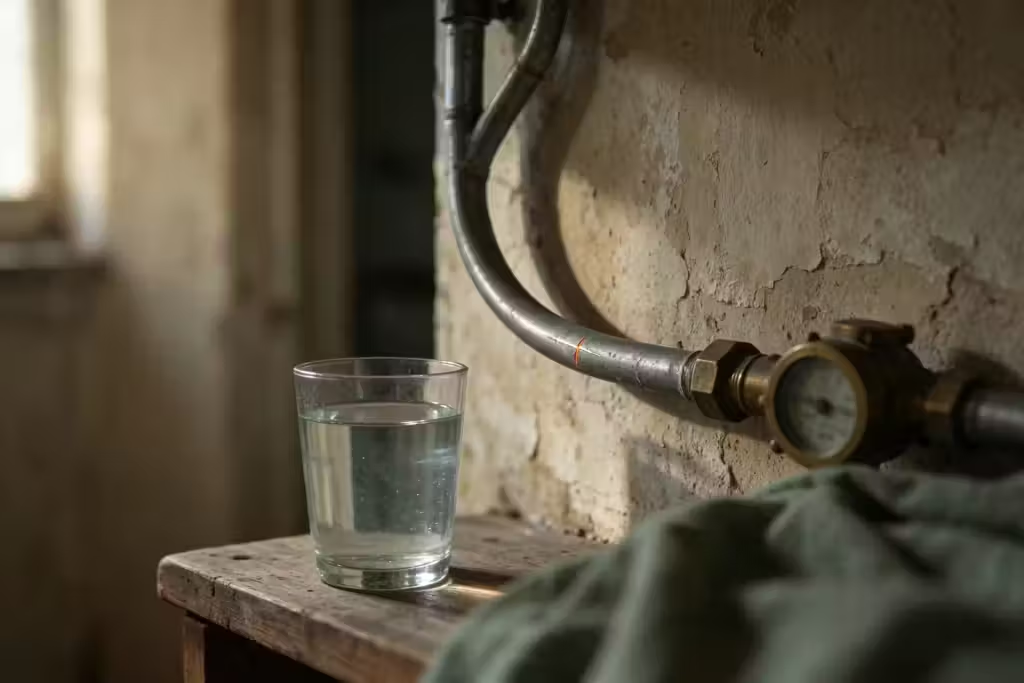
Lead poisoning with clear symptoms is rare in Germany today. Still, every person carries some lead: it enters the body through food, old tap water or hobbies and is stored in the bones for decades. No amount is known to be safe. Unborn babies and small children are especially sensitive, because even small amounts can disturb brain development. The good news: since leaded gasoline disappeared, exposure has dropped sharply. This article shows where lead still comes from today, how to identify lead pipes, and which common claims are not true.
It is part 2 of our series “How Do Humans Get Poisoned?”, in which we examine one poison after another. Part 1 covers mercury poisoning from amalgam and fish. This article is no substitute for a conversation with your doctor. As of November 2026.
Key points at a glance
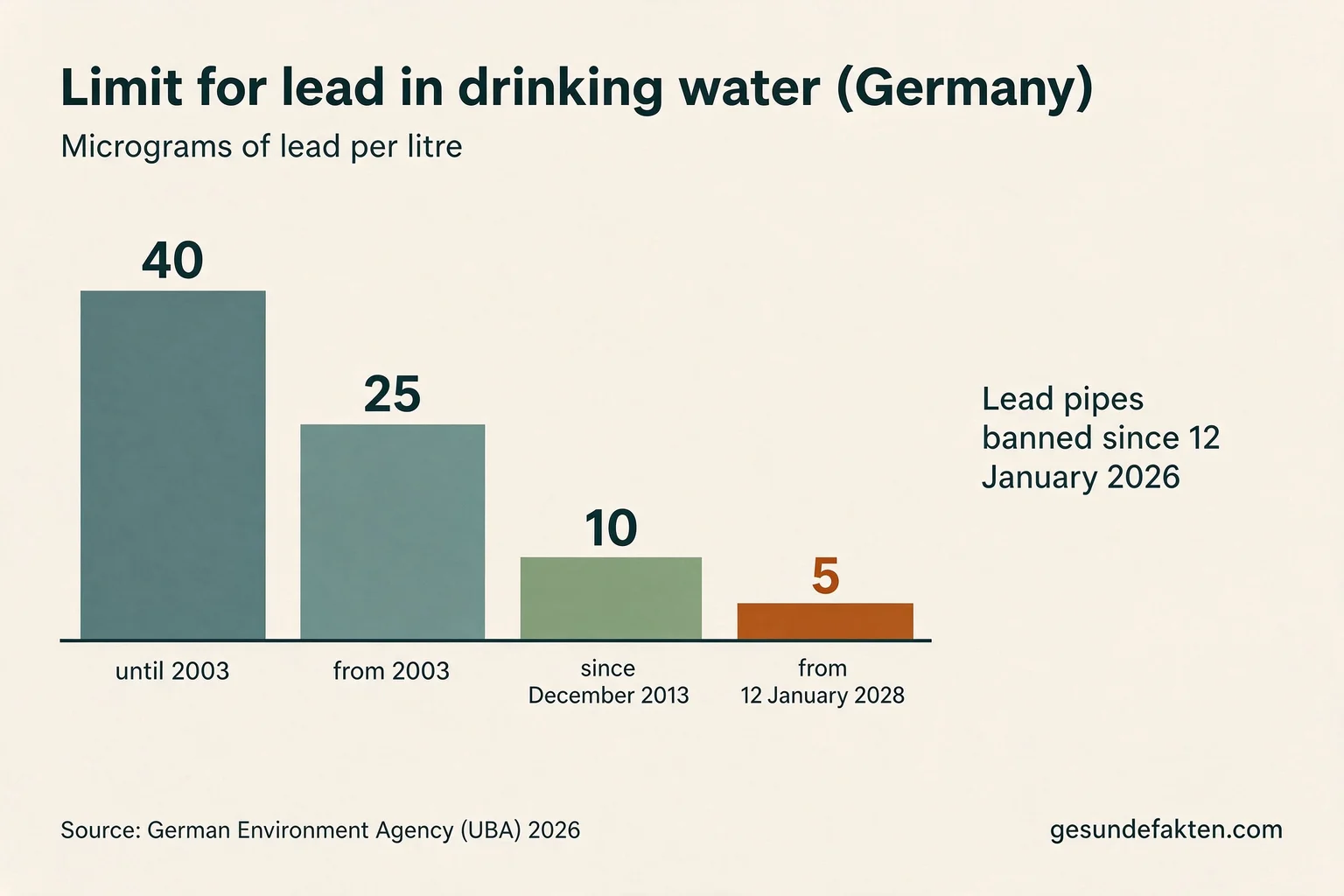
- Since January 12, 2026, drinking water pipes made of lead have been banned in Germany. From January 12, 2028, the German limit for lead in drinking water will be halved to 5 micrograms per liter [1].
- Among young adults in Münster, Germany, lead in blood fell to about one eighth between 1981 and 2016. Since about 2010 it has hardly declined further [3].
- No amount of lead without harmful effects is known [5]. Even at low blood levels, children show somewhat lower IQ scores on average [8].
- According to the German Federal Institute for Risk Assessment (BfR), children, pregnant women and women who want to become pregnant should not eat game shot with lead ammunition [15].
- A drug that binds lead (chelation therapy for lead poisoning) lowered the blood level in toddlers with clearly elevated levels, but improved neither IQ nor behavior [19]. “Detox” cures for lead poisoning in healthy people are not proven.
What is lead poisoning?
Lead poisoning is damage to the nervous system, blood formation, kidneys or blood vessels caused by too much lead. Experts also call it plumbism (saturnism). The heavy metal lead has no useful function in the body. It is distributed through the blood to the brain, liver and kidneys and is stored in bones and teeth [5]. In adults, about 90 percent of the lead is in the skeleton. It stays in the blood for only 20 to 40 days, but in the bones for 10 to 30 years [7]. During pregnancy, part of it is released back into the blood and reaches the unborn child [5].
Children are at particular risk for two reasons: from the same amount, they absorb four to five times as much lead as adults, and they often put their hands and objects in their mouths [5].
Symptoms of lead poisoning
Most people with slightly elevated levels have no complaints. Noticeable symptoms of lead poisoning appear only at much higher levels:
- Abdomen and blood: cramping abdominal pain (lead colic), constipation, nausea, vomiting, loss of appetite, anemia with pallor and fatigue [7][14].
- Nerves: headaches, fatigue, sleep problems, irritability, slowed reactions, tingling or muscle weakness, tremor [7].
- Long-term in adults: higher blood pressure, kidney damage, in men fewer and poorer-quality sperm, in pregnancy a higher risk of miscarriage and premature birth [5][7].
- In children: developmental delay, learning and attention problems. Very high levels can cause seizures, coma and death [5].
Suspect acute poisoning? For example, if a child has swallowed lead shot, lead paint or a lead weight, or in case of severe abdominal cramps and pallor after contact with lead: call Poison Control (1-800-222-1222) or 911.
A case from Leipzig, Germany, in 2007 showed how serious it can get: dealers had cut marijuana with lead to increase its weight. 35 young people had to be treated at the university hospital, mostly for abdominal colic and anemia. Their blood lead level averaged about 1,060 micrograms per liter [14], which is more than 25 times above the German reference value for men.
Where does lead come from today?
For most people in Europe, food is the most important source of lead. According to the European Food Safety Authority (EFSA), cereal products contribute the most, followed by potatoes, leafy vegetables and tap water. Lead reaches plants through air and soil. In children, dust and soil can play an additional role [6]. The EU sets maximum levels for foods [30]. Individual sources can still raise intake considerably:
- Old lead pipes: Water from lead pipes usually does not meet the limit, especially if it has been standing in the pipe for a longer time [1][2].
- Game shot with lead ammunition: The bullets fragment on impact, and tiny lead splinters penetrate deep into the meat. They are found up to 40 centimeters around the wound channel, so generous trimming is not always enough. According to the BfR, adults who eat up to ten servings of game a year have no increased health risk. Hunters’ families who eat game once to several times a week, however, can take in considerably more lead [15].
- Ceramics with a lead-containing glaze: Lead can pass from glazes and decorations into food, especially with acidic foods and long contact. The EU limits for this date from 1984. The BfR considers release amounts up to 400 times lower to be tolerable [16].
- Lead crystal: Only small amounts dissolve while drinking. But port wine stored in a decanter contained about 40 times as much lead after four months as before [17].
- Ayurvedic preparations and traditional remedies from the internet: Some deliberately contain lead, mercury or arsenic. Severe cases of lead poisoning from these have become known in Germany [18]. Some traditional cosmetics can also contain lead [5].
- Adulterated spices: In Bangladesh, turmeric was brightened with the yellow pigment lead chromate. Some samples contained over 1,000 micrograms of lead per gram [34].
- Renovation and hobbies: Sanding or burning off old lead paint releases lead-containing dust and fumes. Leaded glass, lead-containing solder and ammunition also contain lead [5].
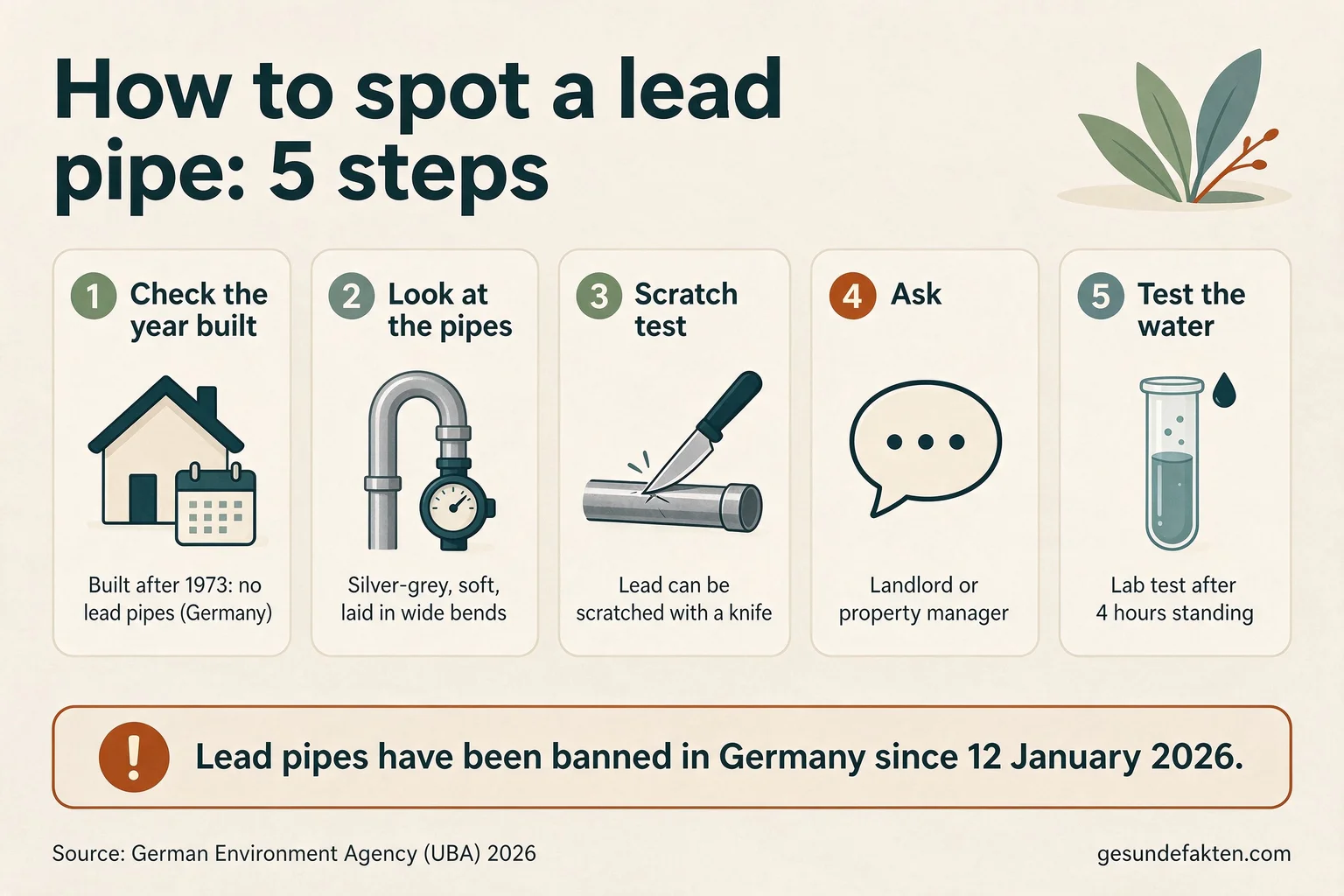
How to identify lead pipes: check your home in 5 steps
In Germany, lead pipes can at most still be found in houses built before 1973. In parts of Bavaria and Baden-Württemberg, they were no longer installed from the end of the 19th century, while in northern and eastern Germany they were in places still installed until the early 1970s. Many older houses are not affected either, because copper or galvanized steel was often used instead [2]. Here is how to proceed:
- Check the year built: If the house was built after 1973, there are no lead pipes [2].
- Look at visible pipes: Ideally in the basement, before and after the water meter. Lead pipes are silver-gray to gray-blue, often laid in large bends on top of the plaster, and sound dull when tapped [1][2].
- Scratch test: Lead is soft. You can easily scratch it with a knife, and it shines silvery underneath. Copper and steel are much harder [2].
- Ask: Landlords, property managers or owners can usually tell when and with what material the pipes were installed [2].
- Have the water tested: If you are unsure, a laboratory measurement provides answers. It costs money. The water should have been standing in the pipe for at least four hours beforehand. The local health department (Gesundheitsamt) advises on sampling [2].

Use the graphic on your site
You may use the graphic freely with attribution and a link. Copy the code:
<a href="https://gesundefakten.com/en/health/lead-poisoning/"><img src="https://gesundefakten.com/wp-content/uploads/2026/11/blei-leitung-erkennen-en.webp" alt="Infographic: How to identify lead pipes in 5 steps: check year built, look at pipes, scratch test, ask, test water. Lead pipes banned in Germany since January 12, 2026" width="1536" height="1024"></a><br>Source: <a href="https://gesundefakten.com/en/health/lead-poisoning/">gesundefakten.com</a>What the German Drinking Water Ordinance requires
Since January 12, 2026, Germany has had a general ban on drinking water pipes made of lead, including short sections. Owners must have any remaining lead pipes taken out of service or replaced as quickly as possible, otherwise they commit an administrative offense. Plumbing and water supply companies must report any lead pipes they find to the local health department, and residents must be informed. Exceptions exist only in certain cases, for example when owners use the building themselves [1]. Tenants with a suspicion should contact the landlord and, if there is no response, the local health department [1].
The German limit was also lowered several times: from 40 micrograms per liter until the end of 2003, via 25, to 10 micrograms since December 2013. From January 12, 2028, 5 micrograms per liter will apply [1]. How important the pipe material is was shown by the US city of Flint: after a switch to more aggressive water without adequate corrosion control, the share of young children with elevated blood lead doubled from 2.4 to 4.9 percent [27].

Use the graphic on your site
You may use the graphic freely with attribution and a link. Copy the code:
<a href="https://gesundefakten.com/en/health/lead-poisoning/"><img src="https://gesundefakten.com/wp-content/uploads/2026/11/blei-grenzwert-trinkwasser-en.webp" alt="Infographic: German limit for lead in drinking water in micrograms per liter: 40 until 2003, 25 from 2003, 10 since December 2013, 5 from January 12, 2028" width="1536" height="1024"></a><br>Source: <a href="https://gesundefakten.com/en/health/lead-poisoning/">gesundefakten.com</a>Until the lead pipe is replaced
- Pregnant women, infants and children up to six years old should never drink water from lead pipes or use it for cooking. For baby food, use bottled water labeled “suitable for the preparation of infant food” [2].
- The German Federal Environment Agency (Umweltbundesamt) advises against water filters for removing lead: they can contaminate the water with germs [1].
- Showering, bathing and washing hands are harmless [1].
- Running the tap or boiling does not make water from lead pipes safe: boiling kills germs but does not remove lead. For pregnant women and children, only bottled water remains [2].
- In lead-free pipes, the general rule is: if water has been standing in the pipe for a longer time, let it run until it comes out cool [2].
How much lead is in your body? Understanding lead in blood
What matters is the lead level in the blood [5]. The German Human Biomonitoring Commission of the Umweltbundesamt sets reference values for it. A reference value describes the usual background exposure: 95 percent of the population is below it. It is not a boundary between “healthy” and “sick.” Anyone above it is more exposed than usual. Then it is worth looking for the source [3].
| Group or reference | Value (µg/l blood) |
|---|---|
| Girls 3 to 17 years, boys 11 to 17 years (German reference value) [4] | 15 |
| Boys 3 to 10 years (German reference value) [4] | 20 |
| Women (German reference value) [3] | 30 |
| Men (German reference value) [3] | 40 |
| USA: value above which children are followed up (CDC) [22] | 35 |
| EFSA: blood level associated with about 1 IQ point less in children (lower confidence limit) [6] | 12 |
| EFSA: blood level associated with about 1 percent higher blood pressure in adults (lower confidence limit) [6] | 36 |
Be careful when comparing: lab reports often give lead in micrograms per deciliter (µg/dl). 1 µg/dl equals 10 µg/l. The German reference values for children come from the German Environmental Survey GerES V (2014 to 2017), those for adults from 2019 [3][4]. You can convert the units with our lab values converter.
In 2010, the European Food Safety Authority (EFSA) declared the earlier “tolerable weekly intake” for lead no longer appropriate, because no threshold without effect could be found. According to EFSA, current exposure means a low risk for most adults. In small children, effects on brain development are possible [6].
Exposure has fallen sharply
Since 1981, the German Environmental Specimen Bank has measured the blood of students in Münster every year. Lead levels fell by about 6 percent per year on average. By 2016, they had dropped to about 13 percent of the 1981 value [3]. Similar declines occurred across Europe [3], mainly after the end of leaded gasoline [10]. In Germany, lead in gasoline was limited from 1971 by the Benzinbleigesetz (Leaded Petrol Act), and leaded regular gasoline has been banned since February 1, 1988 [29]. Across the EU, leaded gasoline has not been permitted since 2000 [32]. Since about 2010, however, levels have hardly declined further. The commission concludes from this that lead continues to be taken in from various sources [3].
What lead does in the body
Children: intelligence and behavior
The best-known analysis pools seven long-term studies with 1,333 children. When the blood lead level rose from 24 to 100 µg/l, IQ was 3.9 points lower on average. A further rise from 100 to 200 µg/l cost “only” another 1.9 points. So the first small amounts have the strongest effect in proportion [8]. For an individual child this is barely noticeable, but for a whole population it is considerable.
A meta-analysis with over 10,000 children found a small to medium association between lead and ADHD symptoms such as inattention and hyperactivity [11]. In a New Zealand birth cohort, people with higher blood lead at age 11 had somewhat more mental health problems as adults [12]. Such observational studies show associations. They do not prove that lead alone causes individual conditions such as ADHD.
Effects of lead poisoning in adults: blood pressure, heart and kidneys
In adults, blood pressure and the kidneys are the main concern [6]. In a US observational study with over 14,000 adults, people with higher blood lead (67 instead of 10 µg/l) had a 70 percent higher risk of dying from cardiovascular disease over almost 20 years [9]. The World Health Organization attributes more than 3.5 million deaths worldwide in 2023 to lead, mainly through cardiovascular disease [5]. According to a World Bank modeling analysis, about 90 percent of these deaths occur in low- and middle-income countries [10]. According to UNICEF, about one in three children worldwide, up to 800 million, has a blood lead level of at least 50 µg/l [35].
Is lead carcinogenic?
The International Agency for Research on Cancer (IARC) classifies inorganic lead compounds as “probably carcinogenic to humans” (Group 2A) and metallic lead as “possibly carcinogenic” (Group 2B). This is based on clear findings in animals and limited evidence in humans, mainly in workers with high exposure [13]. Lead is thus not considered a proven carcinogen in humans.
Myth check: what is said about lead
| Claim | What the evidence shows |
|---|---|
| “Human lead exposure has increased more than 500-fold in 100 years.” | Compared with preindustrial skeletons, exposure in the 1970s was indeed a hundred to a thousand times higher [23][24]. Since then, however, it has fallen sharply, by about 87 percent in the blood of young adults in Münster [3]. There is no further increase. |
| “Amalgam fillings contain lead.” | False. Amalgam consists of mercury and an alloy of silver, tin and copper [28]. More in part 1 on mercury poisoning. |
| “Electronic devices give off lead fumes.” | Not in normal operation. Lead has been largely banned in new electrical and electronic equipment in the EU since 2006, now regulated under the RoHS Directive, with exceptions for certain components [26]. A risk exists when soldering with lead-containing solder or dismantling old devices, mainly through the hands. |
| “Lead causes schizophrenia, psychosis, panic attacks and hair loss.” | For early-life lead exposure, there are indications of somewhat more mental health problems in adulthood [12]. That lead causes specific mental illnesses or hair loss at today’s usual levels is not proven. |
| “Anglers poison themselves when they bite lead shot with their teeth.” | Lead does not belong in the mouth, and pliers are the better choice. There is hardly any data on how much exposure anglers get this way. The environmental damage is well documented: on November 12, 2026, the EU Commission restricted lead fishing weights and lures, phased in from June 2027, to protect about 7 million birds [25]. |
Lead testing, treatment and chelation therapy for lead poisoning
The right test is a blood sample from a vein, analyzed in a laboratory for lead in whole blood [5]. It makes sense if you have symptoms, a known lead source (for example a lead pipe, occupation, sport shooting, Ayurvedic remedies), or in small children from a contaminated environment. The German Human Biomonitoring Commission considers hair analysis unsuitable for diagnosis in an individual: lead sticks to hair from the outside via air, water and cosmetics, and laboratories do not work uniformly [31].
Provocation tests, in which a binding agent (chelators such as DMSA or DMPS) is taken before a urine sample, artificially drive up metal levels in urine, even in people without poisoning. There are no reference values for such samples. The American College of Medical Toxicology calls them scientifically unvalidated, without proven benefit and possibly harmful [21]. The German Human Biomonitoring Commission also sees no gain in knowledge from the DMPS mobilization test; no treatment can be derived from the results [33].
The most important treatment is to find and eliminate the source. Chelators are drugs for acute and severe poisoning. In children, the German Human Biomonitoring Commission considers such treatment indicated from 450 µg/l blood, but not justified for suspected chronic exposure [33]. A large randomized trial with 780 toddlers (blood lead 200 to 440 µg/l) showed how limited the benefit is at moderate exposure: the drug succimer lowered the blood lead level, but after three years IQ was no higher than with placebo [19], nor at school age [20]. That “detox” cures with chlorella algae, cilantro, healing clay or dietary supplements lower the body’s lead content or improve health in healthy people is not proven.
How to reduce your lead exposure
- Check pipes: In a house built before 1973 (Germany), look at the pipes or ask, and have the water tested if you are unsure [2].
- Choose game carefully: For children, pregnant women and women who want to become pregnant, only game taken with lead-free ammunition. Ask the hunter or retailer [15].
- Use ceramics properly: Do not use home-made, very old or vacation-bought ceramics with an unknown glaze for acidic foods and drinks or for storage [16].
- Lead crystal for serving only: Do not store wine and spirits in crystal decanters [17].
- No preparations from unreliable sources: Avoid Ayurvedic and other traditional remedies from the internet, and give them to children only after consulting the pediatrician’s office [18].
- Protect yourself when renovating: Do not dry-sand or burn off old layers of paint, wipe up dust with a damp cloth, and keep children and pregnant women away [5].
- Wash your hands: After soldering, fishing with lead weights or sport shooting, wash your hands before eating.
- Spices from known sources: Avoid loose goods of unknown origin, especially conspicuously bright turmeric [34].
- Eat a balanced diet: Children with iron or calcium deficiency absorb more lead [5].
Frequently asked questions
How do I know if I have lead poisoning?
Slightly elevated levels usually cause no complaints. Abdominal cramps, constipation, anemia, fatigue and concentration problems can point to heavier exposure, but usually have other causes. Only a blood test for lead provides clarity.
Can you get lead poisoning from drinking water?
Yes, if the water flows through lead pipes for a long time. The main source of lead in tap water has been old lead pipes in the house and in the service line. In Germany, they had to be removed or taken out of service by January 12, 2026. Smaller amounts of lead can also come from fittings and components made of copper alloys, whose lead content must continue to fall until 2028 [1].
Until when were lead pipes installed?
In northern and eastern Germany, in places until the early 1970s; in parts of southern Germany, they were no longer installed from the end of the 19th century. Since 1973, lead has no longer been used as pipe material in Germany [2].
Can lead be removed from the body?
Is lead on the skin dangerous?
The skin absorbs only a tiny fraction of metallic and inorganic lead, estimated at 0.06 percent [7]. The problem is the path from hand to mouth. That is why you should wash your hands after touching lead.
May I drink from lead crystal glasses?
Yes. They are harmless for drinking, but drinks should not stand in them for days or weeks [17].
How long does lead stay in the body?
About 20 to 40 days in the blood, 10 to 30 years in the bones [7].
Bottom line: lead poisoning is rare, but lead remains an issue
Lead poisoning with symptoms is rare in Germany. It mainly affects people with a particular source: old lead pipes, preparations from unreliable sources, certain occupations and hobbies, or adulterated drugs. Background exposure has fallen sharply since the end of leaded gasoline. Because there is no safe amount, it is still worth eliminating avoidable sources, especially for pregnant women and small children. Expensive hair analyses, provocation tests and detox cures do not help with this.
The series continues with cadmium: what smoking, grain and chocolate have to do with it.
Suggested citation: gesundefakten.com (2026): Lead Poisoning: Symptoms, Sources and How to Identify Lead Pipes. https://gesundefakten.com/en/health/lead-poisoning/
References
- Umweltbundesamt: Verbot von Trinkwasserrohren aus Blei. Verbot gilt seit dem 12. Januar 2026. Leaflet, as of June 2026. umweltbundesamt.de.
- Umweltbundesamt: Bleirohre: Blei im Trinkwasser ist gesundheitsgefährdend. Environmental tips, updated August 4, 2026. umweltbundesamt.de.
- Kommission Human-Biomonitoring des Umweltbundesamts: Blei: Aktualisierung der Referenzwerte. Bundesgesundheitsblatt 2019;62:1280–1284. DOI: 10.1007/s00103-019-03002-z.
- Umweltbundesamt, Kommission Human-Biomonitoring: Referenzwerte für Metalle im Blut und Urin (table, updated September 30, 2019; children: GerES V 2014–2017). umweltbundesamt.de.
- World Health Organization (WHO): Lead poisoning and health. Fact sheet. who.int.
- EFSA Panel on Contaminants in the Food Chain (CONTAM): Scientific Opinion on Lead in Food. EFSA Journal 2010;8(4):1570. DOI: 10.2903/j.efsa.2010.1570.
- UK Health Security Agency: Lead: toxicological overview. gov.uk.
- Lanphear BP, Hornung R, Khoury J et al.: Low-level environmental lead exposure and children’s intellectual function: an international pooled analysis. Environ Health Perspect 2005;113(7):894–899. PubMed 16002379. DOI: 10.1289/ehp.7688.
- Lanphear BP, Rauch S, Auinger P et al.: Low-level lead exposure and mortality in US adults: a population-based cohort study. Lancet Public Health 2018;3(4):e177–e184. PubMed 29544878. DOI: 10.1016/S2468-2667(18)30025-2.
- Larsen B, Sánchez-Triana E: Global health burden and cost of lead exposure in children and adults: a health impact and economic modelling analysis. Lancet Planet Health 2023;7(10):e831–e840. PubMed 37714172. DOI: 10.1016/S2542-5196(23)00166-3.
- Goodlad JK, Marcus DK, Fulton JJ: Lead and Attention-Deficit/Hyperactivity Disorder (ADHD) symptoms: a meta-analysis. Clin Psychol Rev 2013;33(3):417–425. PubMed 23419800. DOI: 10.1016/j.cpr.2013.01.009.
- Reuben A, Schaefer JD, Moffitt TE et al.: Association of Childhood Lead Exposure With Adult Personality Traits and Lifelong Mental Health. JAMA Psychiatry 2019;76(4):418–425. PubMed 30673063. DOI: 10.1001/jamapsychiatry.2018.4192.
- International Agency for Research on Cancer (IARC): Inorganic and Organic Lead Compounds. IARC Monographs Volume 87, 2006. publications.iarc.who.int.
- Busse FP, Fiedler GM, Leichtle A et al.: Lead poisoning due to adulterated marijuana in Leipzig. Dtsch Arztebl Int 2008;105(44):757–762. PubMed 19623274. DOI: 10.3238/arztebl.2008.0757.
- Bundesinstitut für Risikobewertung (BfR): Fragen und Antworten zum Verzehr von Wild, das mit bleihaltiger Munition geschossen wurde. bfr.bund.de.
- Bundesinstitut für Risikobewertung (BfR): Geschirr aus Keramik: BfR empfiehlt niedrigere Freisetzungsmengen für Blei und Cadmium. Opinion No. 043/2020. DOI: 10.17590/20200921-112429.
- Graziano JH, Blum C: Lead exposure from lead crystal. Lancet 1991;337(8734):141–142. PubMed 1670790. DOI: 10.1016/0140-6736(91)90803-w.
- Verbraucherzentrale: Ayurvedische Nahrungsergänzungsmittel. verbraucherzentrale.de.
- Rogan WJ, Dietrich KN, Ware JH et al.: The effect of chelation therapy with succimer on neuropsychological development in children exposed to lead. N Engl J Med 2001;344(19):1421–1426. PubMed 11346806. DOI: 10.1056/NEJM200105103441902.
- Dietrich KN, Ware JH, Salganik M et al.: Effect of chelation therapy on the neuropsychological and behavioral development of lead-exposed children after school entry. Pediatrics 2004;114(1):19–26. PubMed 15231903. DOI: 10.1542/peds.114.1.19.
- American College of Medical Toxicology: Position statement on post-chelator challenge urinary metal testing. J Med Toxicol 2010;6(1):74–75. PubMed 20354920. DOI: 10.1007/s13181-010-0039-0.
- Centers for Disease Control and Prevention (CDC): Blood Lead Reference Value. cdc.gov.
- Ericson JE, Shirahata H, Patterson CC: Skeletal concentrations of lead in ancient Peruvians. N Engl J Med 1979;300(17):946–951. PubMed 372802. DOI: 10.1056/NEJM197904263001703.
- Patterson C, Ericson J, Manea-Krichten M, Shirahata H: Natural skeletal levels of lead in Homo sapiens sapiens uncontaminated by technological lead. Sci Total Environ 1991;107:205–236. PubMed 1785050. DOI: 10.1016/0048-9697(91)90260-l.
- European Commission: Commission restricts lead in fishing weights and lures to protect people and the environment, 12.11.2026. ec.europa.eu.
- Richtlinie 2011/65/EU zur Beschränkung der Verwendung bestimmter gefährlicher Stoffe in Elektro- und Elektronikgeräten (RoHS). eur-lex.europa.eu.
- Hanna-Attisha M, LaChance J, Sadler RC, Champney Schnepp A: Elevated Blood Lead Levels in Children Associated With the Flint Drinking Water Crisis. Am J Public Health 2016;106(2):283–290. PubMed 26691115. DOI: 10.2105/AJPH.2015.303003.
- U.S. Food and Drug Administration: Dental Amalgam Fillings. fda.gov.
- Gesetz zur Verminderung von Luftverunreinigungen durch Bleiverbindungen in Ottokraftstoffen (Benzinbleigesetz) vom 5. August 1971. gesetze-im-internet.de. Also: Bundeszentrale für politische Bildung: Deutschland-Chronik, 1. Februar 1988. bpb.de.
- Verordnung (EU) 2023/915 über Höchstgehalte für bestimmte Kontaminanten in Lebensmitteln, Annex I, section on lead. eur-lex.europa.eu.
- Kommission Human-Biomonitoring des Umweltbundesamts: Haaranalyse in der Umweltmedizin. Bundesgesundheitsblatt 2005;48:246–250. DOI: 10.1007/s00103-004-0984-3.
- Richtlinie 98/70/EG über die Qualität von Otto- und Dieselkraftstoffen, Article 3 (ban on leaded petrol from January 1, 2000). eur-lex.europa.eu.
- Kommission Human-Biomonitoring des Umweltbundesamts: Einsatz von Chelatbildnern in der Umweltmedizin? Bundesgesundheitsblatt 1999;42:823–824. umweltbundesamt.de.
- Forsyth JE, Nurunnahar S, Islam SS et al.: Turmeric means “yellow” in Bengali: Lead chromate pigments added to turmeric threaten public health across Bangladesh. Environ Res 2019;179:108722. PubMed 31550596. DOI: 10.1016/j.envres.2019.108722.
- UNICEF and Pure Earth: The Toxic Truth. Children’s exposure to lead pollution undermines a generation of future potential. 2020. unicef.org.