
Meal prep guides usually focus on an airtight container and weekly planners. With nitrate-rich vegetables, however, there is an added factor that recipe sites almost never mention – and it is the single area where incorrect beetroot storage genuinely becomes a health consideration.
Nitrate to nitrite conversion: How it happens
Beetroot contains high levels of nitrate. Inside the body, this is desirable because it is converted via intermediate steps into nitric oxide – the exact mechanism is explained in our core guide.
However, the same transformation can also occur outside the human body. Bacteria present on cooked vegetables also possess the enzyme nitrate reductase. If cooked nitrate-rich vegetables are left sitting for hours at room temperature, bacterial growth accelerates and converts nitrate into nitrite.
Nitrite is the problematic form. It can alter haemoglobin so that it can no longer transport oxygen – a condition known as methemoglobinemia (or “blue baby syndrome”), which is the reason behind warnings against nitrate-rich vegetables during infant weaning. Furthermore, in the acidic environment of the stomach, nitrite can react with protein breakdown products to form nitrosamines.
For healthy adults, this does not represent an everyday risk of food poisoning. The amounts involved are small, and the described effect requires conditions rarely created in a standard domestic kitchen. Nonetheless, following sensible reheating guidelines and food hygiene rules costs nothing:
Reheating beetroot safely: The four rules
1. Cool quickly, not slowly. Cooked beetroot should be transferred to fridge storage within two hours. The critical temperature zone lies between 10 and 60°C – precisely where bacterial growth is most rapid. A bowl left on the worktop overnight remains in this danger zone for hours.
2. Keep chilled, not at room temperature. Below 5°C, nitrate reduction practically ceases.
3. Reheat once only, never repeatedly. Every cycle of cooling and warming offers a new opportunity for bacteria. If you are reheating cooked leftovers, take out only the single portion you need and keep the remainder cold.
4. Never for infants under six months. Beetroot, spinach, fennel, and Swiss chard should not be included in a baby’s first purées. In line with NHS food hygiene advice, homemade vegetable purée containing these ingredients should never be reheated.
Can you heat up beetroot? What this means for salads
The situation is much more relaxed than for hot meals. A cold beetroot salad placed straight into fridge storage never enters the critical temperature range. The issue primarily concerns cooked vegetables left standing at warm temperatures.
The practical rule for meal prep: allow roasted beetroot to cool completely, then refrigerate – but do not leave it on the worktop half the night. Turn the oven off, remove the roots from the foil, leave them on the baking tray for an hour, and then transfer to the fridge.
Beetroot storage guide: How to store cooked beetroot safely and shelf life
| Fridge | Notes | |
|---|---|---|
| Beetroot, raw and unpeeled | 2–4 weeks | in the crisper drawer, remove leaves |
| Beetroot, roasted, unpeeled | 5 days | in an airtight container |
| Beetroot, cooked and diced | 3 days | surface oxidises faster |
| Beetroot, raw and finely sliced | 1 day | marinated only |
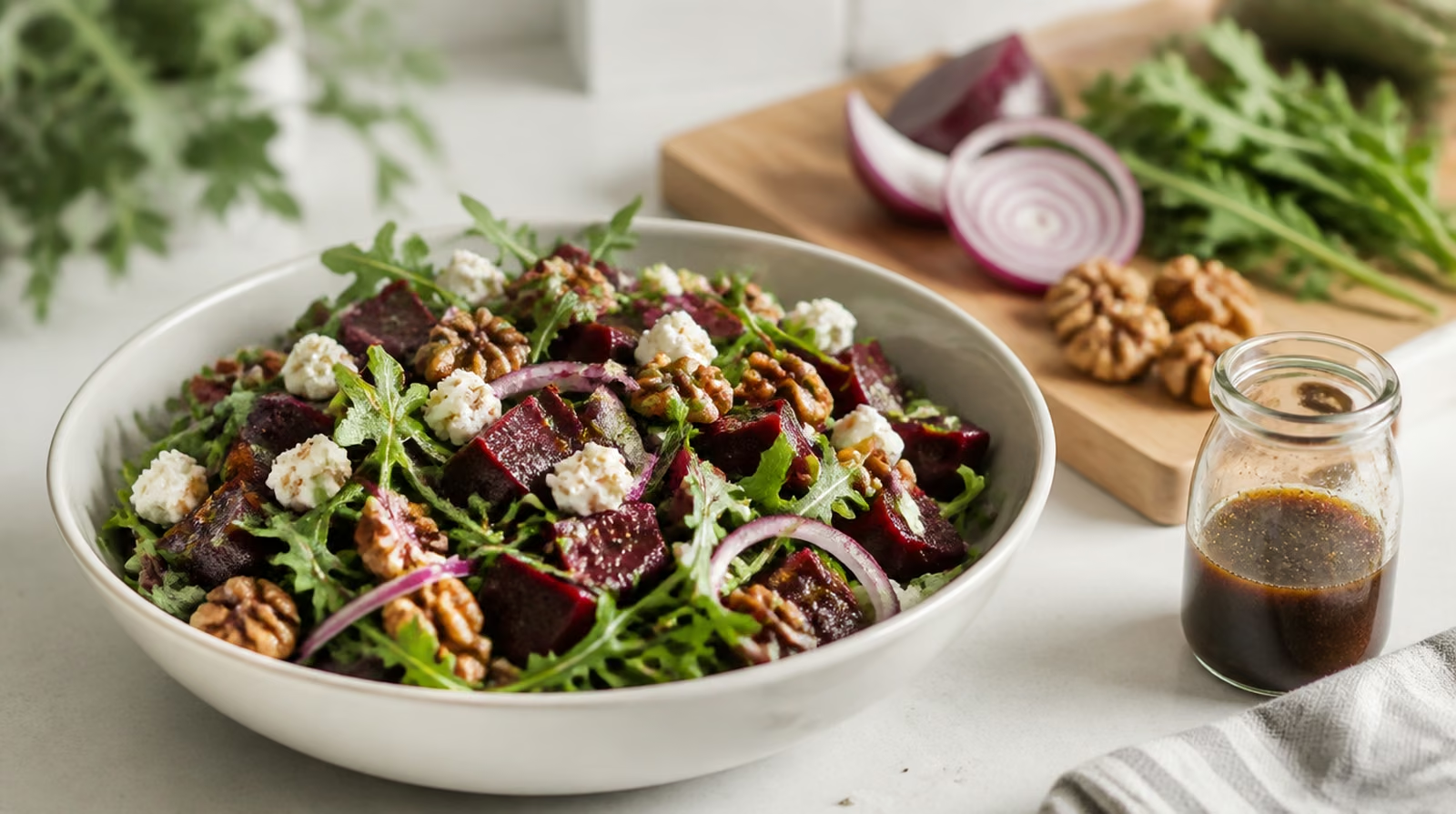
| Prepared salad with dressing | 1–2 days | keep feta separate |
| Beetroot leaves | 2–3 days | treat like spinach |
Removing the leaves is crucial for proper beetroot storage. As long as the greens remain attached to the root, they draw moisture out of it. Beetroot with leaves attached will turn soft within a week; without leaves, it keeps for a month.
And you should not throw the leaves away – they are edible, taste similar to Swiss chard, and contain even more nitrate than the bulb itself, alongside significantly higher amounts of vitamin K and calcium. Briefly tossed in olive oil, they make an excellent side dish in their own right.
Freezing beetroot
Freezing works well, but only when cooked. Raw beetroot turns watery and spongy upon defrosting because ice crystals destroy its cellular structure.
How to do it: Roast or steam the roots, peel, slice or dice, flash-freeze on a baking tray, and only then transfer into a freezer bag. Flash-freezing prevents the pieces from freezing together into a solid block. Keeps for eight to ten months.
Defrosted beetroot is softer than fresh – acceptable for salads, but not for a carpaccio.
The meal prep plan
What can be prepared in advance and what should not:
Prep on Sunday:
- Roast 5–6 beetroot bulbs and refrigerate unpeeled
- Mix dressing in a screw-top jar (keeps for 3–4 days)
- Toast nuts and store in an airtight container at room temperature
Assemble fresh daily:
- Salad leaves – won’t last an hour once dressed
- Crumble feta – otherwise it absorbs the beetroot colour
- Herbs
- Avocado, apple, and anything prone to oxidisation
The layered lunchbox: Dressing goes at the bottom, followed by beetroot, then firm ingredients, with salad leaves right at the top. Shake only just before eating. This keeps your greens crisp and dry until you are ready to eat.
Why the layering order also matters for colour is explained in our core guide.
The canapé variation
In the Netherlands, beetroot and feta are often served as small appetisers rather than a tossed salad – and this happens to be one of the most practical formats for meal prep.
For 12 canapés:
- 3 cooked beetroots, cut into 1 cm thick slices, stamped into neat rounds with a pastry cutter
- 100 g feta
- 12 walnut halves
- Honey
- Fresh thyme
- Coarsely ground black pepper
Top each slice with a piece of feta, a walnut half, a drizzle of honey, fresh thyme, and coarse black pepper. The beetroot slices can be cut two days in advance and kept in fridge storage; assemble just ten minutes before your guests arrive.
Nutritional values per canapé (estimated)
| Per piece | |
|---|---|
| Energy | approx. 55 kcal |
| Protein | approx. 2 g |
| Fat | approx. 4 g |
| Carbohydrates | approx. 3 g |
References
- Kurhaluk N, Kołodziejska R, Buyun L et al.: Dietary Nitrate-Rich Vegetables as Natural Modulators of Health: Mechanisms and Benefits in Ageing Populations. 2026. PubMed 42074104. DOI: 10.3390/ijms27083461.
- Pakravan N, Noori SMA, Salehcheh M et al.: Nitrate measurement and age-specific carcinogenic and non-carcinogenic risk assessment in commonly consumed vegetables from Khuzestan Province, Iran. 2026. PubMed 41741555. DOI: 10.1038/s41598-026-40722-0.
- Kono K, Yamaguchi J, Noda A et al.: Methemoglobinemia suspected of being caused by excessive intake of leafy vegetables due to an unbalanced diet: A case report. 2025. PubMed 41431084. DOI: 10.1097/md.0000000000046782.
- Luetic S, Knezovic Z, Jurcic K et al.: Nitrates and Nitrites in Leafy Vegetables: The Influence of Culinary Processing on Concentration Levels and Possible Impact on Health. 2025. PubMed 40243642. DOI: 10.3390/ijms26073018.
- Dodocioiu AM, Buzatu GD, Botu M. et al.: Nitrates and Nitrites in Vegetables and the Health Risk. 2025. PubMed 40941153. DOI: 10.3390/foods14173037.
- Kardol LR, Rhaman A, Kelty E et al.: Prenatal nitrate and nitrite intake in mammals: A scoping review of effects and associations with pregnancy and maternal and child health. International journal of hygiene and environmental health 2026. PubMed 41248583. DOI: 10.1016/j.ijheh.2025.114712.
- Almohaimeed SA, Al Juhaimi FY, Babiker EE et al.: Fermented Radish and Beetroot Powder as Natural Sources of Nitrite in Beef Burger. 2026. PubMed 42195854. DOI: 10.3390/foods15101651.
- Bondonno CP, Sundqvist ML, Shinde S et al.: A clinical study examining the effects of dietary nitrate on urinary N-nitrosamines. 2026. PubMed 41724486. DOI: 10.1016/j.ajcnut.2026.101239.
- Ho JW, Hobbs R, Brown N et al.: Retrospective cohort analysis of nitrite and nitrate levels in postmortem biological samples after suspected suicide, 2019-24. 2026. PubMed 42094646. DOI: 10.1136/bmjph-2025-004215.
- Wang Y, Chen X, Tong C et al.: Methemoglobinemia Induced by Food During Chemotherapy in a Boy With Acute Lymphoblastic Leukemia and Literature Review. Journal of pediatric hematology/oncology 2025. PubMed 40704648. DOI: 10.1097/MPH.0000000000003061.
- Jones AM, Vanhatalo A, Seals DR et al.: Dietary Nitrate and Nitric Oxide Metabolism: Mouth, Circulation, Skeletal Muscle, and Exercise Performance. Medicine and science in sports and exercise 2021. PubMed 32735111. DOI: 10.1249/MSS.0000000000002470.
- Ashworth A, Bescos R: Dietary nitrate and blood pressure: evolution of a new nutrient?. Nutrition research reviews 2017. PubMed 28511731. DOI: 10.1017/S0954422417000063.
- Bondonno CP, Croft KD, Hodgson JM et al.: Dietary Nitrate, Nitric Oxide, and Cardiovascular Health. Critical reviews in food science and nutrition 2016. PubMed 25976309. DOI: 10.1080/10408398.2013.811212.
- Cavaiuolo M, Ferrante A: Nitrates and glucosinolates as strong determinants of the nutritional quality in rocket leafy salads. Nutrients 2014. PubMed 24736897. DOI: 10.3390/nu6041519.
- Sindelar JJ, Milkowski AL: Human safety controversies surrounding nitrate and nitrite in the diet. Nitric oxide : biology and chemistry 2012. PubMed 22487433. DOI: 10.1016/j.niox.2012.03.011.
- Hord NG: Dietary nitrates, nitrites, and cardiovascular disease. Current atherosclerosis reports 2011. PubMed 21968645. DOI: 10.1007/s11883-011-0209-9.