Our heart beats around 100,000 times a day, pumping up to 10,000 litres of blood through an intricate network of blood vessels. This circulatory system supplies every single cell in our body with oxygen and vital nutrients—keeping us alive. But what exactly happens when the heart pumps blood through our body? And more importantly: how can we support our vascular health and even help rejuvenate our blood vessels?
Table of Contents
- Key Takeaways
- Fundamentals of the Circulatory System
- Anatomy of the Heart
- The Two Circulatory Loops
- The Blood Vessel System
- The Endothelium: Inner Lining of the Blood Vessels
- EPCs: Your Body’s Vascular Repair Team
- Lifestyle Factors for Vascular Health
- Nutrition to Improve Blood Circulation
- Frequently Asked Questions
- Scientific References
Key Takeaways
- Vital engine: The heart pumps approximately 10,000 litres of blood through the body every day and beats around 100,000 times—a tireless, life-sustaining motor.
- Two circulatory loops: The blood circulatory system comprises pulmonary circulation (deoxygenated blood to the lungs) and systemic circulation (oxygen-rich blood to all organs).
- Vascular network: Arteries carry oxygenated blood away from the heart, veins return deoxygenated blood back to the heart, and capillaries facilitate nutrient and gas exchange in the tissues.
- Endothelium as a protective barrier: The innermost cellular lining of the blood vessels (endothelium) prevents clotting and ensures smooth, unobstructed blood flow.
- Repair cells from bone marrow: Endothelial progenitor cells (EPCs) migrate from bone marrow into the bloodstream to repair damaged vessel walls.
- Higher EPC levels = greater longevity: Research indicates that higher circulating EPC counts correlate with a significantly reduced risk of cardiovascular death.
- Smoking is exceptionally harmful: Smoking just one cigarette a day increases cardiovascular risk tenfold—there is no safe level of smoking.
- Exercise doubles EPC counts: Three months of moderate aerobic exercise (such as brisk walking or jogging) doubled circulating EPCs in older adults.
- Reduce saturated fats: Cutting down on saturated fats (such as butter) significantly elevated EPC levels and improved overall vascular health.
- Plant-based power foods: Berries, onions, and green tea have been shown to boost circulating EPCs and enhance endothelial function.
How Does the Circulatory System Work?
The human circulatory system is a closed network comprising the heart and blood vessels that delivers life-sustaining substances to every cell in our body. Without this continuous blood flow, our cells would perish within minutes.
What is the human circulatory system?
The blood circulatory system is an intricate transport network that delivers oxygen, nutrients, hormones, and chemical messengers to cells whilst carrying away carbon dioxide and metabolic waste products. The system operates much like a road network: the heart serves as the central pumping station, the blood vessels act as the highways, and the blood itself is the transport vehicle.
Why does the heart pump blood through the body?
Our body requires an uninterrupted supply of oxygen and nutrients to function. At the same time, metabolic waste such as carbon dioxide must be promptly removed. Through its rhythmic contractions, the heart ensures that blood circulates continuously so this essential exchange can occur. With every single heartbeat, roughly 80 millilitres of blood are pumped into the circulation.
How much blood does the heart pump per day?
At an average resting heart rate of 70 beats per minute, the heart pumps around 5 to 6 litres of blood per minute through the body—a measure known as cardiac output. This equates to approximately 7,200 to 10,000 litres each day. During intense physical exertion, this volume can surge to as much as 25 litres per minute—a remarkable feat for an organ roughly the size of a clenched fist and weighing only around 300 grams.
Anatomy of the Heart
The heart is a hollow muscular organ divided into four chambers, operating as the central pump of the circulatory system. To understand how blood moves through the body, we must first examine the heart’s internal structure.
What are the 4 heart chambers and their functions?
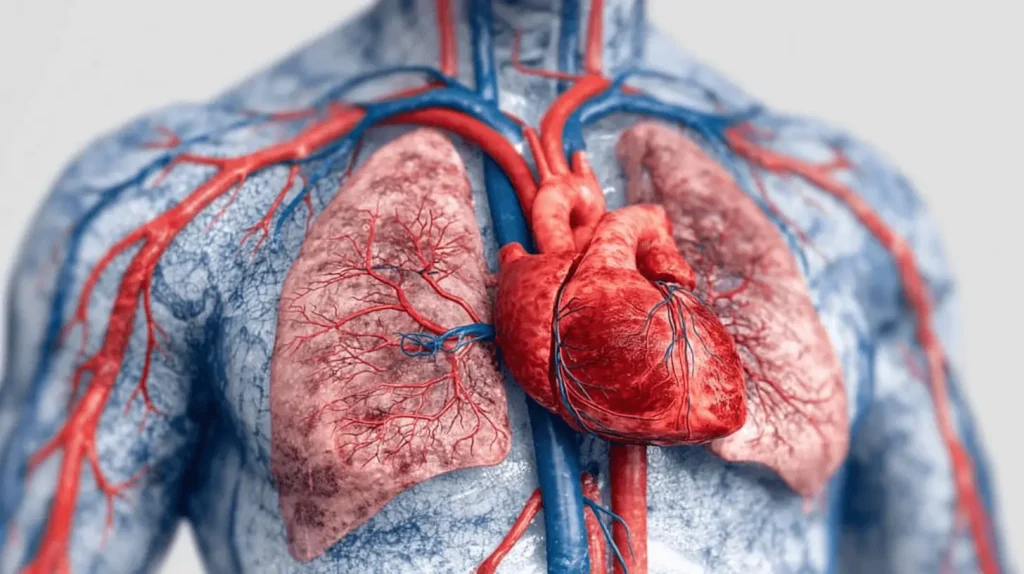
The heart consists of four chambers: the right atrium, the right ventricle, the left atrium, and the left ventricle. The right atrium collects deoxygenated blood returning from the body and directs it into the right ventricle, which pumps it towards the lungs. The left atrium receives oxygen-rich blood from the lungs and delivers it into the left ventricle; with powerful contractions, the muscular heart ventricles pump this oxygenated blood throughout the entire body.
What role do heart valves play in blood flow?
The four heart valves act as one-way gates that prevent blood from flowing backwards. They open and close passively in response to changes in blood pressure: when a chamber contracts, the corresponding valve opens, allowing blood to surge through. As the chamber relaxes, the valve closes tightly to stop backflow. This finely coordinated mechanism guarantees an efficient, unidirectional flow of blood.
Blood flow through the heart step by step
The journey of blood through the heart follows a precise sequence: deoxygenated blood from the body enters the right atrium via the superior and inferior vena cava. From there, it passes into the right ventricle and is pumped through the pulmonary artery to the lungs. Inside the lungs, carbon dioxide is released and fresh oxygen is absorbed. This freshly oxygenated blood returns via the pulmonary veins into the left atrium, moves into the left ventricle, and is finally propelled through the aorta into systemic circulation across the entire body.
How does the heart receive its own blood supply?
The heart muscle itself requires a continuous supply of oxygen to sustain its relentless pumping action. This is provided by the coronary arteries, which branch directly off the aorta to supply the myocardium with oxygenated blood. Although the heart constantly handles large volumes of blood, it cannot absorb oxygen directly from its chambers—it relies entirely on its dedicated coronary network.
The Two Circulatory Loops
The human circulatory system operates via two interconnected loops working in tandem: pulmonary circulation (the lesser circulation) and systemic circulation (the greater circulation). Together, they form a seamless, closed continuous circuit.
How does pulmonary circulation work?
Pulmonary circulation begins in the right ventricle of the heart. From here, deoxygenated, carbon dioxide-rich blood is pumped through the pulmonary artery into both lungs. Within the microscopic alveoli, gas exchange takes place: carbon dioxide is expelled through exhalation, whilst fresh oxygen from inhaled air diffuses into the bloodstream. This oxygen-rich blood then travels through the pulmonary veins back to the left atrium of the heart. The term “lesser circulation” refers solely to the shorter physical distance—not to the vital importance of this oxygenation pathway.
How does systemic circulation work?
Systemic circulation begins in the left ventricle, which pumps oxygenated blood under high pressure directly into the aorta. From the aorta, the vascular tree branches out: large arteries divide into smaller arterioles until the blood flows into microscopic capillaries reaching every organ and tissue. This is where nutrient and gas exchange occurs: oxygen and nutrients pass into the surrounding cells, whilst carbon dioxide and metabolic waste products are collected. The now deoxygenated blood collects in venules and veins, returning via the superior and inferior vena cava to the right atrium.
How fast does blood travel through the body?
The velocity of blood flow varies considerably depending on the vessel type. In the aorta, blood rushes at around 40 centimetres per second, slowing to 10 to 20 centimetres per second in large arteries. In the capillaries, flow slows down dramatically to approximately 0.05 centimetres per second—a deliberate deceleration that allows sufficient time for oxygenation and nutrient exchange. On average, an individual red blood cell completes a full circuit through the entire body in roughly 60 seconds.
The Blood Vessel System
Blood vessels form an extensive branching network spanning the entire human body. They are categorised into three primary types: arteries, veins, and capillaries.
What is the difference between arteries and veins?
Arteries and veins serve opposing functions within the vascular network. Arteries transport blood away from the heart towards the organs and tissues. They possess thick, muscular, elastic walls designed to withstand the high blood pressure generated by cardiac contractions. With the exception of the pulmonary artery, arteries carry oxygen-rich blood. In contrast, veins return blood back to the heart. Their walls are thinner because blood pressure is markedly lower in the venous system. Veins feature one-way valves that prevent blood from pooling or flowing backwards due to gravity. With the exception of the pulmonary veins, veins carry deoxygenated blood.
What are capillaries and what is their function?
Capillaries are the smallest blood vessels in the human body—so narrow that red blood cells must pass through in single file. They form a dense mesh between arterioles and venules, serving as the primary site of biological exchange. Their ultra-thin walls (just one endothelial cell layer thick) allow the seamless diffusion of oxygen, nutrients, carbon dioxide, and metabolic waste between the blood and surrounding tissues. An adult body contains an estimated 40 billion capillaries, providing a total surface area of roughly 1,000 square metres.
Which organs receive the most blood?
Blood distribution throughout the body is strictly regulated according to the metabolic demands of each organ. The kidneys receive the largest share, accounting for roughly 20 to 25 per cent of total cardiac output—despite making up only about 0.5 per cent of body weight. The brain receives around 13 per cent, the liver receives 25 per cent (including 20 per cent via the hepatic portal vein carrying nutrient-dense blood from the digestive tract), skeletal muscles receive around 15 per cent at rest (rising to up to 80 per cent during strenuous physical exertion), and the heart muscle itself consumes approximately 5 per cent.
The Endothelium: Inner Lining of the Blood Vessels
The innermost cellular lining of all blood vessels is known as the endothelium—a delicate yet vital single layer of cells that produces nitric oxide and maintains smooth, laminar blood flow.
Why is oxygen in the blood so vital?
Oxygen serves as the essential fuel for human cells. Inside the mitochondria—the cellular power plants—oxygen is utilised during cellular respiration to convert nutrients into adenosine triphosphate (ATP), the primary energy currency of life. Without a steady supply of oxygen, cells cannot generate energy and rapidly deteriorate. Neurons are especially vulnerable: brain cells begin to suffer irreversible damage after just 3 to 5 minutes without oxygen, making rapid intervention critical during cardiac arrest.
How does oxygen enter the bloodstream?
Oxygen enters the body through the respiratory system. When we inhale, oxygen-rich air fills the pulmonary alveoli. The alveolar and capillary walls are so thin that oxygen diffuses directly into the bloodstream of the surrounding capillaries. Once inside the blood, oxygen binds to haemoglobin within red blood cells (erythrocytes) to be carried across the body. A single haemoglobin molecule can bind up to four molecules of oxygen.
What happens to carbon dioxide in the circulatory system?
Carbon dioxide (CO₂) is produced as a metabolic by-product of cellular respiration in all tissues. It diffuses out of cells into the bloodstream, where it is transported in three ways: approximately 70 per cent is converted and carried as bicarbonate ions (HCO₃⁻) dissolved in blood plasma, 20 per cent binds directly to haemoglobin (forming carbaminohaemoglobin), and 10 per cent remains directly dissolved in plasma. Upon reaching the lungs, carbon dioxide diffuses across the alveolar barrier into the respiratory tract and is exhaled. This continuous elimination of CO₂ is just as vital to survival as the delivery of oxygen.
EPCs: The Repair Team of Your Circulatory System
Endothelial progenitor cells (EPCs) are specialised stem cells that migrate from the bone marrow into the bloodstream to repair damaged sections of the blood vessel wall – a remarkable repair mechanism within the circulatory system.
How can you improve blood circulation?
The ability of our blood vessels to heal themselves depends on endothelial progenitor cells. These stem cells originate in the bone marrow and travel through the blood, where they locate and repair damage in the endothelium. Research demonstrates that higher EPC counts correlate with a significantly reduced risk of dying from cardiovascular disease. A randomised, placebo-controlled study in patients with severe peripheral vascular disease showed remarkable findings: bone marrow injections doubled pain-free walking time and prevented amputations entirely – whilst 14 per cent of the control group lost a leg.
However, there are also natural ways to increase EPC levels without medical intervention. The most critical lifestyle factors are stopping smoking, engaging in regular physical activity, and eating a wholesome diet.
What is a normal blood pressure reading?
Blood pressure is recorded as two measurements: systolic pressure (the higher number) is generated when the heart contracts and pumps blood into the arteries. Diastolic pressure (the lower number) measures the pressure in the arteries when the heart rests between beats. An optimal blood pressure reading is considered to be below 120/80 mmHg. Values between 120/80 and 139/89 mmHg are classified as high-normal, whilst 140/90 mmHg or above indicates high blood pressure (hypertension). Maintaining healthy blood pressure is essential for vascular health – chronically elevated pressure damages the endothelium and accelerates atherosclerosis.
What is cardiac output?
Cardiac output (CO) refers to the volume of blood the heart pumps through the blood circulatory system each minute. It is calculated by multiplying stroke volume (the amount of blood pumped per heartbeat) by heart rate (beats per minute). In a resting adult, cardiac output is approximately 5 to 6 litres per minute. During physical exertion, it can increase to as much as 25 litres per minute. Trained athletes often have a lower resting pulse alongside a higher stroke volume – their heart ventricles and cardiac muscle work far more efficiently.
Lifestyle Factors for a Healthy Circulatory System
The encouraging news is that we can take active measures to support our vascular health. Three factors exert the greatest influence on the quantity and function of endothelial progenitor cells.
Stopping smoking – the most crucial step: Smoking is one of the most damaging threats to our arteries and veins. A meta-analysis of 141 cohort studies revealed that smoking just a single cigarette a day increases cardiovascular risk by ten times the expected level. There is no safe threshold for smoking. Even passive smoking significantly reduces circulating EPC counts. The single most important lifestyle change for your vascular health is therefore straightforward: stop smoking completely – and avoid second-hand smoke.
Physical exercise doubles EPCs: Randomised controlled trials clearly show that aerobic exercise boosts endothelial progenitor cells in the blood. In a study of middle-aged and older men, three months of moderate aerobic training – predominantly walking, with some jogging – led to a doubling of EPCs in the bloodstream. Regular aerobic exercise is consequently regarded as a “first-line strategy” for the prevention and management of vascular ageing. You do not need to run marathons: just 30 minutes of brisk walking per day delivers measurable benefits.
Cutting down on saturated fat: A randomised controlled trial demonstrated that reducing saturated fat – primarily by eliminating butter – significantly increased EPC counts. A study in primates showed that just a few weeks on a diet high in cholesterol and fat resulted in dramatic, premature endothelial cell ageing. The biological mechanism is straightforward: saturated fats promote inflammation and oxidative stress, which damages fragile endothelial cells and restricts their capacity for repair.
Diet and Nutrition to Improve Blood Circulation
Beyond reducing saturated fats, specific foods actively enhance vascular health and stimulate EPC production.
Which foods help improve blood circulation?
Scientific studies have identified three food groups proven to increase circulating endothelial progenitor cells:
Berries: A randomised controlled trial revealed that black raspberry extract increased circulating EPCs and improved arterial stiffness in patients with metabolic syndrome. Berries contain high concentrations of anthocyanins – plant compounds with potent antioxidant and anti-inflammatory properties. These phytonutrients protect the endothelium from damage and support the formation of new capillaries and blood vessels.
Onions: In a study involving overweight individuals, onion skin extract enhanced endothelial function and increased EPC counts. Onions are rich in quercetin, a flavonoid with strong vascular-protective qualities. Interestingly, the highest concentration of bioactive compounds is located in the outer layers – an excellent reason to cook onions with their skins on (the skin can be discarded before eating).
Green tea: In chronic smokers, consuming green tea improved endothelial function and raised circulating EPC levels. The catechins in green tea, particularly EGCG (epigallocatechin gallate), exert powerful antioxidant effects and promote the production of nitric oxide within the endothelium – a vital signalling molecule that relaxes blood vessels and enhances blood flow.
Whole-food plant-based nutrition: Research showed that an eating pattern based entirely on whole plant foods not only increased EPCs, but also improved endothelial function and lowered LDL cholesterol. This portfolio diet combined various heart-protective foods: wholemeal grains, pulses, nuts, fruit, vegetables, and flaxseeds. The synergistic effect of these foods appears far greater than the sum of their individual parts.
The takeaway is clear: unrefined, plant-based foods support the circulatory system and its internal repair mechanisms at a cellular level. They provide not only essential nutrients, but also bioactive substances that safeguard the endothelium, curb inflammation, and stimulate the release of new EPCs.
Frequently Asked Questions
How long does a complete circuit of the circulatory system take?
A single red blood cell takes roughly 60 seconds to complete a full circuit through the body – travelling from the heart to the lungs for oxygenation, returning to the heart, flowing through the systemic circulation to the rest of the body, and returning once again. During physical exercise, this circulatory process speeds up substantially.
Can you feel your blood circulatory system?
Yes, you can feel your pulse – the rhythmic expansion of the arteries with every heartbeat. The pulse is easiest to detect at the wrist (radial artery) or neck (carotid artery). Your pulse rate matches your heart rate precisely.
What causes the most harm to the circulatory system?
Smoking is the single most detrimental factor for vascular health, followed by physical inactivity, saturated fats, chronic stress, and high blood pressure. These factors damage the endothelium, lower EPC counts, and drive atherosclerosis.
How can I keep my circulatory system healthy as I age?
The most effective steps are: avoiding smoking, engaging in daily moderate exercise (at least 30 minutes of walking), eating a whole-food plant-based diet rich in vegetables, fruit, and wholemeal grains, reducing saturated fats, maintaining a healthy body weight, and managing stress. These lifestyle habits are proven to raise endothelial progenitor cells and maintain youthful blood vessels.
Why is the endothelium so important?
The endothelium is the delicate inner lining of all blood vessels, ensuring smooth, unobstructed blood flow. It generates nitric oxide to relax the vessels, helps prevent blood clots, and regulates inflammation. A healthy endothelium is central to vascular health and a strong heart.
Can blood vessels regenerate?
Yes, thanks to endothelial progenitor cells from the bone marrow, blood vessels can regenerate. These stem cells migrate to areas of vascular damage to repair the endothelium. By adopting positive lifestyle measures, you can increase both the number and activity of these cellular repairers.
What are the symptoms of poor blood circulation?
Common warning signs include cold hands and feet, pins and needles or tingling in the arms or legs, pain when walking (intermittent claudication), dizziness, poor concentration, slow wound healing, and erectile dysfunction. If you notice these symptoms, you should consult a GP.
How long after quitting smoking does blood circulation improve?
Blood pressure begins to decrease just 20 minutes after your final cigarette. Within 2 to 12 weeks, circulation improves measurably and EPC levels start to recover. After 1 to 2 years, the risk of having a heart attack drops by approximately 50 per cent. The body starts repairing itself immediately – it is never too late to quit.
Does aspirin help the circulatory system?
Aspirin reduces blood clotting and may be recommended for certain patients at high cardiovascular risk. However, taking aspirin should always be discussed with a doctor or pharmacist, as it carries side effects (including an increased risk of bleeding). Lifestyle improvements should always remain the first-line approach.
How can I get my EPC levels tested?
EPCs can be measured in blood samples using flow cytometry. However, this test is not routinely available on the NHS and is typically carried out only in specialised clinical research laboratories. In everyday life, implementing lifestyle measures is far more practical than testing – scientific evidence clearly demonstrates which daily habits support EPC production.
Scientific Sources
- Möbius-Winkler S, Linke A, Adams V, Schuler G, Erbs S. How to improve endothelial repair mechanisms: the lifestyle approach. Expert Review of Cardiovascular Therapy. 2010;8(4):573-580.
- Wang M, Monticone RE, McGraw KR. Proinflammation, profibrosis, and arterial aging. Aging Medicine. 2020;3(3):159-168.
- Hackshaw A, Morris JK, Boniface S, Tang JL, Milenković D. Low cigarette consumption and risk of coronary heart disease and stroke: meta-analysis of 141 cohort studies in 55 study reports. BMJ. 2018;360:j5855.
- Sharma S, Pandey NN, Sinha M, et al. Randomized, double-blind, placebo-controlled trial to evaluate safety and therapeutic efficacy of angiogenesis induced by intraarterial autologous bone marrow-derived stem cells in patients with severe peripheral arterial disease. Journal of Vascular and Interventional Radiology. 2021;32(2):157-163.
- Tateishi-Yuyama E, Matsubara H, Murohara T, et al. Therapeutic angiogenesis for patients with limb ischaemia by autologous transplantation of bone-marrow cells: a pilot study and a randomised controlled trial. The Lancet. 2002;360(9331):427-435.
- Altabas V, Altabas K, Kirigin L. Endothelial progenitor cells (Epcs) in ageing and age-related diseases: How currently available treatment modalities affect EPC biology, atherosclerosis, and cardiovascular outcomes. Mechanisms of Ageing and Development. 2016;159:49-62.
- Jeong HS, Kim S, Hong SJ, et al. Black raspberry extract increased circulating endothelial progenitor cells and improved arterial stiffness in patients with metabolic syndrome: a randomized controlled trial. Journal of Medicinal Food. 2016;19(4):346-352.
- Cavalcante SL, Lopes S, Bohn L, et al. Effects of exercise on endothelial progenitor cells in patients with cardiovascular disease: A systematic review and meta-analysis of randomized controlled trials. Revista Portuguesa de Cardiologia. 2019;38(11):817-827.
- Ichim TE, Zhong Z, Mikirova NA, et al. Circulating endothelial progenitor cells and erectile dysfunction: possibility of nutritional intervention? Panminerva Medica. 2010;52(2 Suppl 1):75-80.
- Kim W, Jeong MH, Cho SH, et al. Effect of green tea consumption on endothelial function and circulating endothelial progenitor cells in chronic smokers. Circulation Journal. 2006;70(8):1052-1057.
- Choi EY, Lee H, Woo JS, et al. Effect of onion peel extract on endothelial function and endothelial progenitor cells in overweight and obese individuals. Nutrition. 2015;31(9):1131-1135.
- Hoetzer GL, Van Guilder GP, Irmiger HM, Keith RS, Stauffer BL, DeSouza CA. Aging, exercise, and endothelial progenitor cell clonogenic and migratory capacity in men. Journal of Applied Physiology. 2007;102(3):847-852.
- Keith M, Kuliszewski MA, Liao C, et al. A modified portfolio diet complements medical management to reduce cardiovascular risk factors in diabetic patients with coronary artery disease. Clinical Nutrition. 2015;34(3):541-548.
- Gao W, Chen D, Liu G, Ran X. Autologous stem cell therapy for peripheral arterial disease: a systematic review and meta-analysis of randomized controlled trials. Stem Cell Research & Therapy. 2019;10(1):140.
- Werner N, Kosiol S, Schiegl T, et al. Circulating endothelial progenitor cells and cardiovascular outcomes. New England Journal of Medicine. 2005;353(10):999-1007.
- Weech M, Altowaijri H, Mayneris-Perxachs J, et al. Replacement of dietary saturated fat with unsaturated fats increases numbers of circulating endothelial progenitor cells and decreases numbers of microparticles. American Journal of Clinical Nutrition. 2018;107(6):876-882.
- Shi Q, Hubbard GB, Kushwaha RS, et al. Endothelial senescence after high-cholesterol, high-fat diet challenge in baboons. American Journal of Physiology – Heart and Circulatory Physiology. 2007;292(6):H2913-2920.