
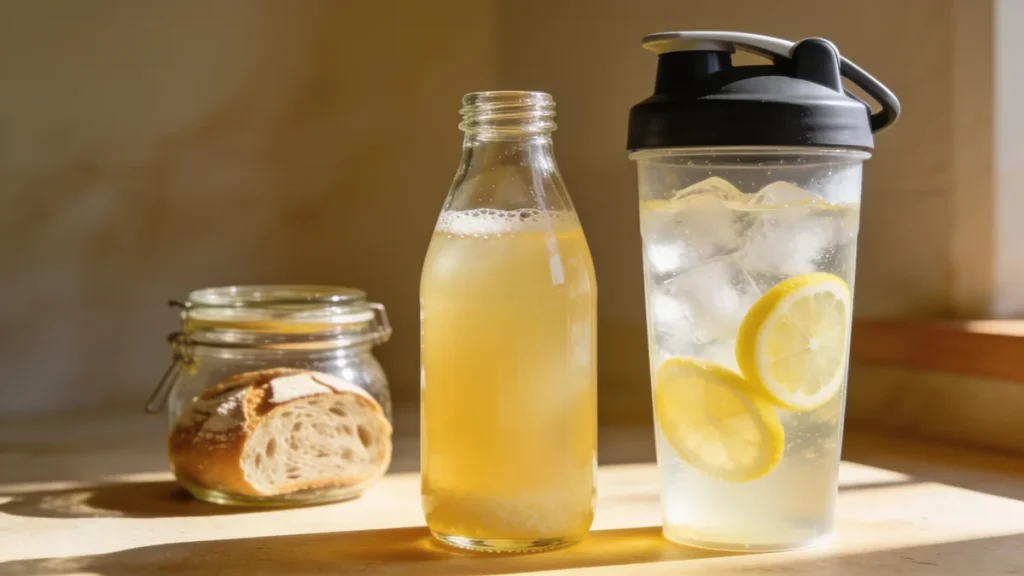
Anyone who makes their own milk kefir at home or is used to straining milk kefir for cheese will be familiar with the translucent, yellowish-green liquid that collects at the bottom of the jar or bowl: kefir whey (cherished across Portugal and Brazil as soro de kefir).
Unfortunately, many beginners pour this valuable liquid straight down the sink—a dreadful mistake! Far from being a waste product, this cultured liquid is a highly concentrated, bioactive elixir brimming with fast-absorbing whey protein, organic acids, bioavailable minerals, and live probiotics.
In this comprehensive guide, you will discover the health benefits of this ferment, why athletes and gut microbiome specialists swear by it, and exactly what to do with kefir whey—from refreshing electrolyte drinks and crusty bread to lacto-fermentation and natural beauty treatments.
1. What is Kefir Whey (Soro de Kefir)? The Underrated Superfood
Whey is produced naturally during the fermentation of milk kefir: as soon as the lactic acid bacteria lower the pH of the milk below 4.6, the casein proteins curdle and separate from the watery liquid—producing acid whey.
Unlike sweet cheesemaking whey, genuine fermented whey is rich in live micro-organisms, bioavailable L(+)-lactic acid, B-complex vitamins, and bioactive peptides.
2. Nutrient Profile & Kefir Whey Benefits: Why You Should Never Pour It Away
| Nutrient (per 100 ml) | Content in Fresh Whey | Function in the Body |
|---|---|---|
| Calories | Only approx. 20–25 kcal | Virtually fat-free, ideal for weight management |
| Whey protein | Approx. 0.9–1.2 g | Highest biological value (rich in BCAAs) |
| L(+)-lactic acid | Approx. 0.8–1.5 g | Lowers pH in the large intestine |
| Calcium & Magnesium | Approx. 60 mg / 12 mg | Maximum bioavailability via organic acid binding |
| Potassium & Sodium | Approx. 140 mg / 45 mg | Ideal isotonic electrolyte balance |
| Vitamins B2, B6, B12 | Highly concentrated | Supports energy metabolism & nervous system |
3. Impact on Muscles, Electrolyte Balance & the Gut Lining
- Rapid muscle recovery: The native whey protein delivers essential BCAAs to repair microscopic tears in muscle fibres.
- Optimal electrolyte replenishment: The natural balance of potassium, magnesium, and calcium acts as an effective post-workout hydration drink.
- Protection for the gut lining: Lactic acid suppresses putrefactive bacteria and supplies colonocytes with direct cellular fuel.
- Uric acid reduction: Alkaline minerals help support healthy kidney function.
4. Natural Isotonic Sports Drink: Whey with Lemon & Sea Salt
Forget artificial, brightly coloured supermarket sports drinks. This homemade isotonic electrolyte drink provides pure, natural hydration:
Ingredients for 500 ml:
- 300 ml fresh, chilled whey
- 200 ml still water or coconut water
- Juice of half a lemon
- 1 tsp raw honey
- 1 tiny pinch of unrefined sea salt
Shake everything together thoroughly and enjoy ice-cold during or after training—it helps prevent cramp and quenches thirst immediately!
5. Probiotic Passion Fruit & Citrus Refresher (Kefir Whey Soda Recipe)
Mix 200 ml whey with 100 ml fresh orange juice, the pulp of 1 passion fruit, and 1 tsp honey in a shaker. It makes a wonderfully zesty, tropical probiotic liquid—entirely free from artificial flavourings!
6. Kefir Whey Uses in Baking: Crusty Bread & Fluffy Pancakes Without Yeast
- Sourdough alternative in bread: Substitute water 1:1 with whey in your bread dough for a crisp crust and a crumb that stays moist for days.
- Pancakes with bicarbonate of soda: Whisk 150 g flour + 1 tsp bicarbonate of soda + 200 ml whey; the natural acidity activates the bicarb instantly, creating remarkably light, fluffy pancakes without yeast.
7. Lacto-Fermentation: Fermenting Vegetables with a Whey Starter
When preparing lacto-fermented sauerkraut, carrots, or cucumbers, simply add **2 to 3 tablespoons of whey** to your fermentation jar. The active cultures help protect against mould and noticeably accelerate fermentation time.
8. Natural Beauty Elixir: Facial Toner & Hair Rinse
- Clarifying facial toner: Apply pure whey onto a reusable cotton pad. The gentle lactic acid exfoliates dead cells and balances the skin’s acid mantle on blemish-prone complexions.
- Shine-enhancing hair rinse: Blend 100 ml whey with 200 ml water and pour over your hair after washing for natural silkiness and shine.
9. How Much Whey Can You Drink Daily?
- Starting out: 100 to 150 ml daily, taken on an empty stomach in the morning.
- Optimal intake: 200 to 400 ml daily for sustained gut support and electrolyte intake.
10. Shelf Life, Freezing & Storing Cultured Whey
- Fridge: Keeps well in clean glass bottles for **2 to 3 weeks**.
- Freezer: Freeze in ice-cube trays to pop conveniently into morning smoothies and baking doughs.
11. Frequently Asked Questions (FAQ)
Does cultured whey still contain lactose?
Very little—the vast majority is converted into lactic acid during fermentation. In standard portions of 100–200 ml, it is generally well tolerated even by sensitive individuals.
12. Summary: Making the Most of Liquid Gold from Fermentation
Cultured whey (soro) is far too valuable to waste down the drain! It serves as a natural isotonic drink, an outstanding baking booster for moist loaves, a reliable starter culture for homemade pickles, and an effective natural cosmetic tonic.
Save the liquid in a clean glass bottle next time you strain your kefir, mix up a lemon isotonic drink, and make the most of this refreshing liquid gold!