
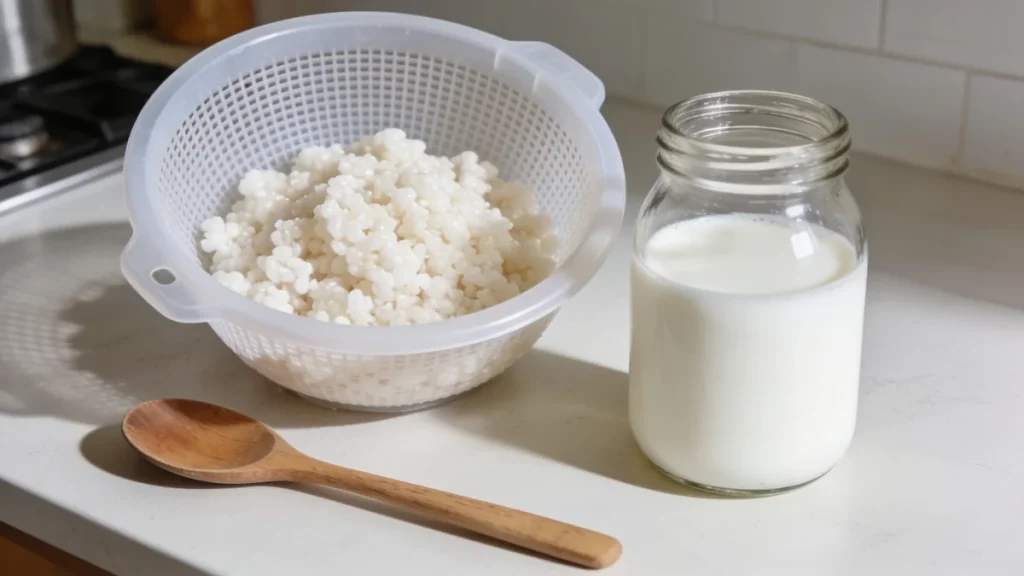
Kefir grains (the traditional milk kefir grains or Tibicos in the case of water kefir) are a living marvel of nature: a symbiotic community of over 30 distinct lactic acid bacteria and wild yeasts, embedded within a matrix of kefiran polysaccharide. With proper care, these grains can thrive for decades.
Yet in daily life, subtle milk kefir making mistakes can easily creep in: suddenly your kefir develops a sharp, vinegary smell, separates too rapidly into thick curds, tastes unpleasantly yeasty, or the kefir grains simply stop growing.
In this comprehensive practical guide, you will discover the 10 most common kefir making mistakes, how to avoid them, reviving sluggish grains when they lose vitality, and holiday grain storage methods to keep your culture safe whilst you are away.
1. Why fermentation errors and kefir making mistakes destroy valuable probiotics
Kefir grains are complex colonies of living micro-organisms. If their environment changes (ambient temperature, nutrient supply, or hygiene), the delicate balance between lactic acid bacteria and beneficial wild yeasts is disrupted. The result is excessive acidity and a diminished probiotic value.
2. Mistake 1: Using metal utensils and strainers (Myth vs reality)
- Reassurance on stainless steel: High-grade stainless steel (18/10) does not harm the grains at all during brief metal utensil contact.
- Danger of reactive metals: Aluminium, copper, or tarnished metals react with the acidity and leach harmful ions into the liquid.
- Recommendation: Use strainers and spoons made from food-grade plastic, wood, silicone, or stainless steel.
3. Mistake 2: Rinsing kefir grains with tap water
Tap water frequently contains chlorine and mineral deposits that degrade the protective kefiran polysaccharide layer. In reality, grains do not need washing at all! If genuinely necessary, simply rinse them every 4–6 weeks in a little fresh organic milk.
4. Mistake 3: Choosing the wrong milk (how to make kefir thick like yogurt)
Ultra-heat treated (UHT) milk stunts grain growth and prevents a rich, creamy consistency. If you want to know how to make kefir thick like yogurt, the gold standard is fresh organic whole milk (at least 3.8% fat) or unpasteurised/hay milk.
5. Mistake 4: Incorrect fermentation temperature
- Below 18 °C: Bacteria become sluggish, leading to an overly yeasty flavour profile.
- Above 28 °C: Bacteria acidify the milk too quickly, triggering premature whey separation.
- Ideal fermentation temperature: 20 °C to 24 °C in a spot away from direct sunlight.
6. Mistake 5: Over-fermentation & whey separation (is over fermented kefir still good for you?)
Optimal probiotic potency is reached after 24 to 36 hours. If you leave the brew standing for days, over-fermentation occurs as the bacteria exhaust their food supply in the acidic environment. While many wonder if over fermented kefir is still good for you (it remains safe to consume, albeit very sour and split), it is best practice to harvest your kefir every 24 hours!
7. Mistake 6: Airtight sealing during primary fermentation
Milk kefir grains require a small amount of oxygen during initial fermentation. Avoid sealing the jar airtight; instead, cover the top with a clean cloth or unbleached coffee filter secured with an elastic band.
8. Mistake 7: Poor timing when drinking kefir
- First thing in the morning on an empty stomach: Ideal for rapid transit to the gut.
- In the evening: Natural tryptophan and calcium help promote restful sleep.
- Getting started: Begin with 100 ml daily to allow your digestive system to adapt gently.
9. Reviving sluggish grains and restoring weakened cultures (The milk-bath reset)
- Strain the grains gently.
- Submerge them in 200 ml of fresh organic whole milk.
- Leave for 24 hours, then strain and discard the milk.
- Repeat this process for 3 consecutive days — this reset will have your sluggish grains thriving again!
10. Holiday grain storage: How to store & freeze kefir grains
- For holiday grain storage up to 3 weeks: Store in 500 ml of fresh milk in a tightly sealed container in the fridge (4–6 °C).
- Up to 6 months: Freeze the grains in a small, airtight tub at -18 °C.
11. Frequently asked questions on grain care & troubleshooting (FAQ)
How to tell if kefir is bad: Is the yellow liquid at the bottom mould?
Not at all! That is simply probiotic kefir whey separating out, which is a natural sign that fermentation is complete.
12. Conclusion: Avoiding kefir making mistakes for lifelong healthy grains
Kefir grains are remarkably resilient. Provided you avoid reactive metal utensil contact, refrain from washing them under tap water, and feed them fresh organic whole milk at 20–24 °C, they will reward you with an endless supply of nutrient-dense probiotics.
Put these tips into practice with your next batch, steer clear of these common kefir making mistakes, and keep your grains thriving for years to come!