
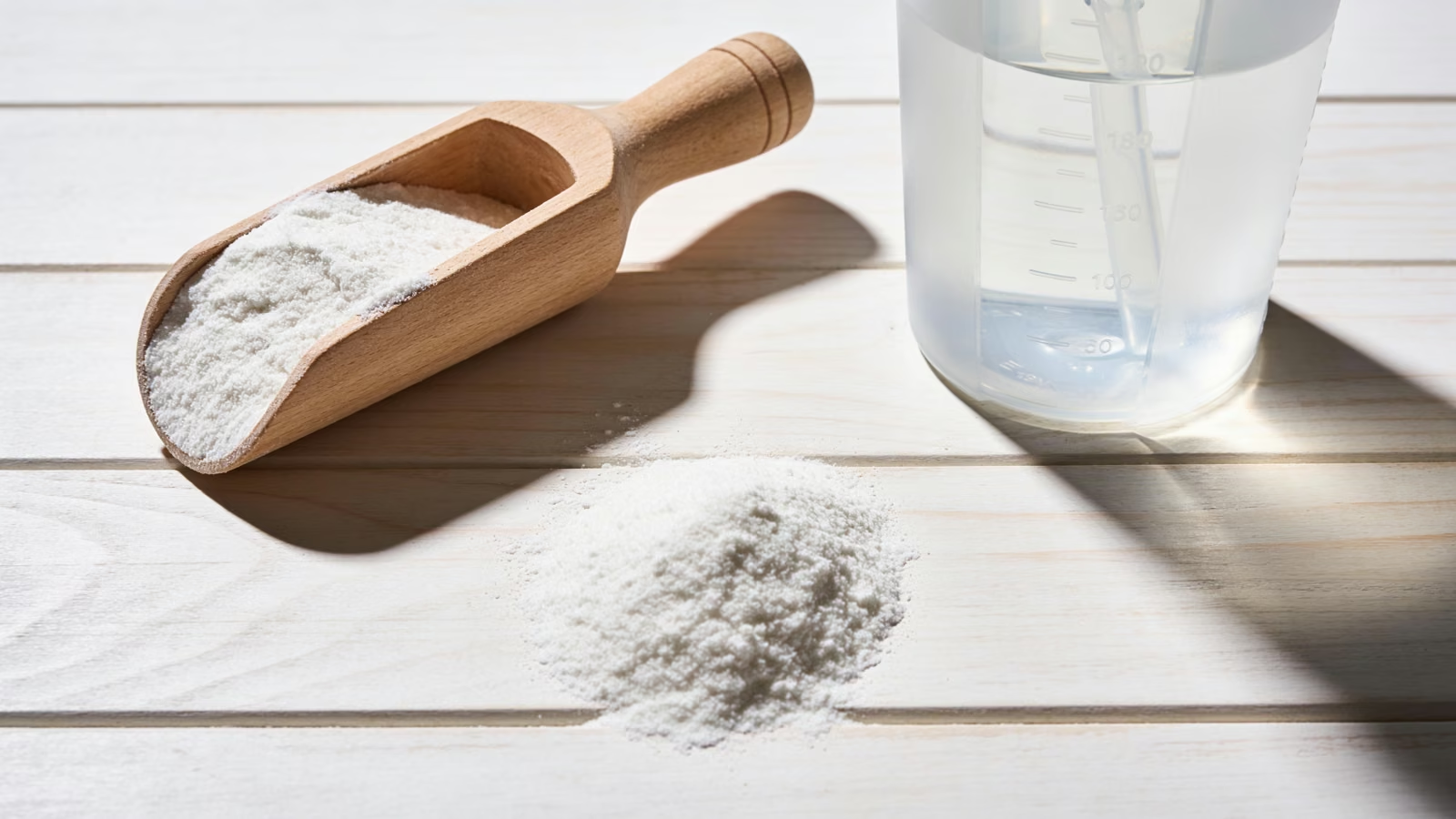
Creatine is one of the most popular and thoroughly researched dietary supplements in the world—best known for its established role in resistance training. In recent years, however, scientific interest in creatine benefits has expanded towards a completely different organ: the brain. Here is an overview of what creatine does in the human body, how it can influence mental performance, and what to consider when taking it.
Key Takeaways
- Creatine is a naturally occurring molecule that serves as a rapid energy buffer in muscle tissue and the brain.
- It assists with atp resynthesis, helping rebuild cellular energy currency—an essential process given the immense amount of ATP our bodies recycle each day.
- Clinical trials demonstrate positive effects not only on physical endurance, but also on cognitive function, processing speed, and memory performance.
- It is of particular interest during ageing, as endogenous synthesis steadily declines over time.
- Creatine monohydrate remains the gold-standard recommendation; high purity and tested raw ingredients should always be prioritised.
Creatine: What Does It Do and Why Does the Body Need It?
Creatine is an organic compound that our bodies synthesise endogenously—producing roughly 1 to 2 grams per day in the liver, kidneys, and pancreas from the amino acids arginine, glycine, and methionine. In addition, we obtain creatine through our diet, predominantly from meat and fish. Anyone consuming an exclusively plant-based or vegan diet takes in substantially lower amounts.
In total, an adult body stores around 120 to 140 grams of creatine, with roughly 95 percent held as muscle phosphocreatine. Crucially, natural synthesis gradually declines with advancing age—which is precisely when targeted supplementation can become especially valuable.
How Creatine Powers Cellular Energy
Whenever our cells require immediate fuel, ATP (adenosine triphosphate) is mobilised. When ATP cleaves off a phosphate group, it transforms into ADP (adenosine diphosphate)—releasing usable cellular energy. ADP is essentially a depleted battery. This is where creatine intervenes: stored as phosphocreatine, it donates a phosphate group to rapidly regenerate ADP back into ATP, the universal energy currency.
The scale of this daily turnover is extraordinary: the body can assemble and break down up to 40 kilograms of ATP every single day. Creatine ensures this cellular energy remains instantly accessible, particularly during short, high-intensity bouts of exertion.
Creatine Benefits on Brain Function: The Overlooked Effect
It is less widely appreciated that creatine is concentrated not only in skeletal muscle, but also in substantial quantities throughout the brain. This is particularly relevant because the human brain accounts for approximately 20 percent of our total energy consumption, despite representing only about 2 percent of total body mass. Every time neurons transmit signals or process complex thoughts, energy is expended—and exploring creatine benefits on brain health shows how supplementation can support this demanding metabolic environment.
What Studies Show About Mental Performance
Several human clinical trials have investigated how creatine impacts cognitive function:
- Processing speed: 26 women took 3 grams of creatine daily for four weeks. In a computerized reaction test, their speed improved by nearly 4 percent on average, whilst the placebo group showed no measurable change.
- Attention (Eriksen flanker task): After four weeks, participants reacted approximately 14 percent faster—average response times dropped from 451 to 387 milliseconds, roughly the blink of an eye.
- Memory performance: In a group of 32 older adults (aged 68–75), memory performance scores improved by an average of 15 percent following one week of taking roughly 20 grams of creatine daily.
- Sleep deprivation stress: Young adults subjected to 24 hours of sustained wakefulness reported significantly less fatigue and greater alertness following creatine supplementation compared to those given a placebo.
Creatine, Mood, and Neurological Health
Energy metabolism is also intimately connected to mood and affective disorders. Brain imaging in young adults has shown that individuals experiencing more severe depressive symptoms frequently exhibit lower creatine concentrations in the prefrontal cortex—the brain region governing executive function, decision-making, and emotional balance.
In a clinical study involving 52 women taking an antidepressant, adding a daily dosage of 5 grams of creatine led to significantly faster symptom improvement than a placebo: a 45 percent reduction (versus 24 percent) after two weeks, and an 80 percent reduction (versus 60 percent) after eight weeks. Early pilot studies exploring Alzheimer’s disease have also observed positive trends: among 20 patients, cerebral creatine levels increased by 11 percent after eight weeks, alongside a 12 percent improvement in working memory capacity.
It is important to view these findings with perspective: several of these investigations were small pilot trials. Creatine is not a replacement for standard clinical care; anyone experiencing depression or neurological disorders should always consult their GP or an NHS specialist.
Creatine Benefits and Side Effects: How to Supplement Safely
The most straightforward regimen is a consistent daily dosage of 3 to 5 grams—taken every day, including rest days. A high-dose loading phase is not necessary; while it saturates muscle stores slightly faster, the eventual plateau is identical. Supplementation timing is secondary to regular, daily consistency.
- Form: Creatine monohydrate is the most rigorously studied, reliable, and cost-effective option on the market.
- Quality: Look for independent purity testing and reputable, certified raw materials to ensure an unadulterated product.
- Daily dosage: 3 to 5 grams per day is fully sufficient for the majority of adults.
- Hydration: Maintaining adequate fluid intake aids absorption and helps prevent minor digestive discomfort.
Conclusion
Realising full creatine benefits goes well beyond bodybuilding. It replenishes cellular energy reserves across muscle tissue and the brain, and clinical evidence indicates that it can support processing speed, focus, and memory performance—especially when under stress or during the ageing process. For anyone wishing to introduce it, a daily routine of 3 to 5 grams of pure creatine monohydrate offers a safe, well-evidenced boost for physical and mental wellbeing.
Frequently Asked Questions
What does creatine do in the body?
Creatine facilitates rapid ATP resynthesis, recharging cellular energy reserves. This supports short, intense bursts of physical effort as well as the continuous metabolic demands of brain tissue.
How much creatine should I take each day?
For most individuals, a daily dosage of 3 to 5 grams of creatine monohydrate is ideal—taken every day, including non-workout days.
Do I need to do a loading phase?
No. A loading phase simply saturates muscle stores slightly faster. Taking 3 to 5 grams daily achieves the identical level of saturation within three to four weeks, with better digestive tolerance and far less hassle.
Does creatine genuinely benefit brain function?
Clinical trials indicate tangible benefits for processing speed, concentration, and working memory, particularly under conditions of fatigue, sleep deprivation, or during ageing. While effects are moderate, they are statistically meaningful.
Does creatine cause weight gain?
During the first couple of weeks, body weight may rise slightly due to intracellular water retention within muscle cells. This is not body fat, causes no harm, and typically levels off.
Is creatine only suitable for weightlifters and gym-goers?
No. Endurance athletes, older adults, and individuals managing demanding cognitive workloads can all benefit, as creatine supports systemic cellular energy beyond pure muscle strength.
Which form of creatine is the best?
Creatine monohydrate, preferably with verified purity standards. Expensive novel compounds or buffered formulations offer no proven clinical advantage over standard monohydrate.
Creatine: is it good for you and is it safe?
Creatine monohydrate is widely considered one of the safest supplements available for healthy individuals, supported by decades of extensive safety data. If you have pre-existing kidney conditions or take prescription medications, consult your GP or an NHS professional beforehand.
References and Further Reading
Systematic reviews, meta-analyses, and controlled clinical trials informing this article. Every link was verified for accessibility on 16.08.2026.
- Sandkühler JF, Kersting X, Faust A et al.: The effects of creatine supplementation on cognitive performance-a randomised controlled study. BMC medicine 2023. PubMed 37968687. DOI: 10.1186/s12916-023-03146-5.
- Candow DG, Forbes SC, Ostojic SM et al.: “Heads Up” for Creatine Supplementation and its Potential Applications for Brain Health and Function. Sports medicine (Auckland, N.Z.) 2023. PubMed 37368234. DOI: 10.1007/s40279-023-01870-9.
- Forbes SC, Cordingley DM, Cornish SM et al.: Effects of Creatine Supplementation on Brain Function and Health. Nutrients 2022. PubMed 35267907. DOI: 10.3390/nu14050921.
- Roschel H, Gualano B, Ostojic SM et al.: Creatine Supplementation and Brain Health. Nutrients 2021. PubMed 33578876. DOI: 10.3390/nu13020586.