The question of whether you should floss before or after brushing has occupied dental professionals and patients for decades. Whilst over 80% of people do not use dental floss regularly, even dentists have long disagreed on the optimal sequence for oral hygiene. A 2018 randomised controlled trial has finally provided a definitive answer – with a surprising result.
Table of Contents
Key Takeaways
- Optimal sequence confirmed: A 2018 randomised controlled trial shows that flossing FIRST, THEN brushing leads to significantly greater plaque removal and superior fluoride retention between the teeth.
- Evidence for flossing is weak, but present: Only 3 out of 11 trials found a significant benefit over brushing alone. The core issue is poor study quality, not a lack of effectiveness.
- Controversy in dentistry: Critics have compared flossing advocates to “flat-earthers” – a debate that highlights broader methodological shortcomings in dental research.
- Interdental spaces are critical: Interdental gaps make up 40% of tooth surfaces, where plaque and bacteria accumulate untouched by standard brushing.
- All types of dental floss are equally effective: Waxed floss vs unwaxed, shred-resistant vs standard – studies show no significant difference in plaque removal.
- Fluoride delivery is crucial: Flossing first clears the contact points, allowing fluoride toothpaste to reach interdental spaces and aid enamel remineralisation.
Dental Floss: Between Evidence and Controversy
What Are the Actual Benefits of Dental Floss?
For years, it was universally accepted that dental floss could remove up to 80% of plaque between teeth. This figure originated from split-mouth clinical trials where participants were randomised to floss only one half of their mouth, using the other side as an internal control.
In one notable trial, participants were asked to refrain from brushing their lower teeth for three weeks to allow substantial plaque accumulation. Floss was then used on only half of these teeth. The results after three weeks showed:
- ~60% plaque reduction compared to the uncleaned control teeth
- A significant reduction in gingivitis (gum inflammation)
- Less bleeding on probing
- Measurable improvements in other inflammatory markers of gum disease
However: These trials merely proved that using dental floss is better than doing nothing at all. The crucial clinical question remained unanswered: does flossing in combination with toothbrushing offer a measurable benefit over brushing alone?
The Controversy: “Flossing Is Like Believing in the Tooth Fairy”
The academic debate escalated in 2008 following a provocative paper. Sceptics argued:
“The recommendation to floss is based primarily on common sense, but common sense is not science.”
The critique was uncompromising: out of 11 systematically reviewed trials, only 3 demonstrated a statistically significant benefit of adding floss to a standard brushing regimen. Opponents went so far as to compare dental professionals who advocate flossing to “flat-earthers”:
“Dentistry is a profession in denial. Over 80% of people do not floss regularly – perhaps the public are right, and the dentists are wrong. Flossing does not work – accept it! Perhaps believing in flossing is like believing in the tooth fairy.”
Why Is the Evidence Weak? Methodological Flaws in Dental Research
Further research has been conducted since 2008. A landmark Cochrane systematic review in 2011 and subsequent meta-analyses revealed that whilst there is some evidence that flossing reduces gingivitis, evidence for additional plaque removal remains weak.
Yet this reflects limitations in study design rather than the efficacy of interdental cleaning itself:
- Small sample sizes: Many trials included fewer than 30 participants
- Short follow-up periods: Often lasting only 2 to 4 weeks
- Unstandardised technique: Researchers rarely controlled HOW participants flossed
- Heterogeneous endpoints: Inconsistent plaque indices and varying scoring criteria
- Lack of blinding: Participants obviously knew whether they were assigned to floss or not
As a 2017 defence of flossing noted: “The methodology of trials evaluating the effectiveness of dental floss is weak – not the floss itself.”
Why Does the Dental Industry Not Fund Better Clinical Trials?
The answer comes down to economics: all types of dental floss perform equally well. Comparative trials evaluating waxed floss versus unwaxed, thin versus thick, or standard versus shred-resistant floss consistently show NO statistically significant difference in plaque removal.
A manufacturer has little commercial incentive to invest millions in a large-scale randomised controlled trial that merely demonstrates interdental cleaning works in general, without proving their proprietary product is superior to cheaper alternatives. This commercial reality explains the scarcity of high-powered clinical trials.
Should You Floss Before or After Brushing? 2018 Study Findings
Should You Floss or Brush First? The Debate
Even when accepting that interdental cleaning is essential, the question of whether you should floss before or after brushing remained contentious. Two distinct schools of thought emerged with seemingly sound logic:
Camp 1: Floss FIRST, then brush
- Flossing dislodges food particles and plaque from between the teeth
- The toothbrush then sweeps away these loosened particles
- Fluoride from toothpaste can penetrate more effectively into clear interdental spaces
- No dislodged debris is left behind in the mouth
Camp 2: Brush FIRST, then floss
- Toothbrushing removes the bulk of plaque across outer, inner, and chewing surfaces
- Flossing afterwards carries residual fluoride paste into the contact areas
- The final pass with floss acts as a definitive finishing step
Both hypotheses sound entirely plausible. As is standard in evidence-based healthcare, theoretical arguments remain speculative until tested in a rigorous trial.
The Mazhari Study (2018): Randomised, Controlled, and Conclusive
Mazhari et al. (2018) conducted the first randomised controlled trial designed specifically to investigate this question: “The effect of toothbrushing and flossing sequence on interdental plaque reduction and fluoride retention.”
The trial design:
- Randomised crossover allocation into two distinct protocols
- Group 1: Dental floss FIRST, followed by toothbrushing
- Group 2: Toothbrushing FIRST, followed by dental floss
- Primary outcome measures: Interdental plaque scores and interdental fluoride concentrations
The outcome was decisive: flossing FIRST proved superior in both parameters.
Participants who flossed before brushing demonstrated:
- Significantly greater plaque reduction between the teeth
- Significantly higher fluoride concentrations retained in interdental spaces
- Superior overall plaque removal across the entire dentition
Why Should You Floss Before Brushing?
The underlying mechanism comes down to basic oral physics and chemistry:
When you floss AFTER brushing:
- Brushing cleans plaque from accessible tooth surfaces
- Flossing subsequently dislodges bacteria and debris from tight interdental spaces
- The issue: These dislodged particles have nowhere to go and often remain trapped between the teeth or redeposited on enamel
- Rinsing or spitting has already cleared the bulk of the fluoride toothpaste, limiting contact time
When you floss FIRST:
- Flossing breaks up interdental biofilm and loosens trapped debris
- Subsequent toothbrushing sweeps these loosened deposits away, which are spat out with the foamed paste
- Active ingredients in fluoride toothpaste can directly reach cleaned interdental enamel, supporting enamel remineralisation and protecting against interproximal caries
- Interdental fluoride retention is maximised where teeth are most vulnerable to decay and gum disease
UK dental guidance and NHS recommendations align with this mechanism: clearing interdental spaces first ensures loosened debris is thoroughly brushed away whilst allowing the therapeutic ingredients in fluoride toothpaste to reach the vulnerable spaces between teeth.
Should You Floss Before or After Brushing and Mouthwash? The Ideal Dental Hygiene Routine
Based on modern clinical evidence, the recommended sequence for your daily dental hygiene routine is:
- Step 1: Interdental cleaning (dental floss or interdental brushes) – Clean the tight spaces that make up 40% of tooth surfaces.
- Step 2: Toothbrushing with fluoride toothpaste – Brush for at least 2 minutes, covering all outer, inner, and biting surfaces. Spit out excess paste, but do not rinse with water immediately to preserve fluoride protection.
- Step 3 (optional): Fluoride mouthwash at a separate time – Using mouthwash directly after brushing can wash away the higher concentration of fluoride from your toothpaste; use mouthwash after meals or at a different time of day instead.
Frequency: Brush your teeth thoroughly at least twice daily (morning and last thing at night), and perform interdental cleaning with floss or interdental brushes at least once daily (ideally as part of your evening routine).
How to Use Dental Floss Correctly
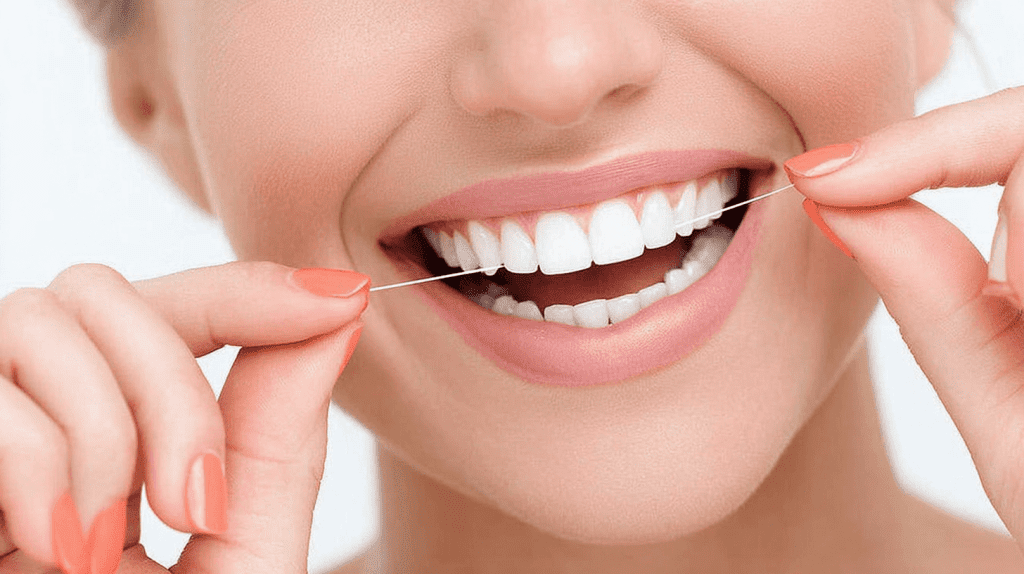
How to Floss – Step-by-Step Technique
The clinical success of dental floss relies heavily on correct technique. Inconsistent user technique is one of the primary reasons historical trials showed variable outcomes.
Step-by-step guidance:
- Use sufficient length: Break off approximately 45–50 cm of dental floss.
- Wind around fingers: Wind most of the floss around the middle finger of each hand, leaving a 2–3 cm working section taut between them.
- Hold firmly: Grip the floss securely using your thumbs and index fingers.
- Insert gently: Guide the floss between your teeth using a gentle back-and-forth sawing motion – NEVER snap the floss down into the gums, as this can cause soft tissue trauma.
- Form a C-shape: Curve the floss around the side of the tooth in a “C” contour against the enamel surface.
- Slide up and down: Gently glide the floss into the space beneath the gum line (1–2 mm), then scrape firmly upwards away from the gum.
- Clean both surfaces: IMPORTANT – each interdental gap contains TWO distinct tooth surfaces. Wrap the floss around the adjacent tooth and repeat the upward scraping motion.
- Advance to a fresh section: Unroll a clean section of floss as you move from tooth to tooth.
Common flossing mistakes to avoid:
- Using too short a piece and reusing the same soiled section across multiple teeth
- Moving straight up and down without wrapping into a C-shape, which only cleans the contact point rather than the tooth face
- Snapping floss aggressively into the gingiva, causing laceration and bleeding
- Staying too superficial and failing to reach 1–2 mm below the gum line
- Cleaning only one side of the gap, missing 50% of the plaque
How Deep Should Dental Floss Go?
Floss should slide gently 1–2 mm beneath the gum margin into the gingival sulcus – the shallow, natural collar of space between the tooth surface and surrounding gum tissue. This is the primary niche where anaerobic plaque bacteria congregate and where gingivitis originates.
Caution: In healthy gums, the sulcus depth measures 1–3 mm. In cases of periodontitis (advanced gum disease), periodontal pockets can measure 4–12 mm. Never force floss aggressively into deep pockets, as this can damage the periodontal attachment and contribute to gum recession.
If flossing causes persistent pain or heavy bleeding after several days of regular use, consult your dentist or dental hygienist, as this frequently indicates underlying gingivitis or active gum disease.
How Often Should You Floss?
The British Dental Association (BDA), the NHS, and international dental organisations recommend cleaning between your teeth at least once a day, ideally at night before bed.
Why is evening interdental cleaning most effective?
- Salivary flow drops substantially during sleep, reducing the mouth’s natural antibacterial protection
- Bacteria have 7 to 8 uninterrupted hours to ferment trapped sugars and multiply
- Food debris accumulated throughout the day is cleared before rest
- Fluoride applied during nighttime brushing remains undisturbed on enamel for longer
Some dental practitioners recommend flossing twice daily – morning and evening – particularly for individuals with:
- A history of periodontitis or recurrent gingivitis
- Tight interdental contacts prone to food impaction
- Orthodontic appliances, crowns, or fixed bridgework
- A high risk of dental caries
At What Age Should Children Start Using Dental Floss?
Interdental cleaning should begin as soon as two adjacent teeth touch and create a contact point. In most children, this occurs around 2 to 3 years of age when the primary molars erupt.
Age-appropriate recommendations:
- Ages 2–6: Parents should perform flossing for the child using gentle technique.
- Ages 6–10: Children can begin flossing under close parental supervision to develop dexterity.
- Ages 10–12+: Children can typically clean between their teeth independently, with occasional checks from parents.
Tip for younger children: Floss harps or handheld flossettes (floss pre-mounted on a small plastic holder) are often much easier for parents and children to manipulate than traditional string floss, helping establish a consistent habit.
Types of Dental Floss: Waxed Floss vs Unwaxed
Which Dental Floss Is the Best?
The honest answer: the dental floss that you actually use consistently. Whether you floss before or after brushing, studies show no significant difference in plaque removal between different types of dental floss.
Waxed floss or unwaxed dental floss?
A comparative randomised controlled trial (Terézhalmy et al., 2008) examined four different types of dental floss:
- Standard unwaxed floss
- Waxed floss
- “Shred-resistant” waxed floss
- Expanding dental floss (swells upon contact with saliva)
Result: ALL four types demonstrated equal effectiveness in plaque removal. Your choice should therefore come down to personal preference:
Waxed floss – benefits:
- Glides more easily between tight interdental spaces
- Less likely to shred or break (more comfortable around tight contact points)
- Smoother glide with less resistance
- Recommended for beginners and closely spaced teeth
Unwaxed floss – benefits:
- Expands slightly between teeth for greater surface contact
- Provides tactile feedback (you can “hear” the plaque removal from the squeaking sound)
- Often more eco-friendly (no wax coating)
- Recommended for normal to wider gaps between teeth
PFAS in Dental Floss – Cause for Concern?
A 2019 study identified elevated levels of PFAS (per- and polyfluoroalkyl substances, often dubbed “forever chemicals”) in individuals using certain Teflon-coated dental floss brands. PFAS are associated with various health concerns, including hormonal disruptions and increased cancer risk.
What can you do?
- Choose unwaxed dental floss or varieties coated with natural wax (such as beeswax or candelilla wax)
- Avoid brands advertising “Glide” or “Easy Slide” features made with PTFE (polytetrafluoroethylene)
- Look for certified PFAS-free labelling
- Opt for silk or bamboo dental floss with a natural coating
This risk must be seen in context: the proven oral health benefits of using dental floss almost certainly outweigh the potential PFAS risk. Nevertheless, selecting PFAS-free alternatives where available is a sensible precaution.
Common Problems and Solutions When Using Dental Floss
Bleeding Gums from Dental Floss – Normal or Concerning?
Mild bleeding gums when you first start using dental floss, or after a prolonged break, is relatively normal. It usually signals existing gingivitis (early gum disease and inflammation).
Bleeding during the first 1–2 weeks:
- Usually a sign of inflammation that will subside with regular interdental cleaning
- Continue to floss gently (do not give up!)
- Bleeding typically stops within 7–14 days of consistent use
- This is a GOOD sign – it shows that gum inflammation has been identified and is being actively treated
Persistent or heavy bleeding after 2–3 weeks:
- May indicate advanced gingivitis or periodontitis (severe gum disease)
- A visit to your dentist or dental hygienist is recommended
- A professional scale and clean may be necessary
- Your technique may be too aggressive – adopt a gentler approach
The Eastman Interdental Bleeding Index is widely used in clinical trials to assess gingivitis. Bleeding during interdental cleaning is a sensitive marker for gum disease – far more sensitive than visual inspection alone.
Can Flossing Cause Receding Gums?
Gum recession (gingival recession) caused by dental floss is possible but rare – almost always resulting from incorrect technique:
Risk factors:
- Overly aggressive, sawing motions
- Forcing the floss violently between tight contact points
- Snapping the floss too deeply below the gum line
- Using unsuitable makeshift materials (such as sewing thread or fishing line – yes, it happens!)
Prevention:
- Use gentle, controlled movements
- Gently glide the floss between the teeth rather than snapping it down
- Use waxed floss or smoother PTFE-free tapes for very tight gaps
- Curve the floss into a C-shape around each tooth – never saw horizontally
- If in doubt: ask your dentist or dental hygienist for a demonstration
Important: The primary cause of receding gums is NOT flossing, but gum disease (periodontitis caused by inadequate oral hygiene) or brushing too aggressively with a hard toothbrush.
Why Does Dental Floss Smell Bad After Use?
The unpleasant odour on used dental floss stems from:
- Bacteria and metabolic by-products: Anaerobic bacteria in particular produce volatile sulphur compounds (VSCs)
- Decomposing food particles: Protein-rich food trapped between teeth is broken down by bacteria
- Plaque: The biofilm itself has a characteristic odour
Paradoxically, that foul smell is clear proof that dental floss was NECESSARY – it illustrates how much bacteria and debris had accumulated between your teeth. Sticking to a consistent dental hygiene routine lowers the bacterial load, so the odour quickly diminishes.
If the smell is extremely strong or foul:
- It may point to interdental tooth decay (caries) between the teeth
- Periodontitis with deep gum pockets
- Impacted food debris
- A dental check-up is recommended
What Is Dental Floss Made Of?
Traditional dental floss is made from:
- Nylon (polyamide): Most commercial flosses consist of multifilament nylon threads
- PTFE (polytetrafluoroethylene): “Glide” flosses – exceptionally smooth, but subject to PFAS concerns
- Silk: Traditional natural material, now relatively rare
- Coatings: Wax (beeswax, candelilla, carnauba), fluoride, and flavourings (such as mint)
Eco-friendly alternatives:
- Bamboo dental floss (coated with natural plant wax)
- Pure silk floss (biodegradable, though more expensive)
- Corn-based PLA floss (biodegradable)
Fluoride and Cavity Prevention: Floss Before or After Brushing?
Why Fluoride Is So Important
The 2018 Mazhari randomised controlled trial demonstrated not only superior plaque removal when deciding to floss before brushing, but also significantly higher fluoride retention in interdental spaces. Why is this so crucial?
Fluoride protects teeth in three key ways:
- Enamel remineralisation: Repairs early carious lesions by replenishing calcium and phosphate within the tooth enamel
- Strengthening the enamel: Forms fluorapatite, which is far more acid-resistant than natural hydroxyapatite
- Antibacterial action: Inhibits bacterial enzymes and reduces plaque formation
Interdental spaces are especially prone to tooth decay because:
- They are difficult to reach with a toothbrush
- Food particles easily become trapped
- Bacteria thrive in these sheltered anaerobic conditions
- They often receive less exposure to fluoride toothpaste than outer tooth surfaces
When considering why should you floss before brushing, establishing this order maximises fluoride availability exactly where it is needed most.
Optimal Fluoride Concentration
NHS and British dental guidelines recommend the following for adults:
- Fluoride toothpaste: 1,450 ppm fluoride (standard for adults)
- Brush at least twice daily: Morning and night
- Spit, don’t rinse: After brushing, spit out excess toothpaste but do not rinse with water (allowing fluoride to remain on the teeth longer)
- Optional: Fluoride mouthwash: As an additional step alongside flossing and brushing
- Fluoridated table salt (where available): Continues to exert an effect for ~30 minutes after eating
Age-appropriate guidelines apply to children (lower ppm levels for young children to prevent swallowing risks).
The 3-Step Dental Hygiene Routine: Should You Floss Before or After Brushing and Mouthwash?
In summary, here is the evidence-based dental hygiene routine:
Step 1: Interdental cleaning
- Dental floss or interdental brushes (for wider gaps)
- All interdental spaces, cleaning both sides of every gap
- C-shape around each tooth, gently curving beneath the gum line
- At least once daily (in the evening), ideally twice daily
Step 2: Brushing with fluoride toothpaste
- 1,450 ppm fluoride toothpaste for adults
- For at least 2 minutes
- All tooth surfaces (outer, inner, and chewing surfaces)
- Spit out after brushing, do not rinse with water
Step 3 (optional): Fluoride mouthwash
- Increases contact time and fluoride availability
- Particularly beneficial for individuals with a high risk of tooth decay
- Do not use immediately after brushing – wait 30 minutes or use at a separate time of day
Whether you wondered if you should floss or brush first, this sequence leads to “more thorough plaque removal, effective clearance of harmful bacteria, and higher concentrations of fluoride on tooth surfaces” – particularly within vulnerable interdental spaces, which make up 40% of all tooth surfaces.
Scientific References
- Mazhari F, Boskabady M, Moeintaghavi A, Habibi A. The effect of toothbrushing and flossing sequence on interdental plaque reduction and fluoride retention: A randomized controlled clinical trial. J Periodontol. 2018;89(7):824-832.
- Berchier CE, Slot DE, Haps S, Van der weijden GA. The efficacy of dental floss in addition to a toothbrush on plaque and parameters of gingival inflammation: a systematic review. Int J Dent Hyg. 2008;6(4):265-79.
- Sambunjak D, Nickerson JW, Poklepovic T, et al. Flossing for the management of periodontal diseases and dental caries in adults. Cochrane Database Syst Rev. 2011;(12):CD008829.
- Bain C. Flossing, remoaning and remania – dentistry in denial. Dental Update. 2017;43(8).
- Vernon LT, Da silva APB, Seacat JD. In Defense of Flossing: Part II-Can We Agree It’s Premature to Claim Flossing Is Ineffective to Help Prevent Periodontal Diseases?. J Evid Based Dent Pract. 2017;17(3):149-158.
- Vernon LT, Seacat JD. In Defense of Flossing: Can We Agree It’s Premature to Claim Flossing is Ineffective to Prevent Dental Caries?. J Evid Based Dent Pract. 2017;17(2):71-75.
- Terézhalmy GT, Bartizek RD, Biesbrock AR. Plaque-removal efficacy of four types of dental floss. J Periodontol. 2008;79(2):245-51.
- Barendregt DS, Timmerman MF, Van der velden U, Van der weijden GA. Comparison of the bleeding on marginal probing index and the Eastman interdental bleeding index as indicators of gingivitis. J Clin Periodontol. 2002;29(3):195-200.
- Henry A, Biddlestone J, Mccaul J. ‘Nasal flossing’: A case report of nasopharyngeal stenosis due to severe erosive lichen planus and a novel therapeutic intervention. Int J Surg Case Rep. 2019;54:99-102.