At first glance, they look remarkably similar – yet when comparing bilberries vs blueberries (wild bilberries versus large cultivated blueberries), they are worlds apart. For this analysis, six frozen blueberry products from various supermarkets were tested in an accredited laboratory for anthocyanins, sugar content, pesticide residues, heavy metals, microbial counts, and more. The findings reveal clearly what matters most when choosing frozen berries.
Key Takeaways
- Wild blueberries (bilberries) contained on average around 3.6 times more anthocyanins than cultivated blueberries in our test.
- There were also huge differences between wild blueberries – origin and colour reveal a great deal about their nutrient density.
- The berries with the highest anthocyanin levels had a tarter flavour and at the same time the lowest sugar content.
- Organic products were free from pesticide residues; non-organic samples contained low, safe trace amounts.
- Heavy metals and pathogens were undetectable in all tested products.
Bilberries vs Blueberries: What Is the Difference?
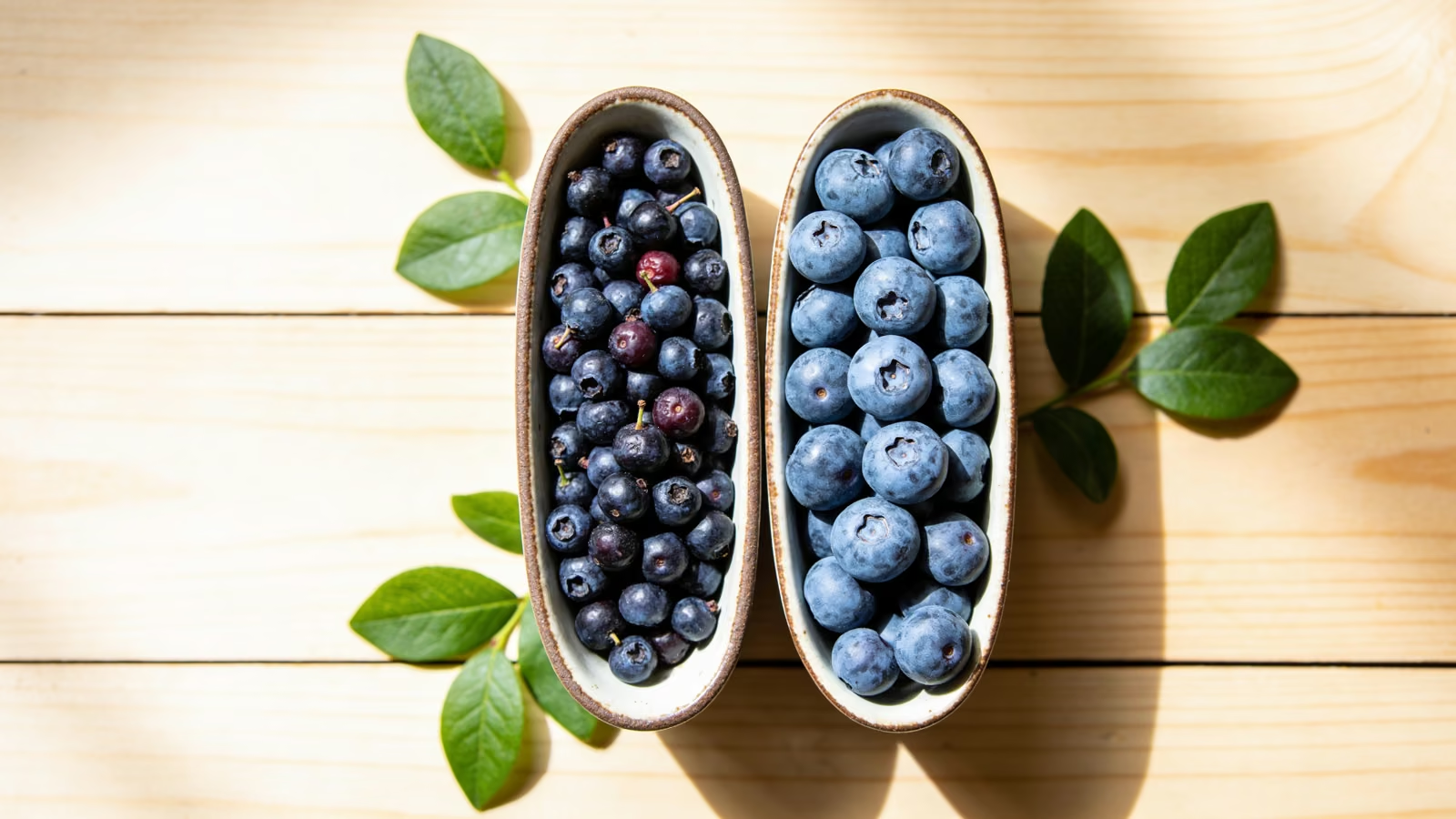
The wild bilberry (Vaccinium myrtillus) grows in native European woodlands, is small, deep blue, and intensely coloured throughout. If you crush one, it stains fingers and tongue deep purple due to its rich flesh pigmentation – its inner flesh is dark blue. In contrast, cultivated blueberries (Vaccinium corymbosum) originate from North America, are considerably larger, lighter in colour, and have pale, translucent flesh. They barely stain and have been selectively bred for size, yield, and transport durability.
Price differences were immediately apparent: wild blueberries cost between 79p and £2.00 per 100 grams, with organic options being by far the most expensive. The two cultivated blueberries came in at 70p and £1.23 per 100 grams – placing them in the same price bracket as budget wild berries.
Anthocyanins: The Decisive Factor in Bilberries vs Blueberries Nutrition
The blue-purple pigment in blueberries is called anthocyanin. Anthocyanins belong to the polyphenol group and are among the most valuable bioactive plant compounds in the berry – renowned above all for their potent antioxidant capacity. Wild bilberries rank among the most anthocyanin-rich foods in existence: they contain roughly three times as many anthocyanins as raspberries and around five times as many as cherries.
Because the pigment in small wild bilberries is distributed throughout the entire flesh rather than just the skin, a single handful delivers a multiple of the anthocyanins found in cultivated varieties. When assessing bilberries vs blueberries taste and colour, an intensely dark hue and a tangy, acidic flavour reliably indicate high anthocyanin levels.
What the Laboratory Test Revealed About Anthocyanin Levels
The laboratory measurements confirmed this observation impressively. The darkest berries contained the highest concentrations of anthocyanins:
| Product | Type | Anthocyanins (mg/kg) |
|---|---|---|
| Organic supermarket | Wild | 885 |
| Rewe | Wild | 834 |
| Kaufland | Wild | 404 |
| Edeka | Wild | 325 |
| Lidl | Cultivated | 176 |
| Aldi | Cultivated | 161 |
On average, the wild bilberries contained around 3.6 times more anthocyanins than cultivated blueberries. Strikingly, there were also vast differences among the wild berries: the lower-priced products from Edeka and Kaufland (both sourced from Canada) scored significantly lower than the premium berries harvested in Ukraine.
Health Benefits: Key Nutrients in Blueberries and Bilberries
Research into anthocyanins from blueberries and bilberries has yielded fascinating findings, particularly regarding cardiovascular and metabolic health:
- In a placebo-controlled trial involving 58 individuals with type 2 diabetes, blueberry anthocyanins improved blood lipid profiles: LDL cholesterol and triglycerides fell, whilst HDL cholesterol rose.
- In a study of 32 overweight, insulin-resistant adults, insulin sensitivity improved by 22% after six weeks of supplementation.
- A large observational study of around 12,000 adults linked higher anthocyanin intake to an up to 32% lower risk of all-cause mortality – and a 39% lower risk of dying from cardiovascular disease.
Important note: observational studies demonstrate correlations rather than direct cause-and-effect relationships. Nonetheless, they provide a compelling reason to regularly include intensely pigmented berries in your diet.
Sugar Content: Lab Results vs Packaging Labels
The sugar analysis delivered some remarkable insights. The two wild berry products with the highest anthocyanin levels (Rewe and the organic supermarket) – which had a distinctly tangy flavour – also had the lowest sugar content. In contrast, the sweeter samples from Edeka and Kaufland contained nearly double the amount of sugar:
| Product | Sugar (g/100 g) |
|---|---|
| Edeka (wild) | 16.0 |
| Kaufland (wild) | 13.9 |
| Lidl (cultivated) | 9.9 |
| Aldi (cultivated) | 9.7 |
| Organic supermarket (wild) | 8.1 |
| Rewe (wild) | 6.9 |
Overall, the packaging nutrition labels aligned well with laboratory measurements – only the Edeka and Kaufland samples had slightly higher sugar levels than stated on the pack, whereas Rewe came in even lower. There was no evidence of added sugar in any of the products tested.
Drip Loss, Heavy Metals and Microbial Purity in Frozen Berries
Drip loss measures how much liquid berries lose as they thaw. In our test of frozen blueberries, the wild berries from Edeka performed best, whilst the cultivated berries from Lidl experienced the greatest drip loss. This has minimal impact on taste and nutritional value – thawed berries with higher drip loss simply have a slightly softer texture.
Encouragingly, no significant levels of heavy metals were detected in any of the six products. Pathogens such as Salmonella, Listeria, and E. coli were completely absent. Minor differences were observed in yeast and mould counts; one product slightly exceeded the benchmark for mould, though this is considered a natural fluctuation typical of raw fruit.
Organic vs Conventional: What the Pesticide Residue Analysis Showed
Three of the six products were certified organic – and none of these showed any detectable pesticide residues. In the three non-organic products, low trace levels of various crop protection agents were found, all well below statutory maximum residue limits. This confirms both the purity of the organic fruit and that conventional berries adhere strictly to legal safety thresholds.
Buying Wild Blueberries: What to Look For
- Colour: Small, deeply dark berries that stain fingers and lips are genuine wild bilberries.
- Taste: An intense, tart flavour indicates high anthocyanin content and low sugar.
- Origin: In our test, European wild berries outperformed North American produce.
- Seasonality: Freshly foraged woodland bilberries are hard to beat; out of season, organic frozen blueberries and bilberries are an excellent choice.
Conclusion: The Verdict on Bilberries vs Blueberries
The laboratory test provides clear evidence: in the comparison of bilberries vs blueberries, wild bilberries offer substantial advantages – delivering on average 3.6 times more anthocyanins alongside generally lower sugar content. However, not all wild berries are created equal. We found significant variations between products, with the darkest, tartest berries proving superior. Choosing berries based on colour, European origin, and organic certification ensures you gain the greatest nutritional return. And if you have the opportunity to forage wild bilberries yourself in local woodlands, you will enjoy the highest quality of all.
Frequently Asked Questions
Are bilberries healthier than cultivated blueberries?
Generally, yes: in our test, wild bilberries contained on average around 3.6 times more anthocyanins and often less sugar. Both varieties, however, are nutritious additions to a healthy diet.
How can you tell the difference between bilberries and blueberries?
By their smaller size, deep purple-black colour, and strong staining properties. Bilberries have dark blue-red flesh throughout, whereas cultivated blueberries have pale greenish-white inner flesh.
Why are some wild blueberries darker than others?
The higher the anthocyanin concentration, the darker and tarter the berry. Botanical species and geographic origin play a significant role – in our test, European wild bilberries were markedly richer in colour than Canadian wild blueberries.
Do frozen blueberries lose nutrients?
No, not to any meaningful degree. The juice released during thawing (drip loss) contains beneficial pigments and can simply be added to porridge oats, smoothies, or yoghurt.
Are pesticide residues in blueberries a concern?
In our laboratory test, all detected residues in conventional berries were well below statutory limits, and organic products were entirely residue-free. For complete peace of mind, choose organic.
How much sugar is in blueberries and bilberries?
Depending on the variety, sugar content ranges from around 7g to 16g per 100g. The anthocyanin-dense, tarter wild bilberries tended to have the lowest sugar levels.
Which berry was the test winner?
The wild bilberry from the organic supermarket emerged on top with the highest anthocyanin content. For a more budget-friendly option, supermarket wild bilberries (such as Rewe) performed almost equally well.
How many blueberries should you eat per day?
A generous handful – roughly 100g to 150g – makes an ideal daily portion. This provides abundant anthocyanins and polyphenols without excessive fruit sugar.
References
Review articles, meta-analyses, and controlled trials relating to the topic of this article. Every link was verified for accessibility on 16 August 2026.
- Kalt W, Cassidy A, Howard LR et al.: Recent Research on the Health Benefits of Blueberries and Their Anthocyanins. Advances in nutrition (Bethesda, Md.) 2020. PubMed 31329250. DOI: 10.1093/advances/nmz065.
- Osei ED, Amotoe-Bondzie A, Afedzi AEK et al.: Nutritional Composition, Phenolic Profile, Antioxidant, and Antimicrobial Activity of Bilberry, Lingonberry, and Blueberry Cultivars. 2026. PubMed 42293327. DOI: 10.1155/ijfo/4181376.
- Ellis LR, O’Connor D, Khan H et al.: A randomised, double-blind, placebo-controlled trial to assess the postprandial dose-dependent effects of wild blueberries on metabolic and cognitive outcomes following a high-carbohydrate breakfast. 2026. PubMed 42191861. DOI: 10.1007/s00394-026-03974-0.
- Wood E, Hein S, Mesnage R et al.: Wild blueberry (poly)phenols can improve vascular function and cognitive performance in healthy older individuals: a double-blind randomized controlled trial. The American journal of clinical nutrition 2023. PubMed 36972800. DOI: 10.1016/j.ajcnut.2023.03.017.
- Silva S, Costa EM, Veiga M et al.: Health promoting properties of blueberries: a review. Critical reviews in food science and nutrition 2020. PubMed 30373383. DOI: 10.1080/10408398.2018.1518895.
- Wood E , Hein S , Heiss C et al.: Blueberries and cardiovascular disease prevention. Food & function 2019. PubMed 31776541. DOI: 10.1039/c9fo02291k.
- Hein S, Whyte AR, Wood E et al.: Systematic Review of the Effects of Blueberry on Cognitive Performance as We Age. The journals of gerontology. Series A, Biological sciences and medical sciences 2019. PubMed 30941401. DOI: 10.1093/gerona/glz082.