Beetroot is widely regarded as a rich source of iron. Blood-building, deep red, and supposedly restorative – its colour has earned the root vegetable a reputation that nutritional tables simply do not support. A closer look at the actual beetroot iron content calls for a reality check, as well as a recipe that genuinely improves how much iron your body absorbs.
Beetroot iron content: What is really inside?
When looking at the beetroot nutritional value per 100g, 100 grams of beetroot contain around 0.8 milligrams of iron. For context, when asking what vegetable is the highest in iron or comparing other everyday dietary staples:
| Food | Iron per 100 g |
|---|---|
| Beetroot | 0.8 mg |
| Spinach (cooked) | 2.2 mg |
| Lentils (cooked) | 3.3 mg |
| Pumpkin seeds | 8.8 mg |
| Red meat (beef) | 2.1 mg |
The daily iron requirement stands at 10 milligrams for men and 15 for women of childbearing age. When evaluating beetroot benefits for female health and energy, a standard portion of beetroot covers only around five per cent of this RDA. As an iron source, its nutrient density is relatively modest.
Compounding this is a second issue: plant-based iron is present as non-haem iron, of which the human body absorbs only about two to ten per cent – compared to 15 to 35 per cent for animal-derived haem iron found in red meat. Very little of the modest beetroot iron content actually makes it into circulation.
Why does the myth persist? Most likely due to the historical doctrine of signatures – red like blood, therefore good for the blood – and because of betalain pigments, which can dye urine pink or red in some people (beeturia), falsely suggesting a direct link to blood where none exists.
Where oranges come in: Boosting vitamin C absorption
And this is where the salad earns its place. Vitamin C is the most potent known enhancer of non-haem iron uptake. It reduces ferric iron to ferrous iron, forming a soluble complex that the intestinal lining absorbs far more readily, significantly enhancing overall vitamin C absorption and iron utilisation.
The effect size is remarkable: adding just 50 milligrams of vitamin C to the same meal can increase the absorption of plant-derived iron two- to three-fold. Half an orange provides around 40 milligrams.
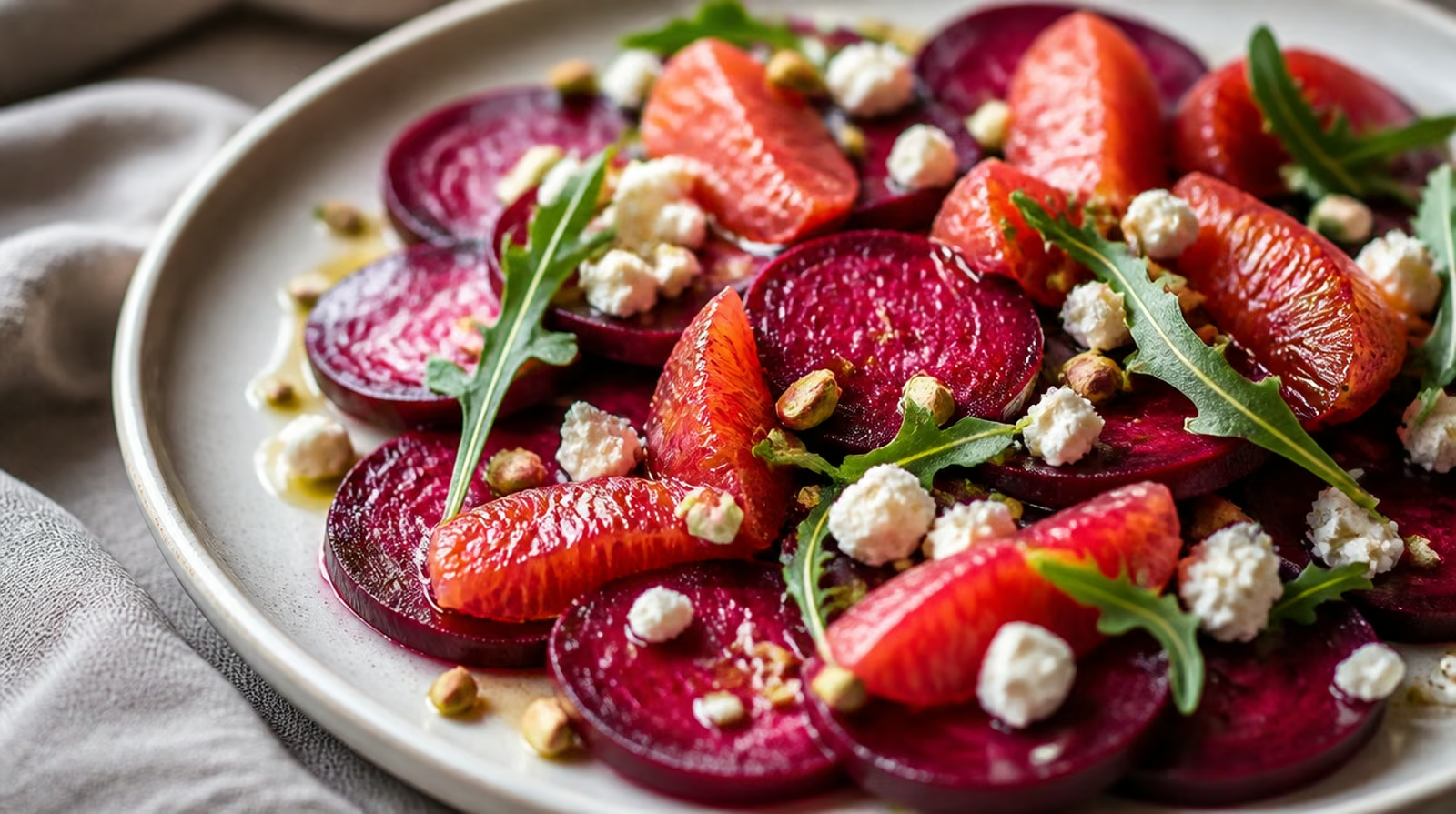
This does not magically turn beetroot into an iron powerhouse. However, it is the reason why this classic combination – popular in Italy as insalata con barbabietola, feta e arancia – is far more than a culinary preference. It is a nutritional principle you can apply to any plant-based iron source: lentils with peppers, porridge oats with berries, or spinach with fresh lemon juice.
The inhibitors at the same table
Conversely, polyphenols and calcium act as absorption blockers. Specifically, drinking coffee or black tea alongside a meal can suppress iron absorption by up to 60 per cent. The feta in this salad also introduces calcium, which exerts an inhibitory effect.
There is no reason to omit the cheese – the quantities are moderate and the salad is not intended as a primary iron therapy anyway. However, if you are actively tackling iron deficiency or borderline anaemia: push your tea or coffee back by an hour. That makes a far greater difference than any single ingredient choice.
The recipe: Maximising beetroot iron
Serves 2
- 250 g cooked beetroot
- 1 large orange (blood orange, if in season)
- 100 g feta
- 1 handful rocket or lamb’s lettuce
- 30 g walnut pieces or pistachios
- 2 tbsp olive oil
- 1 tsp white balsamic vinegar
- Pepper, sea salt
Method: Cut the beetroot into thin slices rather than dicing – slices lie flatter and keep the orange visible. Segment the orange: slice off the top and bottom, cut away the peel and white pith generously, then carve out the segments between the membranes. Catch any juice that escapes and whisk it into the dressing to replace half the vinegar.
Arrange on a flat serving plate rather than tossing in a bowl. Layer the beetroot and orange slices alternately in an overlapping pattern, tuck the salad leaves into the gaps, crumble the feta over the top, and finish with the nuts.
Key for the vitamin C effect: Add the orange raw and do not prepare it far in advance. Vitamin C degrades when exposed to light, oxygen, and heat. Segment, arrange, and eat – in that order, with minimal waiting time in between.
Blood orange or standard orange?
Blood oranges contain a higher concentration of anthocyanins – the same compound that colours blueberries and red cabbage – and complement the dish visually. Their vitamin C content is virtually identical. They are available between December and March; for the remainder of the year, a standard navel orange works just as well.
Avoid bottled orange juice as a substitute: vitamin C levels drop rapidly once opened, and you miss out entirely on the beneficial fibre from whole fruit segments.
Nutritional values per portion (estimated)
| Per portion | |
|---|---|
| Energy | approx. 390 kcal |
| Protein | approx. 12 g |
| Fat | approx. 28 g |
| Carbohydrates | approx. 18 g |
| Vitamin C | approx. 45 mg (56% of RDA) |
| Iron | approx. 1.5 mg |
Are beets good for iron deficiency?
In short: this salad is a welcome dietary contribution, not a medical cure. A confirmed iron deficiency – diagnosed by checking serum ferritin, not haemoglobin levels alone – requires medical evaluation by a GP and usually prescribed supplementation. Diet alone replenishes depleted iron stores very slowly.
What genuinely matters against deficiency: building meals around pulses and wholemeal grains, pairing them with vitamin C, separating tea and coffee from main meals, and booking an NHS blood test if fatigue persists rather than relying on a beetroot juice cleanse.
Incidentally: if your urine regularly turns pink after eating beetroot, this can actually be an indicator of low iron stores – when iron stores are fully replenished, the pigment is metabolised more efficiently. Find out more in our foundational article.
References
- Trinidad TP, Kurilich AC, Mallillin AC et al.: Iron absorption from NaFeEDTA-fortified oat beverages with or without added vitamin C. International journal of food sciences and nutrition 2014. PubMed 24059906. DOI: 10.3109/09637486.2013.836739.
- Wróblewska J, Wróblewski M, Długosz A et al.: Helicobacter pylori Infection and Anemia: The Potential Role of Vitamin C and Vitamin B(12). Molecules (Basel, Switzerland) 2026. PubMed 42123772. DOI: 10.3390/molecules31091406.
- Bisht S, Sina RE, Patel P. et al.: Vitamin C (Ascorbic Acid). 2026. PubMed 29763052.
- Alberts A, Moldoveanu ET, Niculescu AG et al.: Vitamin C: A Comprehensive Review of Its Role in Health, Disease Prevention, and Therapeutic Potential. Molecules (Basel, Switzerland) 2025. PubMed 39942850. DOI: 10.3390/molecules30030748.
- Hackl LS, Moretti D, Sabatier M et al.: Absorption of Iron Naturally Present in Soy. Advances in nutrition (Bethesda, Md.) 2025. PubMed 40020920. DOI: 10.1016/j.advnut.2025.100396.
- Hoppe M, Sandberg AS, Hulthén L. et al.: Influence of Sourdough Fermentation-Induced Dephytinization on Iron Absorption from Whole Grain Rye Bread-Double-Isotope Crossover and Single-Blind Absorption Studies. 2025. PubMed 41470836. DOI: 10.3390/nu17243891.
- Kalman D, Hewlings S, Madelyn-Adjei A et al.: Dietary Heme Iron: A Review of Efficacy, Safety and Tolerability. 2025. PubMed 40647237. DOI: 10.3390/nu17132132.
- Gallahan S, Brower S, Wapshott-Stehli H et al.: A Systematic Review of Isotopically Measured Iron Absorption in Infants and Children Under 2 Years. Nutrients 2024. PubMed 39599621. DOI: 10.3390/nu16223834.
- Roy S, Chourasia P, Sangani V et al.: Megadose Vitamin C Prescription Through Alternative Medicine Leading to End-Stage Renal Disease: Case Study and Literature Review. Journal of investigative medicine high impact case reports 2023. PubMed 36914980. DOI: 10.1177/23247096231158954.
- Doseděl M, Jirkovský E, Macáková K et al.: Vitamin C-Sources, Physiological Role, Kinetics, Deficiency, Use, Toxicity, and Determination. Nutrients 2021. PubMed 33668681. DOI: 10.3390/nu13020615.
- Li N, Zhao G, Wu W et al.: The Efficacy and Safety of Vitamin C for Iron Supplementation in Adult Patients With Iron Deficiency Anemia: A Randomized Clinical Trial. JAMA network open 2020. PubMed 33136134. DOI: 10.1001/jamanetworkopen.2020.23644.