Beetroot tastes sweet. Distinctly sweeter than broccoli, sweeter than carrots, and anyone watching their blood glucose often steers clear of it. Yet the worry around beetroot blood sugar spikes is one of the most stubborn misconceptions in the vegetable aisle – and it quickly collapses under simple maths.
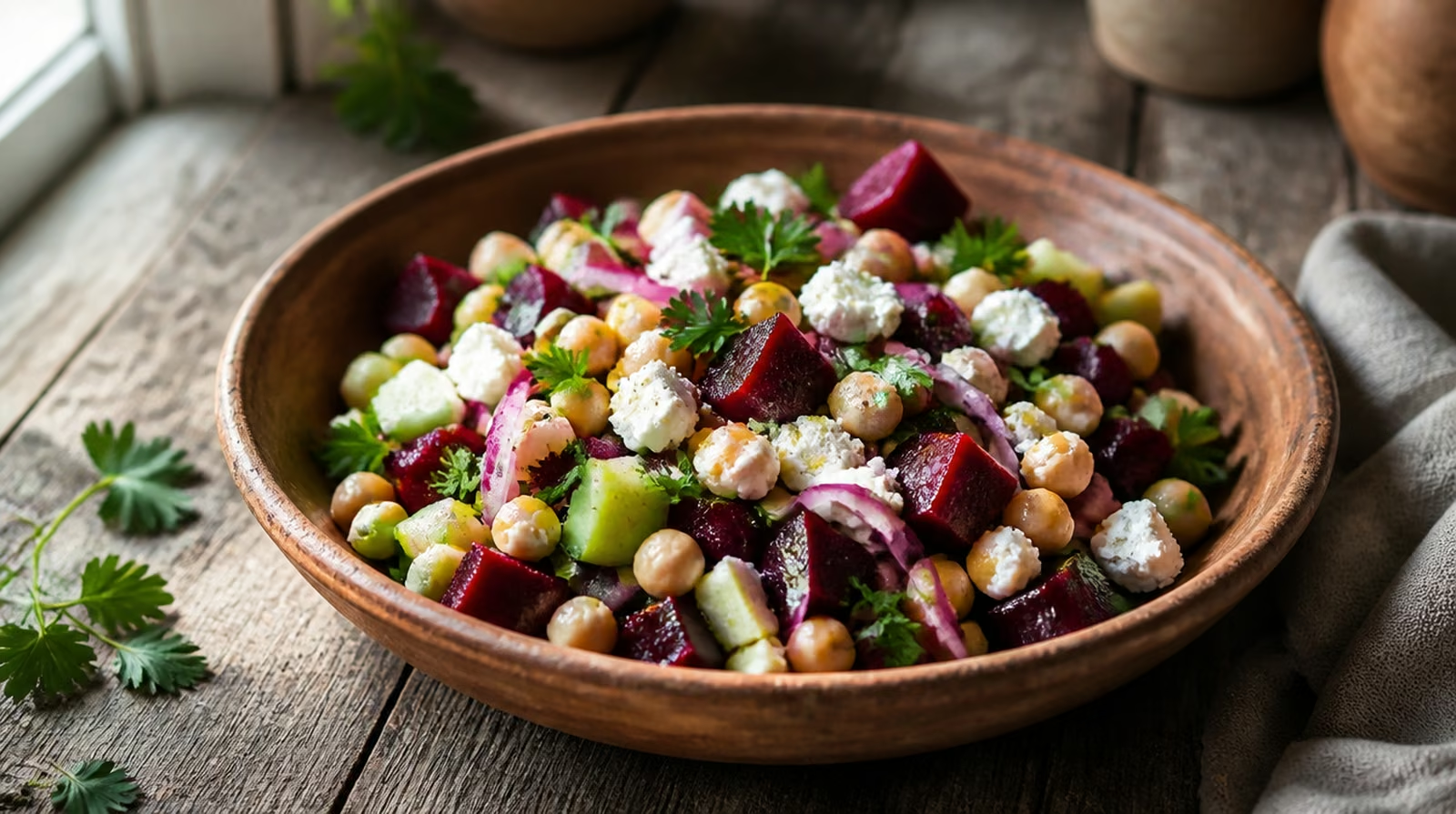
This Italian-inspired recipe, a quick beetroot chickpea salad with feta and red onion, happens to be the very combination that illustrates this maths best.
The number that matters for beetroot blood sugar is not the GI
The glycaemic index of cooked beetroot is around 64. That sounds high – white bread sits at 75. But the GI measures something that has little to do with an actual plate of food: it compares portion sizes that each contain 50 grams of pure carbohydrates.
With beetroot, you would have to eat around 700 grams to reach that. That is because 100 grams contain only around seven grams of carbohydrates. That is the whole trick.
When evaluating beetroot blood sugar impacts, the truly meaningful metric is glycaemic load, which accounts for the actual portion size. For 150 grams of beetroot – a realistic salad serving – it sits at around 5. Anything under 10 is considered low. By comparison, a slice of white bread comes in at 10, and a medium portion of rice at over 20.
The sweetness does not stem from excessive sugar, but rather because the natural sugars present are readily tasted – and because the earthy, bitter notes recede during cooking.
What chickpeas add to the equation
Chickpeas are the complete opposite: plenty of carbohydrates, but extremely slow-release ones. Their glycaemic index is around 28, one of the lowest values among all staple sides. This is down to their dense cellular structure, high protein content, and roughly eight grams of fibre per 100 grams.
When you combine both in a bowl, the result is greater than the sum of its parts: protein and fibre slow down gastric emptying. This blunts the insulin response and ensures the modest amount of sugar from the beetroot enters the bloodstream even more steadily.
The fridge effect
There is also an added bonus when you prep the salad in advance rather than tossing it together fresh. When cooked chickpeas cool down, part of their starch transforms into resistant starch. The small intestine can no longer break this down – it travels undigested into the large intestine, where it functions just like dietary fibre.
In practical terms, tinned chickpeas eaten cold are friendlier on blood glucose than freshly cooked warm ones. A salad that rests overnight in the fridge is far better in this regard than one served straight away. The same applies to potatoes, rice, and pasta, by the way.
The recipe
Serves 2
- 250 g cooked beetroot, diced
- 1 tin of chickpeas (240 g drained weight), rinsed
- 120 g feta
- 1/2 red onion
- 1/2 cucumber, deseeded
- 1 handful flat-leaf parsley
- 2 tbsp olive oil
- 1 tbsp red wine vinegar
- Black pepper, a pinch of salt
Method: Dice all solid ingredients into evenly sized cubes – this is more important here than in other salads, as there is no dressing to mask uneven textures. Slice the red onion into fine rings and roughly chop the parsley. Add the oil and vinegar straight into the bowl, toss everything gently, and fold the feta in last.
Always rinse tinned chickpeas thoroughly. The canning liquid contains most of the added salt alongside the oligosaccharides responsible for bloating.
Red onion: more than just colour
Red onion provides quercetin, a flavonoid concentrated primarily in the outer layers and just beneath the skin. Peeling the onion too aggressively discards the most nutrient-dense part. Removing two layers is plenty.
If raw onion tastes too sharp, soak the slices in cold water for five minutes; this takes away the pungency without ruining the colour.
Who this salad is best suited for
- For insulin resistance or pre-diabetes: High fibre and protein density, low glycaemic load, and no added sugar. Around 16 grams of protein and 11 grams of fibre per portion.
- As a packed lunch: It improves overnight rather than deteriorating. Pack the feta separately, otherwise it will stain.
- When short on time: Requires no cooking if using vacuum-packed cooked beetroot. For details on price, see our fact check on vacuum-packed beetroot.
It is less suitable if you need to strictly monitor your salt intake – feta and tinned chickpeas together contribute a fair amount. How to manage that is explained in our cheese comparison guide.
Nutritional values per portion (estimated)
| Per portion | |
|---|---|
| Energy | approx. 430 kcal |
| Protein | approx. 16 g |
| Carbohydrates | approx. 30 g |
| of which sugars | approx. 10 g |
| Fibre | approx. 11 g |
| Glycaemic load | low (approx. 12) |
Two questions that always come up
Is beetroot bad for blood sugar, and is it suitable for diabetes? Yes, beetroot is completely fine for diabetes, and it is actually one of the more beneficial vegetables. Nobody eats the quantities required for beetroot blood sugar surges to become an issue. The only real caution applies to pickled beetroot in jars – the preserving liquid often contains added sugar, sometimes in substantial amounts. Always check the ingredients list.
Is beetroot juice good for diabetes and blood pressure? That is a different story. Juice concentrates natural sugars and strips away the fibre – one glass equals several beetroot bulbs without the protective food matrix. While juice is the more potent format for blood pressure benefits, it is far less suitable for managing blood glucose.
References
- Bojarczuk A, Kęszycka P, Marszałek K et al.: The Effect of Cooking and Cooling Chickpea Pasta on Resistant Starch Content, Glycemic Response, and Glycemic Index in Healthy Adults. 2024. PubMed 39590821. DOI: 10.3390/metabo14110585.
- Luo T, Wu T, Liu K et al.: Chickpea (<i>Cicer arietinum</i> L.): Integrating Nutritional Excellence, Health Benefits, and Abiotic Stress Resilience for Sustainable Food Systems. 2026. PubMed 42279768. DOI: 10.3390/foods15111982.
- Ata SM, Hussein AMS, Mostafa S. et al.: Germinated legumes for improving nutritional and technological quality of fortified cakes, with further enhancement using phospholipase and SSL. 2026. PubMed 41986389. DOI: 10.1038/s41538-026-00819-2.
- Zargar SM, Khan T, Mir RA et al.: Integrating multi-omics approaches to shape legume root system architecture under drought stress: a comprehensive review. 2026. PubMed 42226928. DOI: 10.3389/fpls.2026.1783318.
- Tazoho GM, Tchassi B, Bossi DSD et al.: Formulation of Gluten-Free Biscuits Based on Tiger Nut, Dana, and Mixture of Avocado and Margarine: Nutritional Composition and Glycemic Index of Optimal Sample. 2026. PubMed 42088465. DOI: 10.1002/fsn3.71852.
- Allouch Tounsi W, Debbabi H, Hadj Yahia N et al.: Nutritionally Enriched Maize- and Rice-Based Gluten-Free Biscuits: Leveraging Local Legume Flours for Improved Quality. 2025. PubMed 40941166. DOI: 10.3390/foods14173050.
- Chuqui-Paulino FJ, Chávez DWH, Ascheri JLR et al.: Impact of Whole Cereal-Pulse Flours on the Functionality and Antioxidant Properties of Gluten-Free Extruded Flours. 2025. PubMed 41154051. DOI: 10.3390/foods14203515.
- Jenkins DJA, Willett WC, Yusuf S et al.: Association of glycaemic index and glycaemic load with type 2 diabetes, cardiovascular disease, cancer, and all-cause mortality: a meta-analysis of mega cohorts of more than 100 000 participants. The lancet. Diabetes & endocrinology 2024. PubMed 38272606. DOI: 10.1016/S2213-8587(23)00344-3.
- Naveed H, Sultan W, Awan KA et al.: Glycemic impact of cereal and legume-based bakery products: Implications for chronic disease management. 2024. PubMed 39568514. DOI: 10.1016/j.fochx.2024.101959.
- Zhang R, Noronha JC, Khan TA et al.: The Effect of Non-Nutritive Sweetened Beverages on Postprandial Glycemic and Endocrine Responses: A Systematic Review and Network Meta-Analysis. Nutrients 2023. PubMed 36839408. DOI: 10.3390/nu15041050.
- Atkinson FS, Brand-Miller JC, Foster-Powell K et al.: International tables of glycemic index and glycemic load values 2021: a systematic review. The American journal of clinical nutrition 2021. PubMed 34258626. DOI: 10.1093/ajcn/nqab233.
- Chiavaroli L, Lee D, Ahmed A et al.: Effect of low glycaemic index or load dietary patterns on glycaemic control and cardiometabolic risk factors in diabetes: systematic review and meta-analysis of randomised controlled trials. BMJ (Clinical research ed.) 2021. PubMed 34348965. DOI: 10.1136/bmj.n1651.