There is a step in this recipe that involves nothing more than waiting. It requires no extra ingredients, no effort, and no money – yet skipping it leaves you with far less active garlic allicin on your plate.
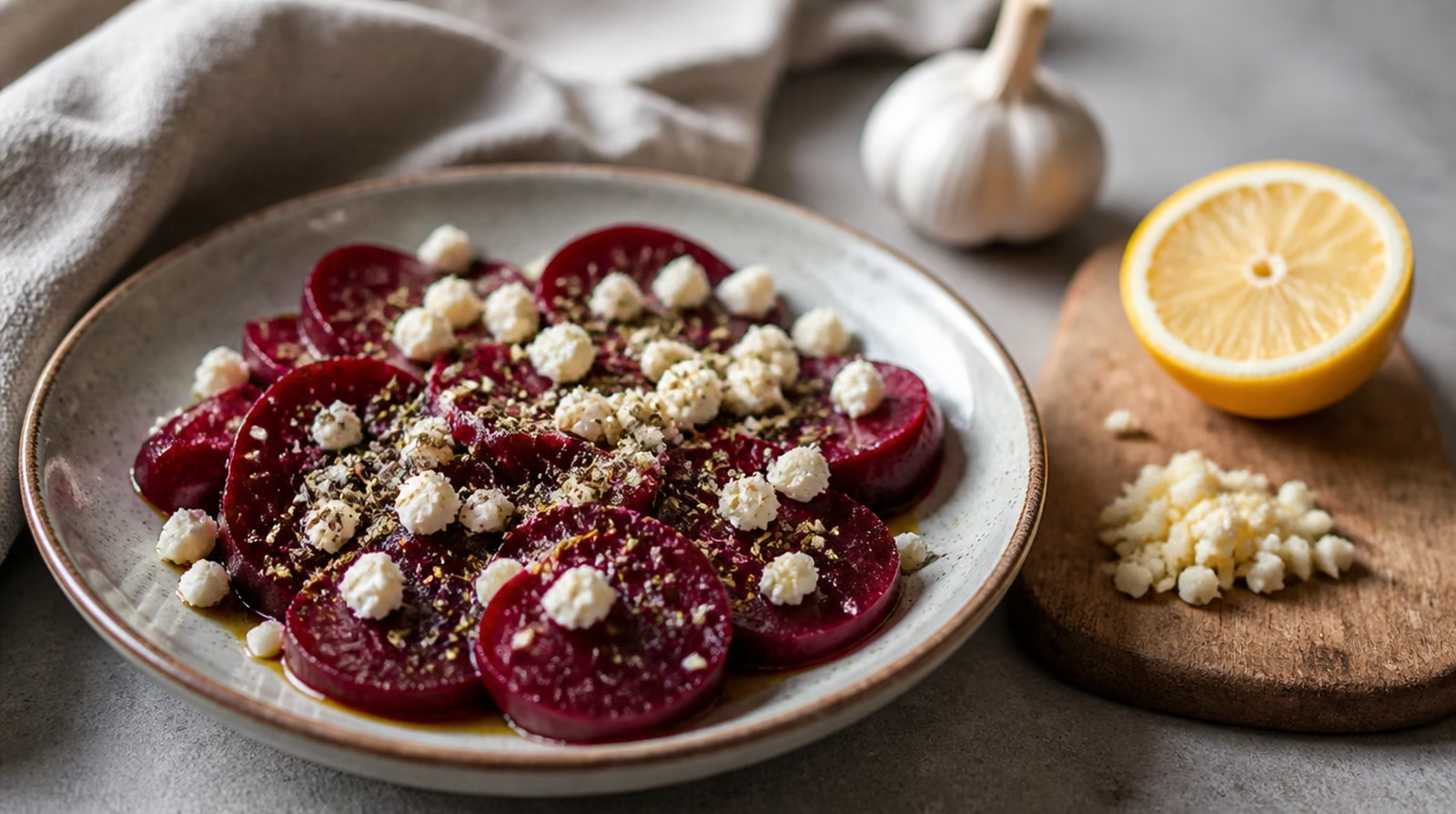
This simple Spanish-inspired recipe – beetroot, feta, garlic, lemon, and extra virgin olive oil – hinges entirely on this subtle culinary preparation detail.
Garlic allicin: why it doesn’t exist in an intact clove
An intact garlic clove contains no allicin whatsoever. Instead, it holds two distinct components stored in separate cellular compartments: the odourless precursor compound alliin and the enzyme alliinase.
Only when the cell walls are damaged – whether by slicing, crushing, chopping, or chewing – do the two come into contact. The alliinase breaks down alliin to produce allicin: the very substance that gives garlic its characteristic aroma, pungency, and the majority of its studied health properties.
This enzymatic reaction takes time. It is not instantaneous, reaching its peak after roughly ten minutes of resting time.
What is the 10 minute garlic rule in everyday cooking?
Alliinase is a heat sensitive enzyme, rapidly deactivated at a cooking temperature above 60°C.
This explains a common mistake made in almost every kitchen: garlic is chopped and tossed immediately into a hot frying pan. The enzyme denatures before it has had a chance to work. What finishes in the pan still smells aromatic, but delivers only a fraction of the potential garlic allicin.
In scientific trials examining this exact mechanism, preserving allicin was straightforward: allowing the crushed garlic or chopped cloves to sit for ten minutes before heating gave alliinase time to complete the conversion. Once formed, allicin withstands heat far better than the fragile enzyme that creates it.
The golden rule: Prepare your garlic first, allow that 10-minute resting time while getting the remaining ingredients ready, and add it to the heat last.
For a cold salad like this one, the process is even simpler because no cooking temperature is involved. Nonetheless, the principle still applies: whisk your garlic into the dressing and let it stand for ten minutes before pouring it over the salad. This also softens the raw bite, allowing the pungent notes to blend seamlessly with the olive oil.
Crushed garlic or chopping: which method releases more?
The more thoroughly the cell structure is disrupted, the higher the yield of allicin. A garlic press causes the greatest cellular damage, fine chopping comes close, while thick slices produce the least.
From a culinary perspective, the flavour intensity mirrors this breakdown: crushed garlic produces a sharper, more assertive taste, whereas sliced garlic remains mild. If you want maximum potency and bioavailability, use a press; if preparing the salad for guests who prefer a gentler flavour, stick to fine chopping.
Raw garlic health benefits: what the evidence actually shows – and what it doesn’t
Honesty is essential here, as few pantry staples have attracted more exaggerated wellness claims than garlic.
Reasonably supported by evidence: Meta-analyses of garlic supplements indicate modest benefits for cardiovascular health, showing small reductions in systolic blood pressure (a decrease of a few mmHg) along with minor improvements in total cholesterol. While clinical trials vary in quality, the overall trend is consistent. Interestingly, the blood-pressure-lowering effect works partly through the same pathway as beetroot: garlic allicin and its secondary metabolites stimulate the production of nitric oxide and hydrogen sulphide, both of which support vascular dilation. Read more in our in-depth article.
Unproven: Claims that raw garlic prevents colds, wards off cancer, eliminates parasites, or acts as a natural antibiotic replacement. While allicin demonstrates antibacterial properties in vitro (in a test tube), the human body metabolises it within minutes, meaning it never reaches comparable tissue concentrations in vivo.
In practical terms: Garlic is an aromatic, nutrient-dense ingredient that provides subtle, measurable perks for cardiovascular health and general wellbeing – but it is not a medical treatment.
Lemon: more than just acidity
The second key pillar of this recipe serves a dual purpose.
First, fresh lemon juice replaces standard vinegar as the acid component – offering a fruitier, milder flavour that is gentler on digestion. For more on why acid balance matters in a beetroot salad, see our vinaigrette guide.
Second, the juice of half a lemon provides around 25 milligrams of vitamin C, which enhances the bioavailability and absorption of non-haem iron from the beetroot – explained further in our iron absorption article.
Thirdly, there is a culinary advantage: acidity stabilises betalain pigments, helping the beetroot retain its vibrant crimson colour rather than turning dull.
Tip: Always use freshly squeezed lemon juice. Bottled lemon juice from concentrate has lost most of its vitamin C content, and the flavour difference is unmistakable.
The recipe
Serves 2
- 300 g cooked beetroot
- 100 g feta
- 1 large garlic clove
- Juice of 1/2 lemon
- 2 tbsp extra virgin olive oil
- 1 tsp dried oregano
- Freshly ground black pepper
- Optional: 1 tbsp chopped fresh flat-leaf parsley
Method:
- Finely chop or crush the garlic and leave to rest for ten minutes. Use this window to prepare the rest of the ingredients.
- Cut the cooked beetroot into slices or bite-sized cubes.
- In a small bowl, whisk together the garlic, lemon juice, extra virgin olive oil, dried oregano, and black pepper.
- Pour the dressing over the beetroot, toss gently, and allow to stand for another ten minutes to absorb the flavours.
- Crumble the feta over the top and scatter with fresh parsley, if using.
No extra salt is required; the feta provides all the seasoning you need.
Why this four-ingredient recipe works
Because each core element covers a distinct taste profile: beetroot offers sweet, earthy depth; feta delivers salt; lemon brings bright acidity; and garlic adds pungent warmth. The dried oregano rounds it off with a gentle herbal bitterness. Hitting all these fundamental flavours without a single cooking step is why the dish feels satisfying and complex rather than sparse.
The downside you need to factor in
Raw garlic leaves a lingering breath odour that can last for hours. The culprit is allyl methyl sulphide, a volatile byproduct that enters the bloodstream and is expelled via the lungs – which is why brushing your teeth provides only temporary relief.
Research has shown that consuming raw apples, fresh mint, or green tea immediately after the meal effectively neutralises these sulfur compounds through their polyphenol content. Whole milk is similarly effective, as dietary fats help bind and trap the volatile compounds before they enter circulation.
Estimated nutritional values per serving
| per serving | |
|---|---|
| Energy | approx. 280 kcal |
| Protein | approx. 9 g |
| Fat | approx. 20 g |
| Carbohydrates | approx. 13 g |
| Vitamin C | approx. 20 mg |
| Salt | approx. 1.5 g |
References
- Vezza T, Guillamón E, García-García J et al.: LDL-Cholesterol-Lowering Effects of a Dietary Supplement Containing Onion and Garlic Extract Used in Healthy Volunteers. Nutrients 2024. PubMed 39203947. DOI: 10.3390/nu16162811.
- Ried K: Garlic Lowers Blood Pressure in Hypertensive Individuals, Regulates Serum Cholesterol, and Stimulates Immunity: An Updated Meta-analysis and Review. The Journal of nutrition 2016. PubMed 26764326. DOI: 10.3945/jn.114.202192.
- Bandyopadhyay R, Pattnaik S.: A Comparative Review of Phytochemical Composition, Bioactivity, and Health Implications of Single- and Multiple-Clove Garlic. 2026. PubMed 42040441. DOI: 10.1021/acsomega.5c11125.
- Tang WR, Chen KQ.: Mini-Review: Allicin as a Potential Neuroprotective Compound in Neurological Disorders. 2026. PubMed 42338797. DOI: 10.2147/ndt.s621474.
- Cheng N, Zhao J, Feng C et al.: The impact of garlic and its active metabolites on degenerative musculoskeletal diseases. 2026. PubMed 42358358. DOI: 10.3389/fphar.2026.1847433.
- Almughamisi M, Amer F, Alqahtani NK et al.: Differential effects of fresh and black garlic extracts on oxidative stress regulation and anti-inflammatory response properties in human HepG2 cells: An <i>in vitro</i> study. 2026. PubMed 42022566. DOI: 10.3389/fphar.2026.1776975.
- Yu MJ, Zhu Y, Zhang W et al.: Therapeutic potential of allicin against viral infections: Mechanisms and safety profile (Review). 2026. PubMed 42016604. DOI: 10.3892/etm.2026.13146.
- Azam F, Anwar MJ, Kahfi J et al.: Cracking the Sulfur Code: Garlic Bioactive Molecules as Multi-Target Blueprints for Drug Discovery. 2025. PubMed 41305007. DOI: 10.3390/ph18111766.
- Chen KQ, Lei HB, Liu X et al.: Mini-review: The health benefits and applications of allicin. 2025. PubMed 41383463. DOI: 10.3389/fphar.2025.1715922.
- Sleiman C, Daou RM, Al Hazzouri A et al.: Garlic and Hypertension: Efficacy, Mechanism of Action, and Clinical Implications. Nutrients 2024. PubMed 39275211. DOI: 10.3390/nu16172895.
- Ge Q, Yan Y, Luo Y et al.: Dietary supplements: clinical cholesterol-lowering efficacy and potential mechanisms of action. International journal of food sciences and nutrition 2024. PubMed 38659110. DOI: 10.1080/09637486.2024.2342301.
- Laffin LJ, Bruemmer D, Garcia M et al.: Comparative Effects of Low-Dose Rosuvastatin, Placebo, and Dietary Supplements on Lipids and Inflammatory Biomarkers. Journal of the American College of Cardiology 2023. PubMed 36351465. DOI: 10.1016/j.jacc.2022.10.013.
- Imaizumi VM, Laurindo LF, Manzan B et al.: Garlic: A systematic review of the effects on cardiovascular diseases. Critical reviews in food science and nutrition 2023. PubMed 35193446. DOI: 10.1080/10408398.2022.2043821.
- Serrano JCE, Castro-Boqué E, García-Carrasco A et al.: Antihypertensive Effects of an Optimized Aged Garlic Extract in Subjects with Grade I Hypertension and Antihypertensive Drug Therapy: A Randomized, Triple-Blind Controlled Trial. Nutrients 2023. PubMed 37686723. DOI: 10.3390/nu15173691.
- Osadnik T, Goławski M, Lewandowski P et al.: A network meta-analysis on the comparative effect of nutraceuticals on lipid profile in adults. Pharmacological research 2022. PubMed 35988871. DOI: 10.1016/j.phrs.2022.106402.
- Borlinghaus J, Albrecht F, Gruhlke MC et al.: Allicin: chemistry and biological properties. Molecules (Basel, Switzerland) 2014. PubMed 25153873. DOI: 10.3390/molecules190812591.
- : Garlic. 2006. PubMed 30000841.